Co-founder and director, Gesher Community Care
Featured Post
On a ski lift, I chose Jewish visibility
When I opened up to a stranger and shared stories of October 7 and what came after, I found an unexpected reason for hope
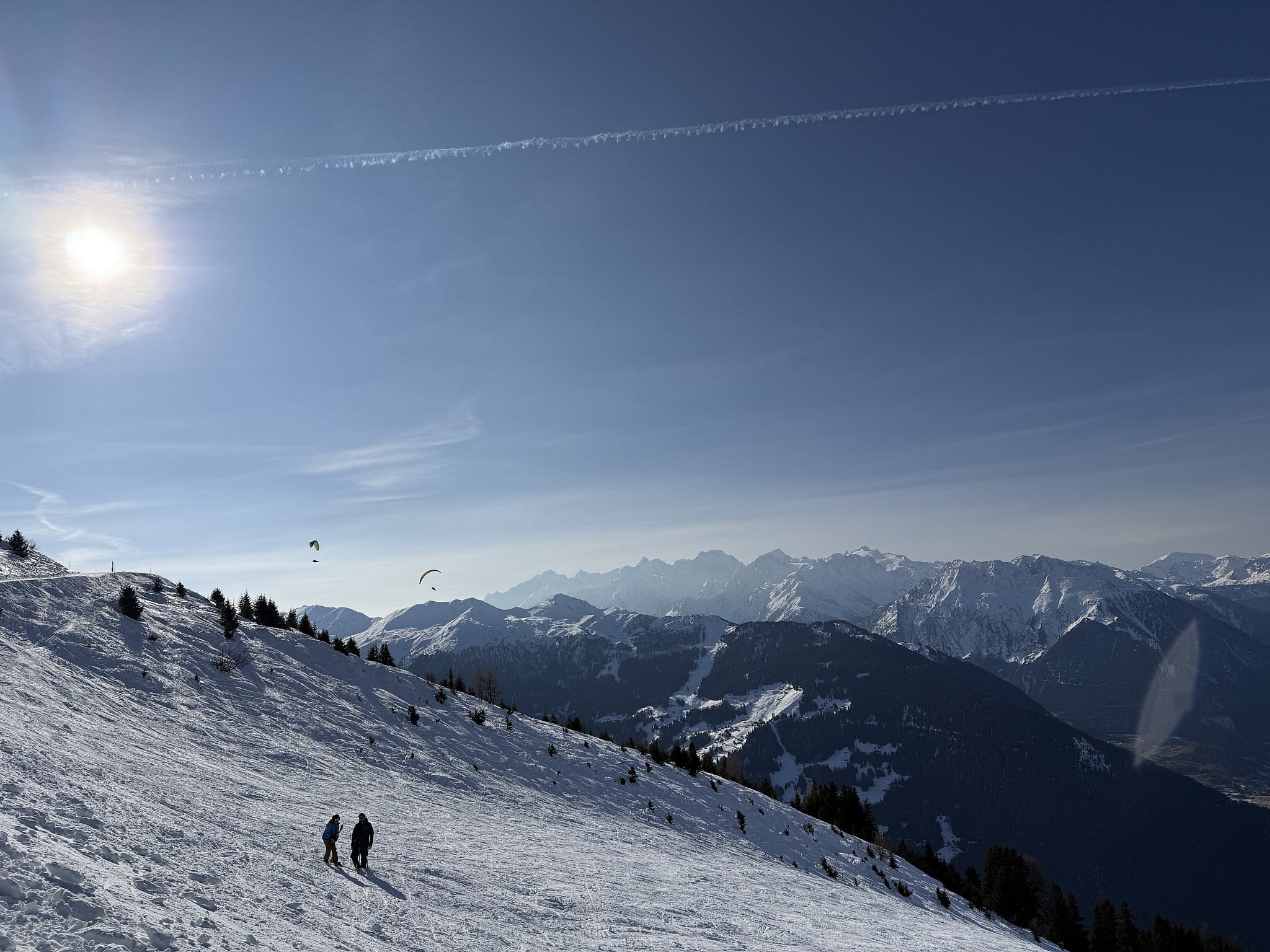
Unexpected adventures in Jewish pride (Courtesy of the author)
I often feel like I live in multiple realities. Most of us do. As a Jewish woman in the diaspora, I can move through daily life talking about kids, work, meals, tennis, vacations, and avoid mentioning my Jewish identity altogether. But since October 7, that separation feels harder to maintain. I’ve come to believe that both realities, ordinary life and Jewish life, have to be held at the same time.
I live in a progressive suburb outside New York City, where social causes trend quickly and opinions form faster. Over the past two years, many people I know have come to see Jewish connection to Israel not as ancestral or spiritual, but as political and oppressive. That shift has changed how I move through conversations. A new question now quietly shadows introductions and small talk: How Jewish should I be right now?
Recently, those parallel realities collided in an unexpected place: a ski trip in Switzerland.
Just days earlier, I attended the Israeli-American Council Summit in Florida, surrounded by people working urgently to strengthen and protect Jewish life in this difficult chapter of our history. From there, I traveled straight to a long-planned multigenerational family ski reunion. Cousins, siblings, grandparents, two sisters who are now grandmothers watching their families expand. It was joyful and grounding.
During the week, several of us worked with a ski instructor named Jon. He was patient, funny, and close to us in age. We spent our days falling, trying again, laughing, cursing, improving slightly, then celebrating with food and drinks. Normal life, exactly as it should be.
On a lift ride, he asked what I do “in the real world.” I gave the shortened version: I’m a psychologist, I work at a medical center, and I cofounded a nonprofit. I stopped there. Lately, disclosure feels calibrated. Being openly Jewish, especially when the work itself is Jewish-focused, has started to feel like a calculated risk.
But he asked more. So I told him about Gesher Community Care, the organization my partner and I built in response not only to October 7, but to what followed — the shock of watching Jewish pain minimized or denied in spaces we once trusted. He responded simply: it is sad such a program is needed at all.
Later that week at après-ski, he noticed a small item I was carrying from the summit, Hersh Goldberg-Polin’s name beside the question, “What’s your why?” He asked about it. When I mentioned Hersh and October 7, he looked blank. He told me he stopped following the news years ago, because it was too painful.
We sat at the base of a mountain with music playing and drinks on the table, the last place for grief-heavy history. I warned him that Hersh’s story was serious and not exactly après-ski material. He wanted to hear it anyway.
So I told him. About Nova. About the shelter. About Aner Shapira throwing back grenade after grenade to save others. About Hersh. About meaning, dignity, and psychological survival under unimaginable conditions. About Viktor Frankl’s idea that a person who holds onto a “why” can survive almost any “how,” and how that teaching reportedly sustained hostages in captivity.
I expected discomfort. Maybe defensiveness. Instead, he listened with full attention and quiet empathy. My body, so used to bracing for argument when Israel or Jewish suffering enters a conversation, slowly relaxed.
Then he shared something of his own. His mother’s family, he said, had hidden Jewish neighbors on their Northern European farm during the Holocaust. He had seen the hiding places himself growing up. Without drama or self-congratulation, he described it as a simple moral duty. We spoke about rescuers, memory, and the idea that saving one life saves a world.
At that moment, time seemed to fold. Holocaust farms, Gaza tunnels, Swiss mountains, present-day conversations, all touching. Two people from very different worlds meeting in honest recognition.
Had I kept my Jewish self separate from my vacation self, that conversation never would have happened. Neither would the connection.
I left with something unexpected: renewed hope. Hope in quiet moral courage passed through generations. Hope in human decency unshaped by propaganda. Hope that even across distance, language, and history, people can still meet each other with openness and care.
I’m still not confident about my future as a skier. But I’m more certain about my future as an unapologetically visible Jew — even at après-ski.
Related Topics
Related Posts