London based entrepreneur, cybersecurity analyst doing a PhD in AI
On Dental and Digital Hygiene.
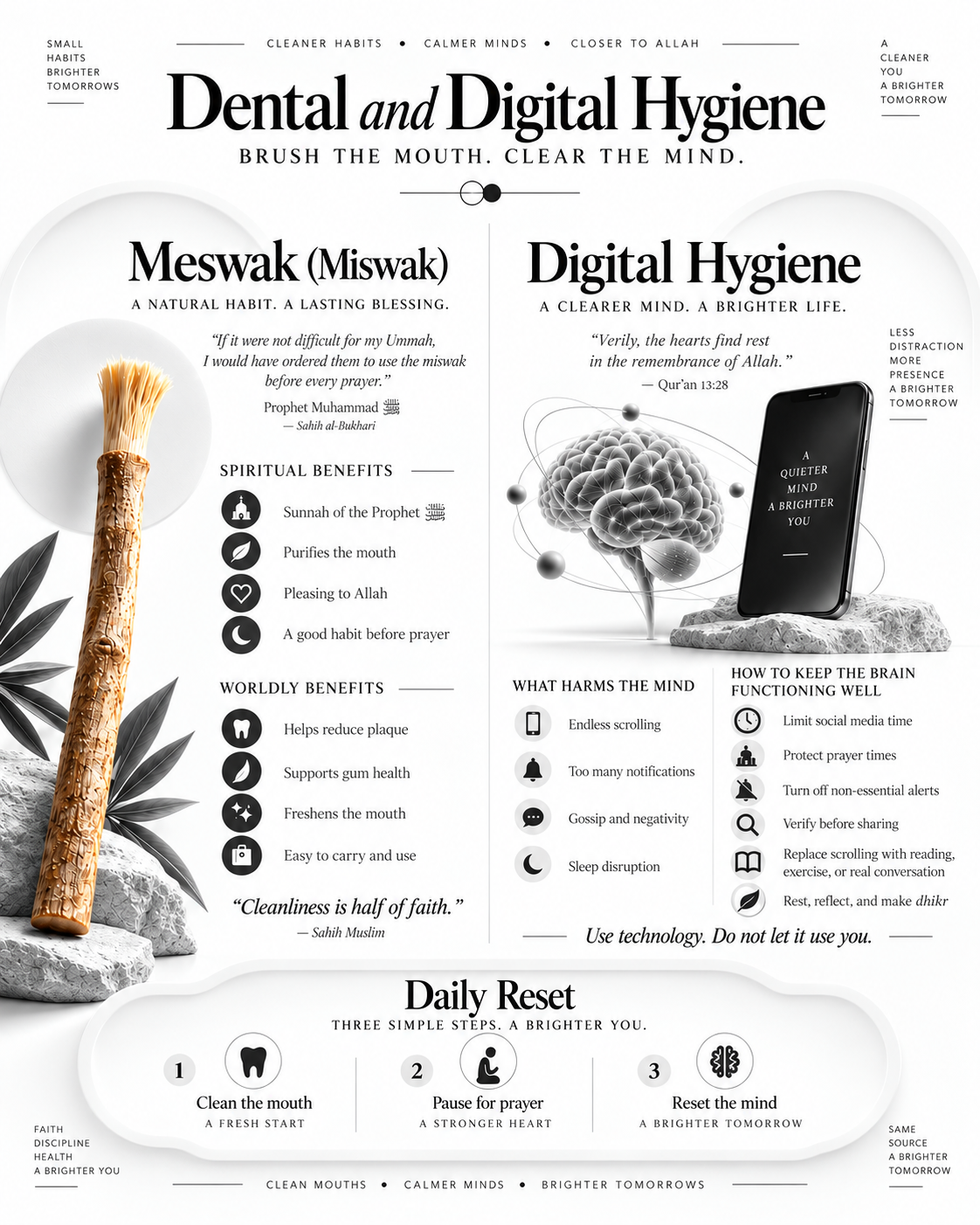
Dental and Digital Hygiene :-
Brush Your Teeth. Brush Your Feed.
There is a reason we brush our teeth: residue becomes plaque. What begins as something almost invisible can, if repeatedly left in place, become inflammation, decay and disease. Islam built this logic of recurrent cleaning into daily life long before modern dentistry. The Prophet Muhammad ﷺ repeatedly used the siwāk, or miswāk, and Abū Hurayrah رضي الله عنه reported him saying that, were it not for fear of hardship, he would have commanded its use with every prayer. ʿĀʾishah رضي الله عنها transmitted the equally striking description that the siwāk is “a purification for the mouth and pleasing to the Lord.” A 2022 systematic review and meta-analysis of randomised trials found miswāk comparable with conventional toothbrushing for reducing plaque and gingivitis, with evidence that using it alongside toothbrushing may add benefit. The traditional stick also has one behavioural advantage worth noticing: it is portable, quick and easy to attach to transitions such as waking, entering the home or preparing for prayer. A practice becomes powerful when it is easy enough to repeat. Modern prevention works by the same logic: brushing twice daily with fluoride toothpaste, cleaning between the teeth, limiting frequent sugar exposure and seeing a dentist when needed are mundane acts whose value lies in repetition, not drama. The sensible Muslim position is not miswāk versus toothbrush; it is miswāk and good dentistry. Clean repeatedly, before small deposits become larger problems. The mouth also reminds us that apparently local neglect can have wider consequences. Periodontitis is a chronic inflammatory disease involving bacterial biofilm around the teeth and gums, and an updated American Heart Association scientific statement in Circulation concludes that periodontal disease is associated with atherosclerotic cardiovascular disease while carefully noting that association does not prove that periodontal treatment prevents heart attacks. The relationship is biologically plausible through inflammation, immune responses, bacterial exposure and shared risk factors, but it should not be exaggerated. Gum disease and cardiovascular disease also share important causes, including smoking, age, diabetes and socioeconomic disadvantage, so a statistical link cannot automatically tell us how much one directly causes the other. A 2026 systematic review and meta-analysis in The Lancet Public Health has also examined oral health and diabetes at population scale, adding to longstanding consensus evidence that diabetes can worsen periodontal disease while severe periodontitis can complicate glycaemic control. The lesson is modest but important: the mouth is not an isolated cosmetic compartment. A good daily hygiene practice protects a system.
The same model can be applied to the mind. Digital life also leaves residue. A single notification is trivial; thousands of interruptions are not. One amusing video is harmless; two hours of involuntary scrolling can consume attention without ever becoming a conscious decision. One angry post may disappear from the screen in seconds while remaining in memory, search results or someone else’s humiliation for years. The scientific evidence on social media is more nuanced than either “social media is destroying everyone” or “there is no problem.” A major 2024 review in Nature Reviews Psychology concluded that associations between social-media use and adolescent mental health are mixed and depend on mechanisms such as social comparison, self-presentation, feedback, exclusion, stress sensitivity and reward processing. In other words, the issue is not merely minutes on a screen but what those minutes are doing. Experimental evidence nevertheless suggests that deliberate reduction can help. A randomised controlled trial of 154 adults found that taking a one-week break from Facebook, Instagram, Twitter and TikTok improved wellbeing and reduced symptoms of depression and anxiety compared with normal use. A later 2025 JAMA Network Open study of young adults found that a voluntary one-week social-media detox was associated with reductions in anxiety, depression and insomnia, although the authors properly cautioned that the intervention was not randomised and cannot prove that every reduction was caused by the detox itself. Importantly, the JAMA study also found that raw screen-time measures were less strongly related to mental-health symptoms than self-reported problematic or addictive use. That points toward a better target than arbitrary purity: loss of control, compulsive checking, sleep disruption, comparison, conflict and use that displaces valuable activity. The most useful concept, therefore, is not digital abstinence but digital hygiene. We do not stop eating because food leaves plaque on our teeth; we clean our teeth and improve what we consume. In the same way, we do not need to abandon technology, messaging, news, humour or online communities. We need to prevent the feed from becoming an environment in which mental debris accumulates faster than we remove it.
The Qur’an already supplies a moral vocabulary for this. Successful believers are described as those who turn away from al-laghw—idle, vain or useless speech: “those who avoid idle talk” (Qur’an 23:3). The verse does not prohibit relaxation, humour or ordinary conversation; it identifies a quality of attention. A person should be able to turn away from what has no worthwhile claim upon him. That ability is precisely what an infinite feed is designed to weaken. The Qur’an then addresses some of the specific content that social media can industrialise. “Do not spy or backbite one another,” it commands, using the unforgettable image of eating the flesh of one’s dead brother (Qur’an 49:12). What was once gossip between a few people can now be clipped, reposted and distributed to millions. Slander, suspicion and humiliation acquire engagement metrics. Qur’an 17:36 adds another rule that could sit above every share button: “Do not pursue that of which you have no knowledge. Indeed, the hearing, the sight and the heart—about all those one will be questioned.” The believer therefore has a duty not only to ask whether content is interesting, but whether it is true. Digital platforms make this discipline harder because speed is rewarded: outrage travels before verification, screenshots detach words from context, and repetition can make an unsupported claim feel familiar enough to seem true. The Prophet ﷺ adds the missing economic category: time. “There are two blessings that many people are deceived into losing: health and free time,” he said in Ṣaḥīḥ al-Bukhārī. Social media is unusual because it can consume free time without feeling like a decision to spend it. Five minutes becomes forty because the product has removed the natural stopping points. Yet Islam does not answer this by making leisure shameful. In the hadith of Ḥanẓalah, the Companion worried that ordinary family life and worldly activity distracted him from the spiritual intensity he felt around the Prophet ﷺ. The Prophet corrected the anxiety: there is a time for this and a time for that. ʿĀʾishah رضي الله عنها also watched the Abyssinians perform with spears while the Prophet ﷺ shielded her so she could enjoy the display. Entertainment, play, family life and rest are not defects in human beings. The distinction is between recreation that restores us and stimulation that consumes us.
That is why the five daily prayers offer such a powerful model for mental hygiene, provided we do not reduce ṣalāh to a wellness technique. Prayer is worship before it is anything else. But its architecture has psychological wisdom. Five times a day, attention is interrupted on purpose. Fajr prevents the morning from beginning entirely on someone else’s terms. Ẓuhr interrupts work. ʿAṣr interrupts the momentum of the afternoon. Maghrib marks the transition into evening. ʿIshāʾ closes the day. The phone is put down; wuḍūʾ changes the physical state; the body stands, bows and prostrates; the tongue recites words that are not selected by an algorithm. “Surely in the remembrance of Allah do hearts find rest,” says Qur’an 13:28. Mental hygiene is an analogy here, not a medical claim: prayer is not a substitute for treatment of mental illness. Its relevance is that it creates recurrent moments in which the mind is not available for sale. The similarity with the toothbrush is useful. Nobody brushes once a month for twenty minutes and expects excellent teeth. Hygiene works because it is small, repeated and attached to routine. Attention is similar. A person who spends every waking hour moving between messages, headlines, outrage, short videos, work notifications and entertainment cannot repair that merely by taking one annual holiday. The mind needs smaller interruptions. Prayer supplies five of them automatically. Each one can function as a checkpoint: What has occupied me since the last prayer? What am I carrying emotionally? What deserves to continue into the next part of the day, and what can simply be left behind? The healthiest digital routine can therefore be built around what Muslims already possess: fixed points at which the screen loses priority. These pauses also expose whether use is truly chosen. If putting the phone down for ten minutes to pray feels intolerable, the problem is no longer simply entertainment. A tool has begun making demands upon its owner.
The practical formula should therefore be closer to brushing than detoxing. First, measure: check one ordinary week of screen-time data and identify the two or three applications actually taking the hours; vague guilt is less useful than numbers. Second, remove unnecessary triggers: switch off non-human notifications, remove compulsive apps from the home screen, disable autoplay where possible, and make the most addictive platform slightly inconvenient to enter. Friction restores choice. Third, create protected spaces: no scrolling during ṣalāh, meals, face-to-face conversation, the first part of the morning or the final part of the night. Fourth, clean the feed itself: unfollow accounts that reliably create envy, rage, lust, gossip or pointless argument; keep material that teaches, informs, connects or genuinely entertains. Fifth, introduce a sharing test drawn directly from revelation: Is it true—Qur’an 17:36? Does it violate someone’s dignity—Qur’an 49:12? Is this worth part of my finite life—“By Time, surely mankind is in loss,” Qur’an 103:1–2? Sixth, replace what you remove. This is where many digital detoxes fail. A person deletes an app but leaves behind an empty hour, and the brain naturally searches for the easiest replacement. Give that hour somewhere to go: walking, gym, swimming, reading, Qur’an, a long-form podcast, cooking, gardening, football, a museum, a board game, a proper telephone call, coffee with a friend, a comedy, a documentary, a film chosen deliberately rather than an endless queue chosen by software. Keep entertainment. Keep jokes. Keep useful social media. Keep group chats that sustain real relationships. Seventh, review the system once a week rather than policing yourself every hour: if sleep, prayer, work, exercise or relationships are still being displaced, tighten one boundary at a time. If use genuinely feels uncontrollable or is tied to significant anxiety, depression or compulsive behaviour, treat that as a health problem rather than a moral failure and seek appropriate professional help. Islam does not require a grey life stripped of pleasure; it requires proportion. Then anchor the system to prayer: when prayer time comes, stop, clean the mouth when appropriate with miswāk or toothbrush, make wuḍūʾ, pray, and only afterwards decide whether the screen still deserves your attention. The toothbrush does not ask us to stop eating. The miswāk does not ask us to fear food. They simply refuse to let residue remain indefinitely. Digital hygiene should do the same for the mind.
References
- Ṣaḥīḥ al-Bukhārī 887 — the siwāk with every prayer. Read the hadith
- Sunan al-Nasāʾī 5 — “purification for the mouth and pleasing to the Lord.” Read the hadith
- Ramli H et al. “The effectiveness of miswak practices in reducing plaque and gingivitis among adults: A systematic review and meta-analysis.” Journal of Ethnopharmacology (2022). PubMed
- Tran AH et al. “Periodontal Disease and Atherosclerotic Cardiovascular Disease: A Scientific Statement From the American Heart Association.” Circulation (2026). PubMed
- Botelho J et al. “Oral health and diabetes: a systematic review and meta-analysis.” The Lancet Public Health (2026). PubMed
- Sanz M et al. Scientific evidence on the links between periodontal diseases and diabetes: consensus report and guidelines. PubMed
- Orben A, Meier A, Dalgleish T, Blakemore S-J et al. “Mechanisms linking social media use to adolescent mental health vulnerability.” Nature Reviews Psychology (2024). Nature Reviews Psychology
- Lambert J et al. “Taking a One-Week Break from Social Media Improves Well-Being, Depression, and Anxiety: A Randomized Controlled Trial.” Cyberpsychology, Behavior, and Social Networking (2022). PubMed
- “Social Media Detox and Youth Mental Health.” JAMA Network Open (2025). JAMA Network Open
- Qur’an 23:3 — turning away from al-laghw. Read Qur’an 23:3
- Qur’an 49:12 — suspicion, spying and backbiting. Read Qur’an 49:12
- Qur’an 17:36 — do not pursue what you have no knowledge of. Read Qur’an 17:36
- Qur’an 13:28 — remembrance of Allah and tranquillity of the heart. Read Qur’an 13:28
- Sūrat al-ʿAṣr, Qur’an 103:1–3 — time, loss, truth and patience. Read Sūrat al-ʿAṣr
- Ṣaḥīḥ al-Bukhārī 6412 — health and free time as two frequently wasted blessings. Read the hadith
- Ṣaḥīḥ Muslim 2750a — Ḥanẓalah and the Prophetic principle of a time for spiritual intensity and a time for ordinary worldly life. Read the hadith
- Ṣaḥīḥ al-Bukhārī 454–455 — ʿĀʾishah watching the Abyssinians’ display while the Prophet ﷺ enabled her to watch. Read the hadith
Related Topics