London based entrepreneur, cybersecurity analyst doing a PhD in AI
On Healing and Cure.
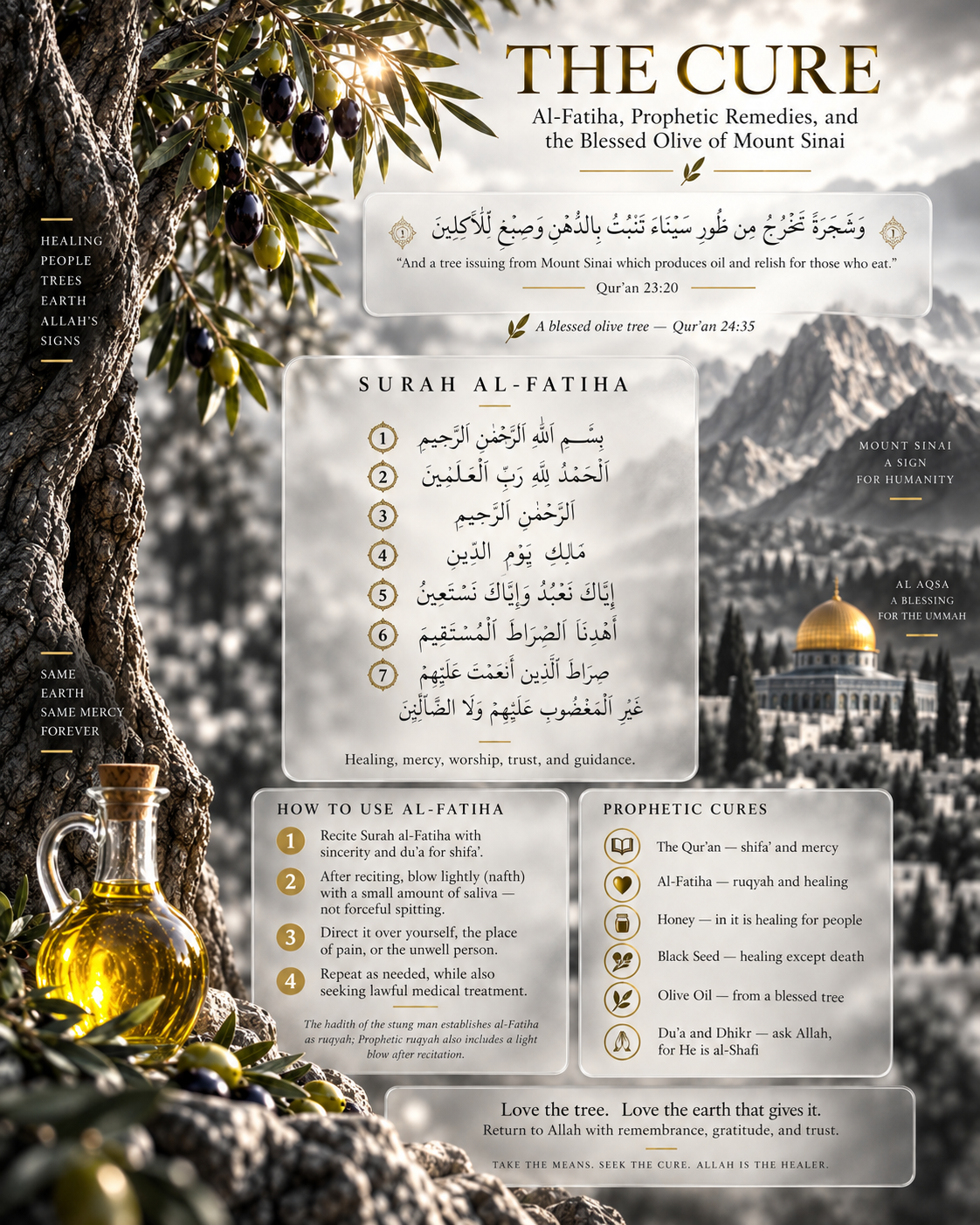
Blessing in Olive and Olive Trees, and List of Prophetic Cures.
The Cure
1. Al-Fātiḥah: Ruqyah, Not Metaphor
The clearest place to begin is not with a herb but with revelation.
In Ṣaḥīḥ al-Bukhārī, a group of the Prophet’s Companions encountered a tribal chief who had been bitten by a snake or stung by a scorpion. One Companion treated him by reciting Sūrat al-Fātiḥah, gathering saliva and spitting it at the affected place. The man recovered. When the incident was reported to the Prophet Muhammad ﷺ, he approved it and asked:
“How did you know that it is a ruqyah?”
— Ṣaḥīḥ al-Bukhārī 5736. Read Ṣaḥīḥ al-Bukhārī 5736
This gives al-Fātiḥah a specific place in Prophetic healing—and it clarifies the practice. The narration describes recitation with saliva directed towards the afflicted site. It does not establish forceful spitting, a compulsory number of repetitions, or a requirement that every recitation of al-Fātiḥah be accompanied by blowing.
Elsewhere the Sunnah explicitly describes nafth—a light blow with slight moisture—after reciting al-Ikhlāṣ, al-Falaq and al-Nās before sleep. Read Ṣaḥīḥ al-Bukhārī 5017 The sound practical conclusion is therefore simple: al-Fātiḥah may be recited over oneself or an unwell person as ruqyah; light blowing or slight saliva has Prophetic precedent, but it should not be turned into an invented ritual.
Its content explains why it belongs naturally at the centre of healing:
Iyyāka naʿbudu wa iyyāka nastaʿīn.
“You alone we worship, and You alone we ask for help.”
— Qur’an 1:5. Read Qur’an 1:5 with Ibn Kathīr
Ibn Kathīr explains that advancing iyyāka—“You alone”—expresses exclusivity: worship belongs to Allah alone and ultimate reliance belongs to Him alone. Healing therefore begins, spiritually, by refusing to make illness, fear, medicine or even the human body into an ultimate power.
2. The Qur’an: Medicine for the Inner Human Being
Al-Fātiḥah is not an isolated exception. The Qur’an describes revelation itself as shifāʾ:
“We send down of the Qur’an that which is healing and mercy for the believers.”
— Qur’an 17:82. Read Qur’an 17:82 with Ibn Kathīr
Ibn Kathīr explains the healing here first in relation to diseases of the heart: doubt, hypocrisy, shirk, confusion and attraction towards falsehood.
Allah similarly describes revelation as:
“A healing for what is in the breasts, and guidance and mercy for the believers.”
— Qur’an 10:57. Read Qur’an 10:57
This establishes a category of medicine that a laboratory cannot fully encompass: treatment of the interior human being.
Fear can dominate a life.
So can resentment.
Despair.
Arrogance.
Envy.
Misplaced dependence.
Moral confusion.
The Qur’an addresses these through truth, remembrance, warning, hope and guidance.
The Sunnah then gives Qur’anic protection a practical nightly form. ʿĀʾishah رضي الله عنها reported that the Prophet ﷺ would cup his hands, recite al-Ikhlāṣ, al-Falaq and al-Nās, blow into them, then wipe them over as much of his body as possible, beginning with his head, face and front. He did this three times. Read Ṣaḥīḥ al-Bukhārī 5017
That is a defined Prophetic practice: recitation, nafth, wiping, three times.
3. Duʿāʾ: Ask the One Who Heals
Prophetic medicine is not only something placed upon the body. It is also speech directed towards Allah.
ʿĀʾishah رضي الله عنها reported that the Prophet ﷺ would pass his right hand over the place of illness and supplicate:
“O Lord of the people, remove the harm and heal. You are the Healer. There is no healing except Your healing, a healing that leaves no illness.”
— Ṣaḥīḥ al-Bukhārī 5750. Read Ṣaḥīḥ al-Bukhārī 5750
The centre of that supplication is:
Anta al-Shāfī.
You are the Healer.
Abraham عليه السلام expresses precisely the same hierarchy:
“And when I am ill, it is He who heals me.”
— Qur’an 26:80. Read Qur’an 26:80 with Ibn Kathīr
Ibn Kathīr explains that no one independently possesses the power to cure; Allah heals through the causes and means that lead towards recovery.
Duʿāʾ therefore does not cancel causality. It places causality beneath God.
Allah says:
“Call upon Me; I will respond to you.”
— Qur’an 40:60. Read Qur’an 40:60
And the believer calls upon Him knowing:
“He is the All-Hearing, All-Seeing.”
— Qur’an 42:11. Read Qur’an 42:11
4. Honey: “In It Is Healing”
The Qur’an then turns our attention from revelation to creation.
Of the bee, Allah says:
“From their bellies comes a drink of varying colours, in which there is healing for people.”
— Qur’an 16:69. Read Qur’an 16:69 with Ibn Kathīr
Ibn Kathīr identifies the drink as honey.
The Sunnah makes the principle concrete. A man told the Prophet ﷺ that his brother was suffering from abdominal trouble. The Prophet instructed him to give his brother honey. The instruction was repeated, and the narration concludes that the man recovered.
— Ṣaḥīḥ al-Bukhārī 5684. Read Ṣaḥīḥ al-Bukhārī 5684
Precision matters. The Qur’an says honey contains healing; the hadith records a particular gastrointestinal illness. Neither text says honey replaces antibiotics, surgery, insulin or specialist assessment.
The disciplined position is to believe exactly what revelation says without making revelation say more.
5. Black Seed: A Strong Claim, Carefully Used
Abū Hurayrah رضي الله عنه reported that the Prophet ﷺ said:
“There is healing in black seed for every disease except death.”
— Ṣaḥīḥ al-Bukhārī 5688. Read Ṣaḥīḥ al-Bukhārī 5688
Few natural remedies receive language this strong in an authentic hadith.
Precisely because the text is strong, Muslims should resist adding things to it. The hadith establishes black seed as a genuine Prophetic means of healing. It does not specify one universal dosage, preparation, duration or disease-specific protocol.
Those questions require medical evidence.
Using black seed as food or a remedy is consistent with the Sunnah. Telling someone to discontinue proven treatment because of an internet protocol is not.
Respecting the Prophet ﷺ includes refusing to attribute prescriptions to him that he never gave.
6. The Olive of Sinai: Food, Oil, Light and Blessing
The olive is distinctive because the Qur’an joins nourishment, landscape and sacred memory in one image:
“And a tree issuing from Mount Sinai which produces oil and relish for those who eat.”
— Qur’an 23:20. Read Qur’an 23:20 with Ibn Kathīr
Ibn Kathīr identifies this as the olive tree, placing it among Allah’s blessings in rain, vegetation and food.
The image returns in the Verse of Light:
“…lit from a blessed olive tree…”
— Qur’an 24:35. Read Qur’an 24:35
The Qur’anic foundation is therefore secure: the olive gives food and oil, grows within the imagery of Sinai, and is described as blessed.
A well-known report says:
“Eat olive oil and use it as an ointment, for it is from a blessed tree.”
— Jāmiʿ al-Tirmidhī 1851. Read Jāmiʿ al-Tirmidhī 1851 and its transmission note
Scholarly honesty requires mentioning that al-Tirmidhī himself records instability in its chain and differing forms of transmission.
That qualification does not diminish the Qur’anic honour of the olive.
A tree can simultaneously be food, oil, livelihood, ecology, inheritance and a sign.
7. Zamzam: A Prophetic Water
Zamzam also has a secure place in Prophetic practice.
Ibn ʿAbbās رضي الله عنهما reported:
“I served Zamzam water to Allah’s Messenger ﷺ, and he drank it while standing.”
— Ṣaḥīḥ Muslim 2027a. Read Ṣaḥīḥ Muslim 2027a
This establishes the Prophet’s ﷺ drinking of Zamzam without needing exaggerated claims to make it meaningful.
The distinction matters. Authentic devotion is strengthened, not weakened, by evidential discipline. What is established should be embraced confidently; additional therapeutic claims should stand or fall on their own evidence.
8. When Worship Enters the Body
Allah says:
“Surely in the remembrance of Allah do hearts find comfort.”
— Qur’an 13:28. Read Qur’an 13:28 with Ibn Kathīr
Ibn Kathīr describes hearts settling and becoming tranquil through Allah’s remembrance.
Modern science cannot test whether Allah answers duʿāʾ or whether revelation carries barakah. It can investigate what prayer, belief, meaning and religious coping do within the human organism.
A BMJ study found that rhythmic prayer and mantra recitation slowed respiration to approximately six breaths per minute while increasing baroreflex sensitivity and synchronising cardiovascular rhythms. It did not investigate Islamic prayer specifically, but it demonstrated that patterned devotional recitation can measurably alter autonomic physiology. Bernardi et al., BMJ, 2001
Psychology presents a similarly nuanced picture. A meta-analysis of 49 studies in the Journal of Clinical Psychology found that positive religious coping generally tracked better psychological adjustment to stress, while negative religious coping tracked poorer adjustment. Ano & Vasconcelles, Journal of Clinical Psychology, 2005
A systematic review of 152 prospective studies in the Journal of Affective Disorders found that religion or spirituality predicted a modestly better course of depression in roughly half the studies, while religious struggle was more often associated with worse outcomes. Braam & Koenig, Journal of Affective Disorders, 2019
Another systematic review and meta-analysis of randomised trials found evidence that adapting established psychological therapies to patients’ faith frameworks could benefit depression and anxiety. Faith-adapted psychological therapies, Journal of Affective Disorders, 2015
The conclusion should remain modest. Science does not prove revelation. It does show that breathing, meaning, hope, attention and religious coping can have measurable psychological and physiological consequences.
Worship is embodied.
9. The Formula for Cure
The order matters because it avoids both superstition and reductionism. Revelation is not a laboratory chemical; laboratory medicine is not independent of its Creator. Revelation tells the believer whom to trust and how to orient himself. Medicine investigates created mechanisms through which treatment may work.
The Islamic formula can therefore be stated simply:
- Rely upon Allah. Begin from Abraham’s creed: “When I am ill, He heals me.” Ask al-Shāfī sincerely, knowing that Allah is al-Samīʿ, al-Baṣīr—the All-Hearing and All-Seeing. Qur’an 26:80 Qur’an 42:11
- Use the Prophetic means responsibly. Recite al-Fātiḥah as ruqyah. Use the nightly Muʿawwidhāt in the manner actually reported. Make the Prophetic duʿāʾ for healing. Where appropriate, use honey, black seed, olive oil and Zamzam—without inventing guarantees, dosages or treatments that revelation never specified.
- Seek the best lawful conventional treatment available. When the Prophet ﷺ was asked whether people should use medicine, he answered: “Make use of medical treatment,” explaining that Allah has appointed remedies for disease, with old age excepted in the narration. — Sunan Abī Dāwūd 3855. Read Sunan Abī Dāwūd 3855 A scan, antibiotic, operation, psychotherapy, insulin or chemotherapy is not a rival to tawakkul. It is part of taking the means Allah created.
- Make duʿāʾ from the beginning, not merely when medicine fails. “Call upon Me; I will respond to you.” Qur’an 40:60 The believer acts while knowing that his prayer is neither unseen nor unheard: Allah hears. Allah sees. Allah knows.
That is the hierarchy.
Rely upon Allah.
Take the Prophetic means.
Seek competent medical treatment.
Make duʿāʾ.
Leave the outcome to al-Shāfī.
The physician treats. The medicine acts through mechanisms Allah created. The believer takes the means without worshipping them.
References
- Qur’an 1:5 — “You alone we worship, and You alone we ask for help.”
https://quran.com/1/5 - Qur’an 10:57 — “A healing for what is in the breasts, and guidance and mercy for the believers.”
https://quran.com/10/57 - Qur’an 13:28 — “Surely in the remembrance of Allah do hearts find comfort.”
https://quran.com/13/28 - Qur’an 16:69 — Honey: “In which there is healing for people.”
https://quran.com/16/69 - Qur’an 17:82 — “We send down of the Qur’an that which is healing and mercy for the believers.”
https://quran.com/17/82 - Qur’an 23:20 — Olive tree from Mount Sinai producing oil and food.
https://quran.com/23/20 - Qur’an 24:35 — The “blessed olive tree.”
https://quran.com/24/35 - Qur’an 26:80 — “And when I am ill, it is He who heals me.”
https://quran.com/26/80 - Qur’an 40:60 — “Call upon Me; I will respond to you.”
https://quran.com/40/60 - Qur’an 42:11 — Allah as al-Samīʿ, al-Baṣīr — the All-Hearing, All-Seeing.
https://quran.com/42/11 - Tafsīr Ibn Kathīr on Qur’an 1:5 — exclusivity of worship and seeking help from Allah.
https://quran.com/1:5/tafsirs/en-tafisr-ibn-kathir - Tafsīr Ibn Kathīr on Qur’an 16:69 — honey and healing.
https://quran.com/16:69/tafsirs/en-tafisr-ibn-kathir - Tafsīr Ibn Kathīr on Qur’an 17:82 — Qur’an as healing for diseases of the heart.
https://quran.com/17:82/tafsirs/en-tafisr-ibn-kathir - Tafsīr Ibn Kathīr on Qur’an 23:20 — identification of the Sinai tree as the olive.
https://quran.com/23:20/tafsirs/en-tafisr-ibn-kathir - Tafsīr Ibn Kathīr on Qur’an 26:80 — Allah heals through the causes and means of recovery.
https://quran.com/26:80/tafsirs/en-tafisr-ibn-kathir - Ṣaḥīḥ al-Bukhārī 5736 — al-Fātiḥah used as ruqyah for a bite/sting; approved by the Prophet ﷺ.
https://sunnah.com/bukhari:5736 - Ṣaḥīḥ al-Bukhārī 5017 — al-Ikhlāṣ, al-Falaq and al-Nās recited into the hands with nafth and wiped over the body three times.
https://sunnah.com/bukhari:5017 - Ṣaḥīḥ al-Bukhārī 5750 — “You are the Healer; there is no healing except Your healing.”
https://sunnah.com/bukhari:5750 - Ṣaḥīḥ al-Bukhārī 5684 — honey prescribed for abdominal illness.
https://sunnah.com/bukhari:5684 - Ṣaḥīḥ al-Bukhārī 5688 — black seed: “healing for every disease except death.”
https://sunnah.com/bukhari:5688 - Ṣaḥīḥ Muslim 2027a — the Prophet ﷺ drank Zamzam water.
https://sunnah.com/muslim:2027a - Jāmiʿ al-Tirmidhī 1851 — olive oil: “Eat it and use it as an ointment, for it is from a blessed tree,” with transmission discussion.
https://sunnah.com/tirmidhi:1851 - Sunan Abī Dāwūd 3855 — command to seek medical treatment.
https://sunnah.com/abudawud:3855 - Bernardi L, et al. “Effect of rosary prayer and yoga mantras on autonomic cardiovascular rhythms.” BMJ (2001).
https://www.bmj.com/content/323/7327/1446 - Ano GG, Vasconcelles EB. “Religious coping and psychological adjustment to stress: a meta-analysis.” Journal of Clinical Psychology (2005).
https://pubmed.ncbi.nlm.nih.gov/15503316/ - Braam AW, Koenig HG. “Religion, spirituality and depression in prospective studies: a systematic review.” Journal of Affective Disorders (2019).
https://pubmed.ncbi.nlm.nih.gov/31326688/ - Anderson N, et al. Faith-adapted psychological therapies for depression and anxiety: systematic review and meta-analysis. Journal of Affective Disorders (2015).
https://pubmed.ncbi.nlm.nih.gov/25723562/
Related Topics
Related Posts