Reflections on past and present
On Modernity and Irresponsibility
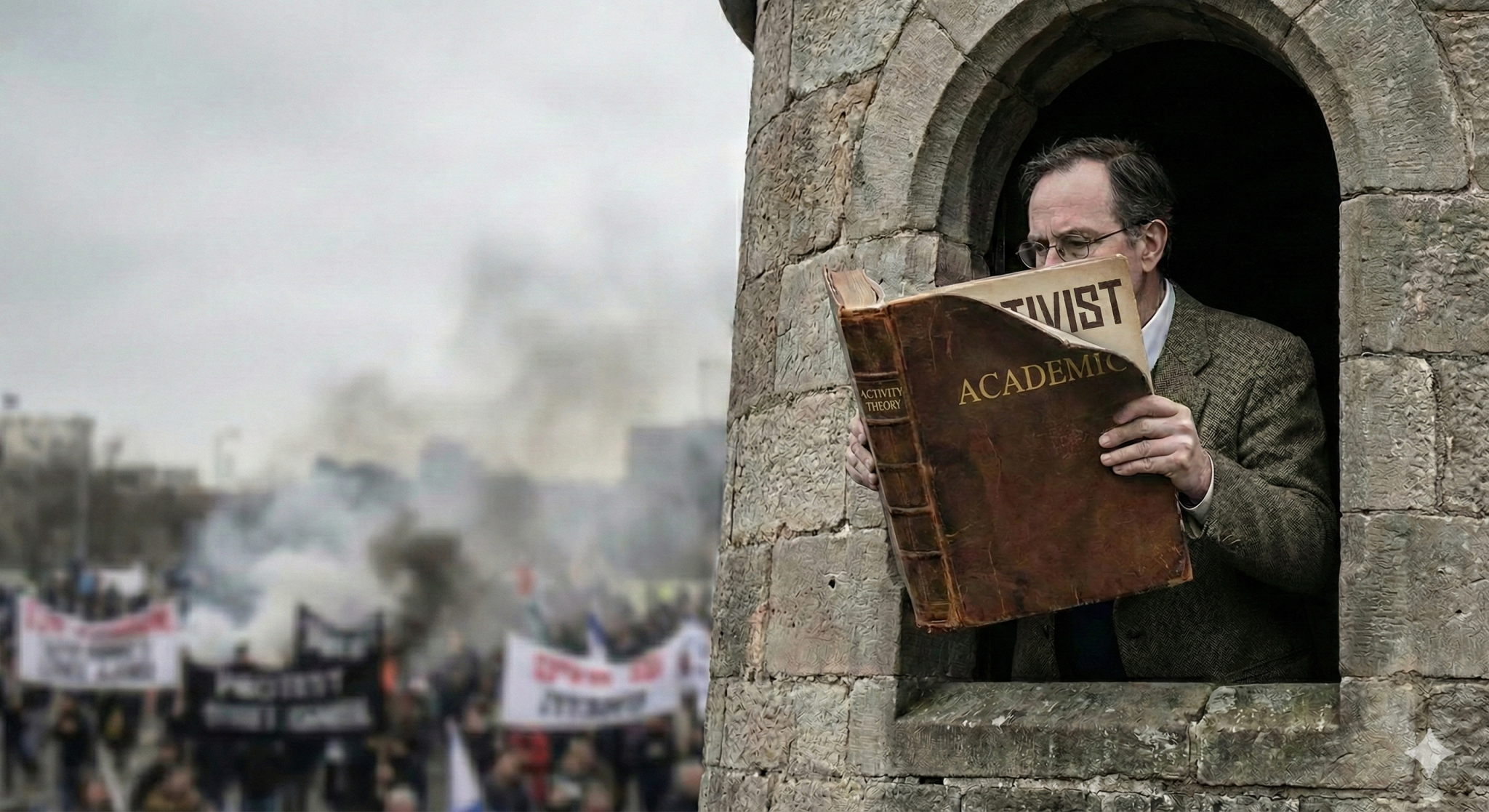
The dissonance between campus protests against Israel and the academic silence surrounding the killing of protesters in Iran exposes a sharp—and painful—paradox: the growing aversion of significant segments of Western academia to Western values themselves. As Israeli intellectual Tomer Persico has argued, this hostility often reflects a deeper discomfort with modernity—that is, with a worldview that places the human being, rather than God, at the center.
Building on this insight, I want to suggest that hostility toward modernity often functions less as a critique than as a form of self-definition. It allows academics to imagine themselves as revolutionaries and activists, thereby imbuing their professional lives with moral meaning. Yet beyond its intellectual weakness, this posture has concrete political consequences. Chief among them is a systematic evasion of
In critical-progressive research across the humanities and social sciences, the logic is by now familiar. At its core lies a claim to a single universal truth, of which the researcher alone is custodian by virtue of academic credentials. This truth is positioned against the West and modernity. In doing so, it rejects liberal commitments to open debate, pluralism, and political judgment, replacing them with a stark moral dichotomy of “good” and “evil,” victims and oppressors.
In the Jewish context, this rejection of modernity almost inevitably translates into a rejection of Zionism and Jewish sovereignty. Within the progressive imagination, the only “legitimate” Jew is one who remains abstract and universal—unencumbered by power, responsibility, or political agency. Sovereignty, with all the messiness and accountability it entails, is thus framed as a betrayal of Judaism’s historical role.
Ironically, this critique largely ignores the messianic dimensions of Religious Zionism or the radicalism of the so-called Hilltop Youth. Instead, it directs its ire at secular-liberal Zionism, from the historical Mapai movement to today’s Israeli hi-tech industry. Within this framework, the “Tel Aviv Zionist” becomes the root of the problem, with fascism attributed not only to political views but to cultural tastes and aesthetic sensibilities.
The result is a flattening of Israeli society into a single, undifferentiated moral object. “The Israelis” can thus be accused of any crime—genocide included—and symbolically expelled from the moral community. Factual precision becomes secondary. What matters is the blow struck against Zionism and modernity. One might consider this position misguided or condescending, yet still legitimate. The real danger appears when its advocates are asked to account for their claims.
At that point, a striking intellectual maneuver takes place. When it is noted that no accepted legal definition supports the charge of genocide; when the instrumental use of that term is shown to trivialize the memory of the Holocaust; or when it is argued that absolutist rhetoric obstructs serious discussion of actual wrongdoing—the response is not engagement but reversal. Critics are branded fascists or apologists and swiftly silenced, while the academic recasts himself as a persecuted martyr whose freedom of speech is under threat.
Almost overnight, the self-styled activist retreats into the role of the powerless scholar, merely cataloging dusty archives and innocently pursuing truth. Political intervention is claimed when it grants moral authority; political innocence is claimed when responsibility is demanded.
As Douglas Murray remarked in a conversation with Dave Smith, one cannot actively participate in political discourse and then, when challenged, insist on being “just a comedian.” Public speech entails accountability.
A similar logic operates in Israeli populist politics. Critics are denounced as traitors, and a machinery of delegitimization is deployed against them. Yet when responsibility is demanded—from the government, from ministers, from those in power—the blame is redirected outward: to elites, to the opposition, to the “deep state.” Even in the face of a national catastrophe like October 7, the most basic political gestures—admission of failure, resignation, or the establishment of a commission of inquiry—remain conspicuously absent.
One might argue that these different manifestations—academic radicalism and political populism—are unrelated phenomena arising from opposing ends of the ideological spectrum. Yet a deeper affinity unites them: both seek release from the burden of responsibility and from the moral complexity of political agency.
It is here that progressive utopianism and visceral nationalism converge, abandoning the modern sovereign experiment altogether. In this space—where responsibility is sacrificed either to abstract “justice” or to raw political survival—the human being is reduced once again to an object of history: a victim or a villain, but never an accountable agent.
Related Topics