Grammy and Emmy nominated singer-songwriter, author, essayist
On Navi Pillay’s Nobel Peace Prize and Other Imponderables
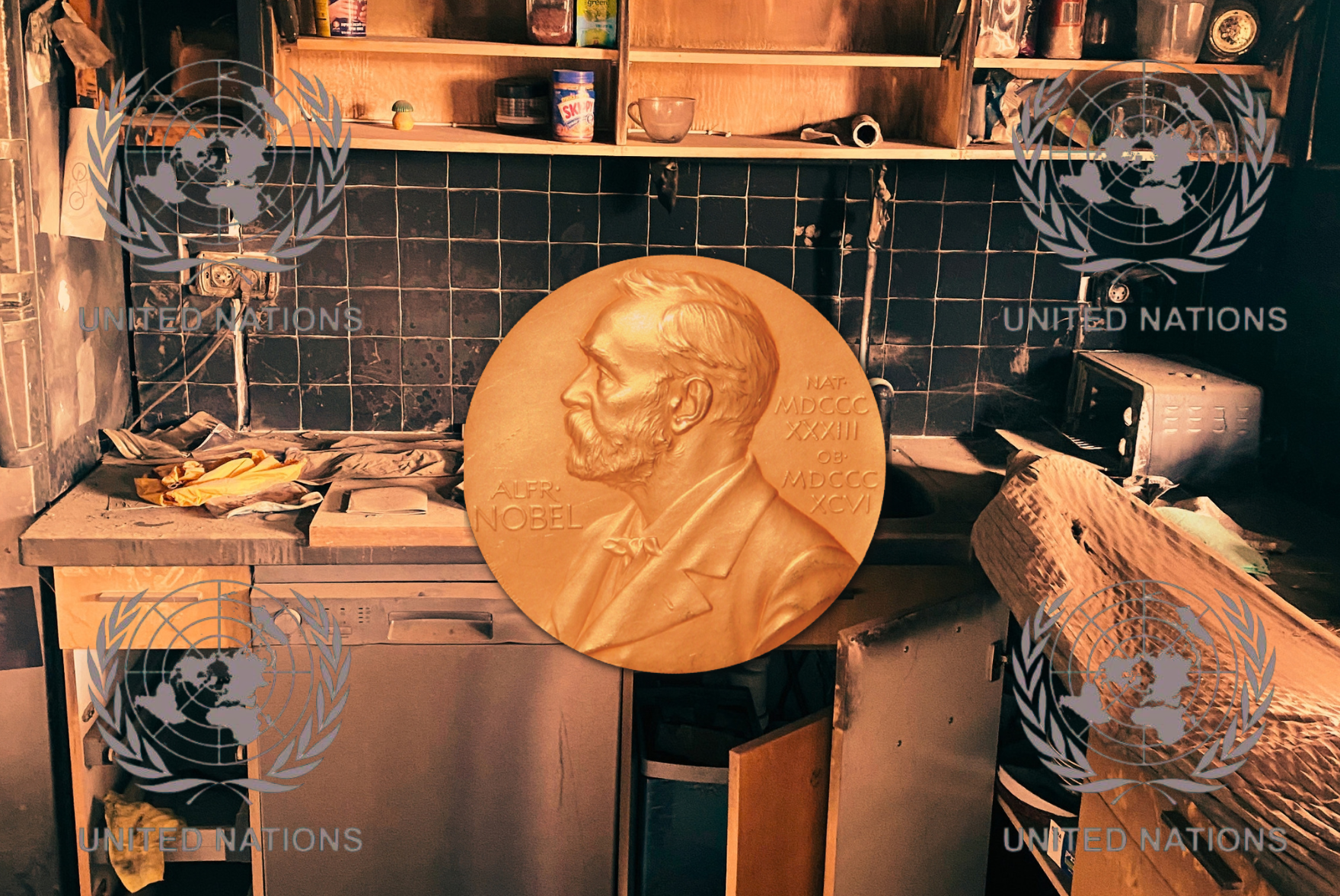
Photography and collage by the author
On Navi Pillay’s Nobel Peace Prize and other imponderables
It’s coming up on one year since I stood in the home of the Bibas family. A year since I released a modicum of the pent-up emotions I had carried since learning of the murder by “cruel hands” of the family’s two boys, one nine months old, the other four years old. A year since I reflexively attempted to relieve myself of the pain of learning that Shiri Bibas, the boys’ mother, was kidnapped and murdered. It has been a year of trying to grasp what Yarden Bibas must have felt after sixteen months of torture in the warrens of Hamas’s tunnels, finally returning home to the fact that his family had been obliterated — a year since I stood in his family’s burned and ravaged kitchen and wept for fifteen straight minutes. The ruins of that kitchen, which bore witness, spoke. I stared at the charred refrigerator, feeling the incongruity of breakfast and barbarity converging in one spot.
Yesterday, I began examining the nature of those tears, their provenance. After all, I didn’t know these people. And yet, I felt an inseparable connection to them. Such are the feelings that Jews have for one another, this small tribe of people that, perhaps more than any other, has created and continues to uphold the moral scaffolding of Western civilization.
There was more that I uncovered in my search of self. Tears, as I have written many times, come about when one’s language, one’s vocabulary —even the strongest— becomes feeble in describing what still needs to be said.
This self-reflection brought to mind another dimension to those tears: incredulity. The sheer sense of wonderment at the state of the world, and the Jew’s place in it. Once again, as has played out innumerable times in history, the Jewish people are to blame. There are those who, for every possible reason but the truth, find benefit in spreading this canard.
Though the word “genocide” is applied most often to nations, it is no less powerful than branding a single person a pedophile, a serial rapist, or a wanton murderer. It marks a nation with the guilt of Cain as surely as it would a human being. Today, it is being used with impunity against the Jewish state, and nowhere more consistently than by Navanethem Pillay, the 85-year-old South African jurist and former United Nations High Commissioner for Human Rights, who chaired the UN commission that made this false claim. The UN Human Rights Council, which created her commission, is a body so corrupt that its findings and pronouncements about the world’s only Jewish state could be the basis of a Saturday Night Live skit. And to make matters worse, this jurist has now been awarded the Nobel Peace Prize.
Recall that the commission she chaired was brought into being with the support of such solid world citizens as China, Cuba, Eritrea, Russia, Venezuela, Sudan, Libya, Pakistan, Bahrain, Somalia, Uzbekistan, and others, with Iran and Syria among those requesting it.
I have a friend who would occasionally pantomime for me his own sense of incredulity. It was so simple, so funny. He’d approach a wall and with his hands held up in a kind of pleading motion, pretend to bang his head against it. I laughed every time he did it. I laugh even now when I think of him doing it. And yesterday, sitting with the question of my tears, I began to understand that his wall routine and my weeping were essentially the same thing. Both are what the body does when the mind’s language gives out. Incredulity can come about from absurdity or grief, but the sources often mesh. They clearly do today: a world that hands its highest prize for peace to the woman who branded the Jewish state with the worst word in the human vocabulary, while a father who spent 484 torturous days in the dark returns home to a world without his wife or his boys.
I stood where Shiri, Yarden, Kfir and Ariel lived. Again, the wall. A wall of incredulity so tall and so thick that words cannot begin to describe it. And so the body does its strange and uniquely human thing. It releases salt water from the eyes. Perhaps the biological mechanism is tied to something deeper, more spiritual. The tears, full of salt, come to blur our vision, to protect us from what cannot be comprehended. Or perhaps they come not only to blur but to purify our vision of the world, a vision in danger of defilement from seeing too much pain, too much sorrow, and, most painful of all, I think, from hearing the gleeful chants and cheers for the murderers, as happened recently on the third anniversary of the 10/7 pogrom in cities across the globe. And from seeing acclaimed world bodies, the UN and the Nobel Prize committee, advancing the cause of the Bibas family’s killers.
Perhaps that is what our tribe, our tiny but resilient, heroic and inimitable peoplehood, asks of us: even in the face of that wall, refuse to forget, refuse to become inured to the insanity of the world, refuse to be weak despite the overwhelming numbers. And know that our mission, our purpose, is to be a light unto the nations.
I ask you, would we have been given that task if the world weren’t so dark?
Related Topics
Related Posts