London based entrepreneur, cybersecurity analyst doing a PhD in AI
On Reflection – Part 2 – Mindful.
Reflection, Part 2
Cultivating Reflection in Everyday Life
There is a difference between looking and seeing.
There is a difference between hearing and listening.
And there is an enormous difference between passing through life and actually paying attention to it.
In the first part of this discussion, I explored mindfulness through the idea of slowing down when reading the Qur’an: not racing across words merely to reach the end of a page, but reading carefully, pondering meaning and allowing revelation to affect the heart.
But reflection cannot end when the Muṣḥaf closes or the Salah ends.
It should follow us into the rest of life.
I use the English word “reflection” here deliberately as an umbrella term. I am not proposing a new Islamic ritual, nor suggesting that Islam contains a prescribed spiritual exercise called “mindfulness.” That is usually a term associated with Buddhism in the secular view. And I believe there is merit in that view as well. Mindful eating, mindful living, watching your breath. There is enough science to back this up, including the famous Harvard experiments. More specifically, it is seen as reduced stress as measured through blood cortisol levels. For anyone interested in this research, use this link here and this link here.
The Islamic tradition already possesses its own, much richer vocabulary: dhikr (remembrance), tafakkur (reflection), tadabbur (deep consideration), taqwā (God-consciousness), niyyah (intention), iḥsān (excellence in worship and conduct), itqan (doing things with utmost precision and thoroughness), and the examination of what we have sent ahead for the Hereafter.
Now, before I carry on, it would be good to define Excellence.
One definition I heard which stuck with me is as follows :-
Do something so the final result is such that nothing is needed to be added to it or taken away from it
Put together, these ideas describe something beautiful:
A human being who is awake to Allah, awake to creation, awake to his own intentions, and awake to the consequences of his actions.
That is not a modern invention.
It is profoundly Qur’anic.
Look up
The Qur’an does something remarkable when describing ulū al-albāb—people of understanding.
It does not portray them merely accumulating information.
It describes people:
“who remember Allah while standing, sitting and lying on their sides, and reflect upon the creation of the heavens and the earth…”
— Qur’an 3:191
The Arabic is particularly important:
وَيَتَفَكَّرُونَ فِي خَلْقِ السَّمَاوَاتِ وَالْأَرْضِ
They reflect upon the creation of the heavens and the earth.
Reflection is not being smuggled into the verse through a twenty-first-century translation. The verb itself is there: yatafakkarūn.
The Quranic Arabic term yatafakkarūn (يَتَفَكَّرُونَ) is a third-person plural, present-tense verb that translates broadly to “they reflect,” “they ponder,” or “they give thought.”
According to classical lexicographers like Imam Raghib al-Isfahani, Fikr is the fundamental cognitive facility or power that allows a human being to transition from what they already know to acquire brand-new knowledge
And notice the sequence.
They remember Allah.
They reflect upon creation.
And their reflection produces a conclusion:
“Our Lord, You have not created all this without purpose…”
This is reflection with a destination. This also fits with the conversation Moses has with Pharaoh where he tells Pharaoh :-
He said, “Our Lord is He who gave each thing its form and then guided [it].”
This conversation is covered in a previous article.
The night sky is not merely beautiful. It becomes a sign.
A tree is not merely biological machinery. It becomes something to contemplate.
I personally find trees fascinating. How on earth does a seed know it’s lying on concrete or mud – and activate a plant or stay dormant. I am sure a biologist will give me a sophisticated explanation of it’s mechanism, but it does not make it any less wonderful.
The alternation between darkness and daylight is not simply another rotation of the Earth. It prompts the intelligent person to ask what it means to inhabit an ordered creation. I am orbiting around space at a speed of 67,000 mph – faster than a bullet.
Ibn Kathīr, commenting on these verses, discusses the heavens, Earth, planets, seas, mountains, trees, animals, colours, tastes and other features of creation as signs for sound minds to contemplate. His treatment also records the Prophetic practice of reciting the closing verses of Āl ʿImrān upon waking during the night.
This gives us an important correction to the modern idea of mindfulness.
Islamic reflection is not simply awareness of the present moment.
It asks:
What does this moment point towards?
Remember
The foundation is therefore not the self.
It is Allah.
The Qur’an says:
“Surely in the remembrance of Allah do hearts find comfort.”
— Qur’an 13:28
That changes the entire architecture.
The centre of an Islamic reflective life is not endless introspection. It is dhikr.
Remember Allah while standing.
Remember Him while sitting.
Remember Him while lying down.
Remember Him when successful.
Remember Him when frightened.
Remember Him before deciding.
Remember Him after making a mistake.
Reflection without a fixed point can become rumination. The mind circles itself endlessly.
Dhikr gives reflection an orientation.
And alongside dhikr sits taqwā: living with awareness that Allah knows what we do.
Then comes one of the most extraordinary concepts in the Prophetic tradition: iḥsān.
In the famous Hadith of Jibrīl, the Prophet Muhammad ﷺ explained iḥsān as worshipping Allah as though you see Him; although you do not see Him, He sees you.
Consider what that does to ordinary life.
The question is no longer simply:
Can I get away with this?
It becomes:
What should I do knowing Allah sees me?
That can transform worship, work, relationships and private conduct.
Worship: be present before Allah
Start with ṣalāh.
The Qur’an describes successful believers as those who possess khushūʿ in their prayers (23:1–2).
Yet it is perfectly possible for the body to perform the movements while the mind travels somewhere else.
I know the experience. I am not criticising anyone else.
Takbīr.
Then tomorrow’s meeting.
Al-Fātiḥah.
Then an unanswered email.
Rukūʿ.
Then something somebody said yesterday.
Sujood.
Product design or a paper.
Suddenly the prayer is ending.
Reflection invites us to recover presence.
Not by inventing another ritual around ṣalāh, but by taking seriously what ṣalāh already demands: attention, humility, remembrance and sincerity.
Slow down.
Understand what you are saying.
Know before Whom you are standing.
The objective is not merely completing prayer.
It is allowing prayer to complete something in us.
Once in a while when I feel this, as if you are transported to another realm.
Knowledge: do not merely consume
The same principle applies to learning.
We live in an age of astonishing information abundance.
Articles, podcasts, videos, books, AI systems and social feeds can place more information before us in one morning than previous generations might have encountered in weeks.
But information consumed is not necessarily knowledge acquired.
The Qur’anic model asks us to reflect.
Read something.
Stop.
Ask what it means.
Compare it with what you already know.
Ask whether it is true.
Ask what evidence would falsify it.
Ask what another discipline might see that yours does not.
Most importantly, when engaging revelation, distinguish between what Allah actually says and what we have merely assumed He says.
This is where tafakkur and tadabbur matter.
A reflective mind does not become less rigorous.
It becomes more rigorous because it refuses to confuse speed with understanding.
Feynman’s famous words – “If you can’t explain something simply (to a 12 year old), you don’t understand it.”
The self: examine intention
Reflection must eventually turn inward.
The Prophet ﷺ taught that deeds are judged according to intentions.
That makes niyyah one of the great internal checkpoints of human behaviour.
Before doing something, ask:
Why am I doing this?
Would I still do it if nobody applauded?
Would I still say it if nobody knew I had said it?
Am I trying to benefit somebody—or merely to appear beneficial?
Am I correcting someone because truth matters, or because winning feels good?
The external action may look identical.
The internal reality may be completely different.
This is why reflection cannot merely mean becoming more productive.
A person can efficiently pursue the wrong objective.
Islam asks us to examine the objective itself.
Relationships: reflection becomes character
There is an easy way to test whether reflection is working.
Look at how we treat people.
Not strangers we want to impress.
The people who live with us.
The Prophet ﷺ said that the best are those who are best to their families; al-Tirmidhī records the narration from ʿĀʾishah and grades it ḥasan gharīb ṣaḥīḥ.
That is a demanding standard.
It is easy to write beautifully about compassion.
Harder when someone interrupts you.
Easy to advocate patience.
Harder when tired.
Easy to praise mercy.
Harder when angry.
Reflection creates a tiny space between stimulus and action.
In that space, ask:
Does this need to be said?
Does it need to be said like this?
Have I understood the other person?
Am I being just?
Can I respond better?
Sometimes the most reflective action is speaking.
Sometimes it is remaining silent.
This is also very consistent with the Zen definition of mindfulness – the space between stimuli and reaction.
Work: excellence and justice
This extends into worldly work.
Islam does not require us to manufacture a questionable narration about productivity to establish this principle.
The Qur’an gives us something stronger:
“Indeed, Allah commands justice and excellence…”
— Qur’an 16:90
Think about what ʿadl and iḥsān could mean in ordinary professional life.
Excellence is not merely aesthetic perfection.
It has a moral dimension.
Reflection asks not only:
Does this work?
but:
Should it work this way?
Take account
Then, at the end of the process, look backwards.
The Qur’an says:
“Let every soul look to what it has put forth for tomorrow.”
— Qur’an 59:18
Classical commentary understands “tomorrow” here as the Hereafter and the verse as an instruction to prepare through one’s deeds. Al-Qurṭubī explains that each soul should consider the good or evil it has sent ahead.
That gives us a profoundly useful habit of self-examination.
At the end of a day, ask:
What did I do well?
What did I learn?
What should I do differently tomorrow?
This is not a newly prescribed ritual with a special number, formula or time attached to it.
It is simply a practical way of applying the Qur’anic command to consider what we are sending forward.
This is not “religious” guidance as such – it can apply to worship and in secular life.
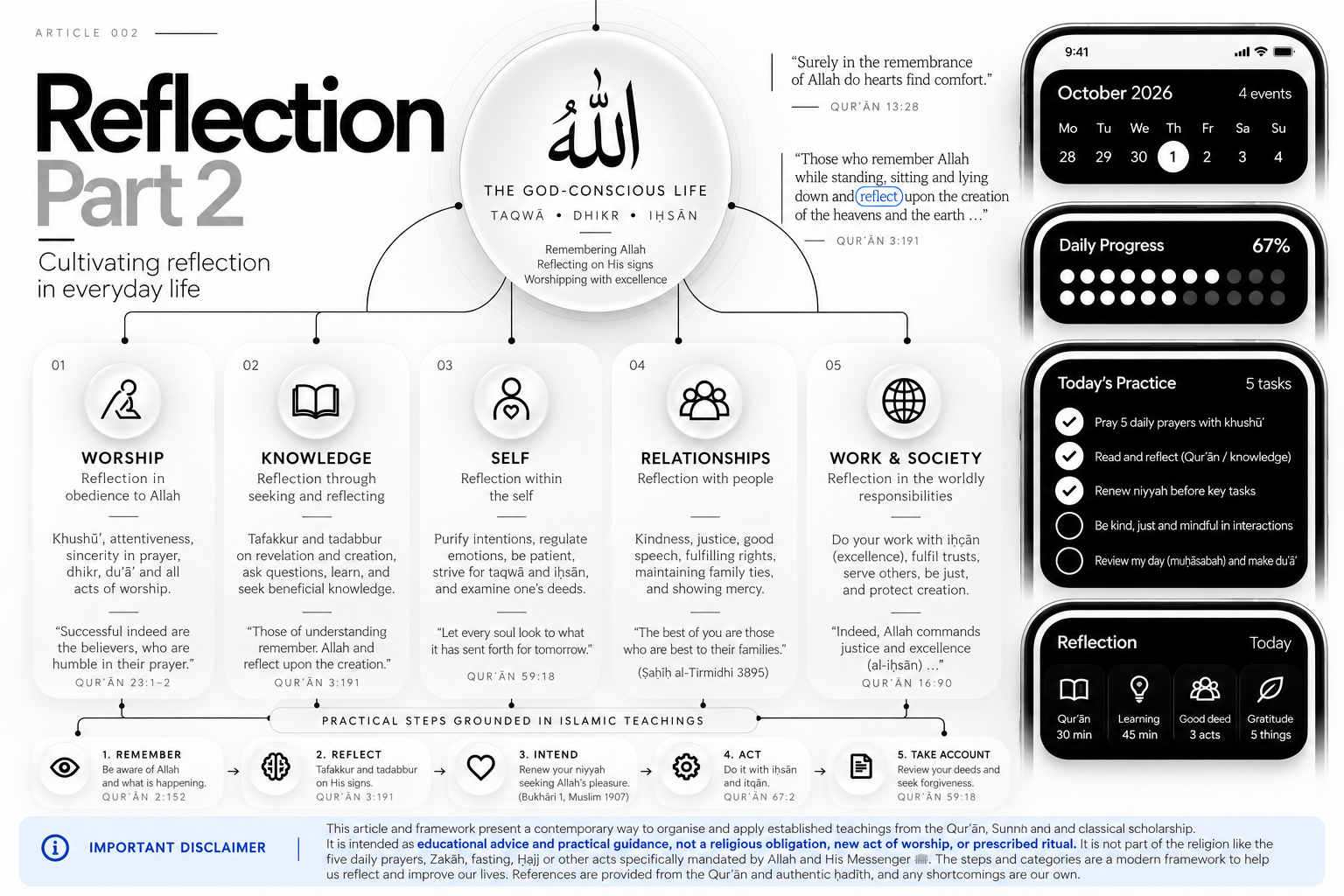
Remember. Reflect. Intend. Act. Take account.
So perhaps we can organise these established principles into a simple practical framework.
Not a new act of worship.
Not a new Sunnah.
Not a claim that the Prophet ﷺ prescribed these five stages in this order.
Simply a contemporary diagram for remembering classical Islamic principles:
Remember.
Begin with Allah.
Reflect.
Look carefully at revelation, creation, circumstances and consequences.
Intend.
Ask why you are about to act.
Act.
Choose justice and iḥsān.
Take account.
Look at what your actions produced—and what you are sending ahead for tomorrow.
Then repeat.
This is not mindfulness as an escape from reality.
It is deeper engagement with reality.
A calmer heart may follow.
Clearer thinking may follow.
Better actions may follow.
But those are consequences, not the centre.
The centre is Allah.
And perhaps genuine reflection begins when, amid all the noise competing for our attention, we recover the ability to notice His signs—and stop long enough to think about what they mean.
Author’s note :-
IMPORTANT DISCLAIMER
This article and its accompanying framework are a contemporary way of organising and applying established teachings drawn from the Qur’an, authentic Sunnah and classical Islamic scholarship. The framework itself is not part of the religion, not an act of worship, not a Sunnah, not a religious obligation, and not a newly prescribed devotional practice. It should be understood only as educational advice and practical guidance for reflection and everyday life.
The five categories and the sequence Remember → Reflect → Intend → Act → Take Account are my own organisational framework. They are not claimed to have been prescribed by Allah or His Messenger ﷺ in this particular form, number, sequence or presentation. No special religious merit, reward, virtue, frequency or obligation is attributed to following this framework.
Islam’s prescribed acts of worship and religious obligations—such as the five daily prayers, Zakāh, fasting in Ramaḍān, Ḥajj for those upon whom it is obligatory, and other matters established by the Qur’an and authentic Sunnah—remain distinct from this framework and are not being supplemented, replaced or modified by it.
The Prophet ﷺ warned against introducing into the religion matters that do not belong to it: “Whoever introduces into this matter of ours that which is not from it, it is rejected.” (Ṣaḥīḥ al-Bukhārī 2697; Ṣaḥīḥ Muslim 1718.) Accordingly, introducing a new belief or devotional practice into Islam and attributing religious prescription to it without evidence is to be rejected; this framework makes no such claim.
The Qur’anic verses, Prophetic teachings and established Islamic concepts discussed here—including dhikr, taqwā, tafakkur, tadabbur, niyyah, iḥsān and self-examination—belong to the Islamic tradition. My arrangement of them into this visual framework does not. It is simply a modern explanatory device intended to help me—and anyone who finds it useful—reflect upon and apply teachings that already exist. Any shortcomings in the framework or its presentation are my own.
Images are generated using AI and are for illustrative purposes only. Minor defects may exist in text such as spelling mistakes, or typography errors – every effort is taken to avoid such, but cannot be guaranteed. Therefore, use these simply to take inspiration and apply it in your own life.
Related Topics