Jewish values, leadership, and honest conversation
On the Eve of 1,000 Days, a Cornerstone
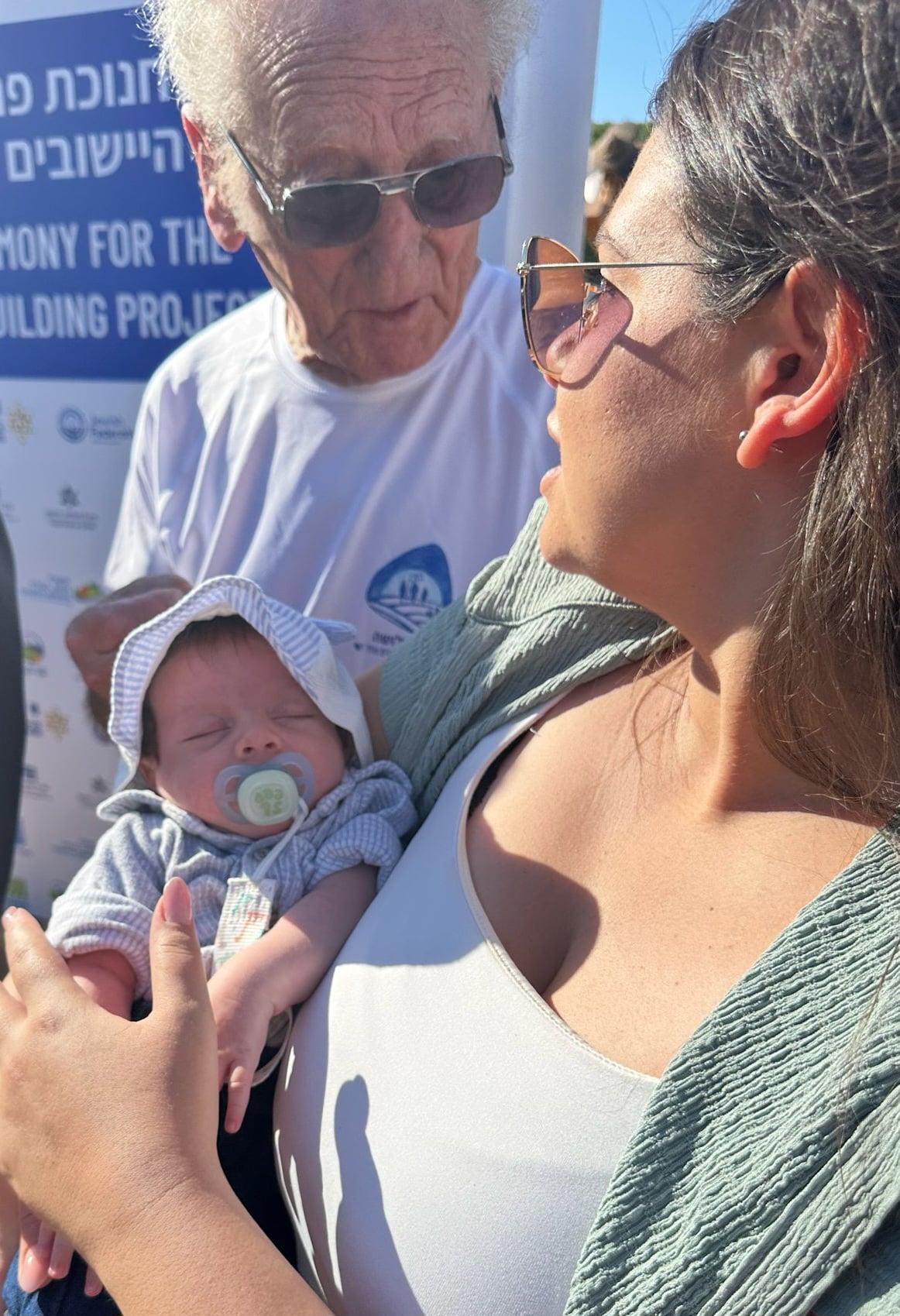
The oldest (in background) and newest members of Kibbutz Ein HaShlosha (Courtesy)
This week I am in Tel Aviv for the Jewish Agency Board of Governors meeting. This afternoon, our delegation visited the Gaza Envelope. I want to tell you what we saw and what I think it means.
But first, let me tell you about Pinchas.
This week’s parasha bears his name. Pinchas is a complicated figure — zealous, polarizing, the kind of person who makes us uncomfortable. But buried inside the portion is a moment that speaks directly to where we stand right now.
After the violence, after the plague, after all of it — God says to Moses: take a census. Count the people. See who is still here. And then: assign them their inheritance in the Land. Not someday. Now. While the wounds are still fresh.
The Torah doesn’t say wait until things settle down. It says: count your people, plan for the future, and claim your portion — now, in the middle of everything.
I read that this week knowing that in four days — on July 3rd — we will mark 1,000 days since October 7.
One thousand days. The number sits in the chest like a stone. One thousand days of war, of grief, of communities shattered and slowly, painstakingly rebuilding. One thousand days of the Jewish people being asked, over and over, to choose the future anyway.
That is exactly what we witnessed this afternoon.
Ein HaShlosha is a kibbutz in the western Negev, deep in the Gaza Envelope. On October 7, approximately 90 militants infiltrated the kibbutz, killing four civilians, looting, shooting, and burning houses. After a five-month evacuation to Eilat, the kibbutz’s 320 residents — including 92 children — returned in March 2024.
The kibbutz was named in memory of three founding members killed in the 1948 War of Independence. It was established by Zionist youth from South America. Named for the fallen. Built by idealists. And still here.
This afternoon, residents and partners gathered for a cornerstone ceremony — the laying of a foundation for new homes. A future being built, four days before the 1,000th day, on ground that terrorists tried to erase.
One resident put it simply: we came back because this is our home. Not because it’s easy. Because it’s ours.
That is what it means to be am Yisrael.
The work of rebuilding in the Gaza Envelope is long, unglamorous, and essential. The Jewish Agency, in partnership with the government and Jewish communities worldwide, is advancing plans to expand housing in communities near the Gaza border and supporting the renewal of the region. Through the Partnership2Gether network, Israeli communities in the North and South have been paired with partners abroad to ensure sustained accompaniment and shared rebuilding efforts.
The Victims of Terror Fund, housed at the Jewish Agency, distributed more assistance in these almost 1000 days than in its entire 21-year history before October 7. Twenty-one years of work — surpassed in almost three. The scale of need has been staggering. So has the response.
At Ein HaShloshah itself, volunteers built a gazebo, an outdoor kitchen, a circle of benches around a fire pit, a greenhouse, and a community garden. At the homecoming celebration, every returning family received a planter box, ready to be filled with soil and flowers.
Soil and flowers. On ground that was burned.
Earlier this week, in my role as chair of the Aliyah and Absorption Committee, I did site visits across Israel — to Beit Brodetsky, where the Kanafayim Wings program supports young adults making aliyah alone and joining the IDF; to Ulpan Etzion; to the Global Aliyah Center in Jerusalem; and to Nof HaGalil, where the Bnei Menashe community is beginning its absorption into Israeli life — a journey home millennia in the making.
In every place, the same thing: people choosing the future. Choosing to build.
A young man at Kanafayim said: I may be a lone soldier, but I have never been alone.
A Bnei Menashe olah who arrived in April dreams of becoming a doctor in Israel. She has carried a Jewish identity across generations and across the world. She is just beginning.
And this afternoon, four days before 1,000, the residents of Ein HaShalosh laid a cornerstone.
Pinchas. Count the people. Assign the inheritance. Build — now.
Rav Nachman of Breslov teaches that the 42 stops in the wilderness were not detours. Each one had a purpose. The journey home happens stop by stop.
One thousand days is a stop. A hard one. A heavy one. But not the last one.
That is what rebuilding looks like. A cornerstone. A new olah. A lone soldier who finds his family. An ulpan classroom. A planter box filled with soil and flowers.
Each stop matters. Each one is part of the journey home.
The Jewish people — in Israel and around the world — are making that journey together. And we are not stopping.
Am Yisrael Chai.
Related Topics