
On the Pitfalls of ‘Anti-Antizionist’ Apologetics
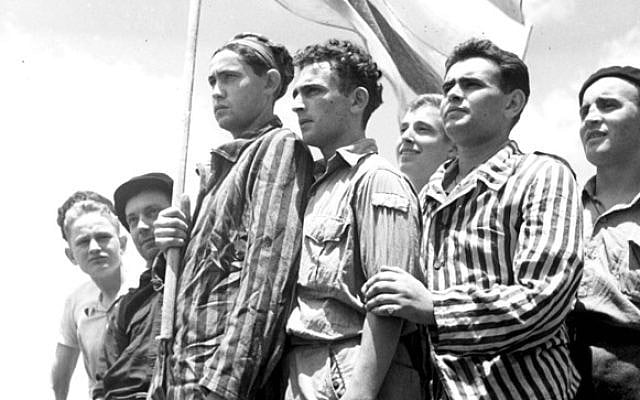
The long-standing debate regarding the significance of the Shoah for the creation of the State of Israel seems to have reemerged with some force since the genocidal massacre perpetrated by Hamas on 7 October 2023, and one would need to be extraordinarily gullible not to attribute this fact to an apologetic desire to meet the increasingly widespread claim that the Arabs in the contested territories are “paying the price” for the Shoah—a claim rendered all the more bizarre by the fact that the Arab leadership that murdered virtually all of its non-rejectionist peers in, and emerged triumphant (on the Arab street) from, the Arab revolt of the late 1930s aligned itself with Nazi Germany and would enthusiastically have implemented the total annihilation of the Yishuv’s population had the Germans given them the opportunity.
As is well known, the Germans had already stationed a skeleton Einsatzgruppe in Athens, ready to jump in and direct the slaughter as soon as the Germans reached the Yishuv. It was taken for granted that the Germans would only need to take care of the logistics since the butchery could be left to Arab forces. Had the British not won the second battle at El Alamein, not only would there be no Israel, there would be not a single Jew living in the territory of the former British mandate. So, if one is going to argue that the Arabs in the contested territories are paying a price for the Shoah, one also needs to acknowledge that they would be paying it for their own forebears’ support of, and intended involvement in, the Shoah, and not for the “sins of the Europeans”. Failure to carry out genocide does not remove one’s responsibility for the intention to do so. In reality, they are, above all, paying the price for the fact that their leadership and its international supporters have repeatedly tried to implement (in the words auf Jean Améry) “Auschwitz II on the Mediterranean” ever since.
There are a number of approaches one can take to the issue of the Shoah’s significance for the creation of the state of Israel. What makes this debate so tricky is the fact that it is difficult to draw a precise line between what one might describe as the measurable impact of the Shoah on relevant material factors, the central decision makers and the actual course of events, on the one hand, and its significance for the legitimacy of the State of Israel, on the other. In the first instance, the core issue seems to be that of agency: did the Jews gain their state through their own effort or was it given to them because of something others did to them? In the second instance, the core issue seems to be: is the State of Israel the fruit of Jewish national aspirations or of international acknowledgment (such as it was and is) that Jews would be foolhardy ever to rely in earnest on anything other than self-defense in the face of potential threats? Both, I would argue, are false, highly ideological alternatives. In both cases, the answer is emphatically: both.
To be sure, there is some room for reasoned disagreement on the relative significance of each factor in both instances, yet the vehemence with which some are keen to privilege the aspect of agency and national aspiration at the exaggerated or almost total expense of external factors is indicative of an agenda that is based on a merely selective reading of the historical record and plays national mythology off against rational argument. (By national mythology I mean the established, carefully crafted, extensively abridged, to varying degrees invented or distorted and gradually canonized sense of national distinctiveness in contrast to a dispassionate account of a nation state’s characteristics and history as it can be established by empirically verifiable means. Some may recall the controversy between Amos Funkenstein and Yosef Yerushalmi on this issue.) This will obviously not trouble those for whom national mythology provides a sufficient and/or the only valid source of legitimacy. Yet there is a strong case to be made that Israel can rely on a set of distinct, unassailable rational arguments to demonstrate the need for its existence, and that these ultimately form a more effective means of defense than any national mythology. Relying on national mythology, after all, is something Israel has in common not only with all other nation states but also with all the groups with national aspirations who do not, cannot and/or, for various reasons, should not have their own nation state.
One might have thought that the following would constitute more or less common ground, controversy extending only to specific emphases and nuances rather than the big picture. On the one hand, the creation of the State of Israel in 1948 would not have been a realistic prospect, had the Yishuv not already existed and put in place the population, infrastructure and military capabilities required to establish and defend the state. The existence of the (new) Yishuv, in turn, was the product of national aspirations (putting it simplistically: pull) and the need for a secure homeland (push). Within the world order as it is constituted, states need to be nation states (at least notionally) and, as one historian put it rather cleverly in the Ukrainian context: any nation state that has a future will also have a past; in other words, nation states cannot exist without some kind of national mythology.
On the other hand, what Jeffrey Herf has called “Israel’s Moment” would have been inconceivable without the pressures, both material and immaterial, created by the Shoah, from the totally unprecedented Jewish refugee crisis to a widely shared—in part genuine, in part grudging, in part feigned—sense of moral commitment, guilt and shame. Nor was a consensus reached within the Zionist movement itself that only a sovereign nation state would genuinely offer a safe homeland until news of the unfolding Shoah convinced even the most idealistic cultural Zionist that spiritual centers do not save lives. Nor, for that matter, was the demise of Autonomism owed to Zionism winning the argument (except in the most cynical sense of the word), it was simply a fait accompli resulting from the physical annihilation of the populations to whom it had, in part, applied in the interwar period and was, ideally, supposed to apply in future.
To my mind, it seems highly improbable that the UN would have agreed on the partition plan in 1947 had it not been for the Shoah (although, as I have already stated, neither would this have been a plausible decision, had the Yishuv not already existed). From this assumption follow a host of interconnected questions, the first and most crucial being: would Czechoslovakia have supplied Israel with arms as readily or at all? If not, would Israel have been able to win the War of Independence? I think it is clear how very different the situation and how much weaker and potentially untenable the Yishuv’s status and future might well have been, had the Shoah not created weighty facts and placed specific pressures on crucial decision makers that could barely be managed in any other way.
As I have already indicated, it seems to me that the vehemence with which the assertion of Jewish (national) agency over external factors has recently resurfaced exceeds the grounds for reasoned controversy on the matter itself, and it is difficult not to be reminded of one of the sadder chapters in the history of Israeli public discourse in the first decades after the Shoah that saw widespread denigration of the victims of the Shoah and implicit (and occasionally explicit) victim blaming based on the reasoning that diaspora Jews had only themselves to blame if they suffered repression or worse. As is well known, Yad Vashem was initially focused almost entirely on heroism to the exclusion of suffering, rendering a totally distorted representation of the Shoah, as though resistance had been the norm and inescapable death the exception. (As the late Yehuda Bauer emphasized, given the objective conditions, the fact that there was any resistance at all borders on the miraculous.)
Israel has every reason to be proud of the fact that it offered refuge to large numbers of survivors and that they and their descendants have been able to thrive in the Jewish state. Israel has every reason to insist that Jews cannot be expected to rely on anyone else to defend them if push comes to shove. This is a fact of life that owes its unassailable status fundamentally to the historical experience of the Shoah. This source of legitimacy is eliminated if one dismisses the significance of the Shoah for Israel’s existence and mission and insists that it is a nation state like any other whose right to exist is simply a reflection of the supposedly universal right to national self-determination. Why, then, should Israel’s entitlement to exercise this right not be negotiable, given that it is granted/defended so selectively elsewhere, and so many others are refused the opportunity of exercising this right? All over the planet, populations live in territories their descendants have inhabited for sometimes substantially shorter stretches of time than Arabs have lived and, indeed, controlled, the territory of the current State of Israel. Nor, of course, were the Israelites the first to inhabit this territory. Bringing God into the equation is no help either, because this conjuring trick is equally available to all religions and denominations. In the end, one is left with no more than the contingent argument that the Jews were able to assert their claim because their military prowess outstripped that of others staking a claim to the same territory—which sounds a whole lot like one of the standard antizionist denunciations of Israel, now bizarrely propagated in the name of anti-antizionism.
This renewed apologetic discourse is all the more troubling in light of the fact that it transpires in a global context pervaded by innumerable attempts of various kinds to relativize, minimize, distort and essentially neutralize the Shoah. Pretty much everyone has for quite some time now been sick and tired of having to pretend that the historical experience of the Shoah makes it seem wise to insist on certain constraints to avoid the perpetration of similarly exceptional barbaric crimes in future. In some respects, this has led to something of a reversal of fortunes: the forces most intent on bringing about a great deal of fundamental change—the left and the anti-authoritarian far right—are, for obvious reasons, most irked by the call for constraints, while it least affects, and to some extent quite suits, the conservative right. Secondary and Israel-related antisemitism are in large part inextricably linked and routinely reinforce each other. Whatever the momentary apologetic gains of playing along to this agenda by trying to detach the legitimacy of Israel from the Shoah may seem to be, in the medium and long term, this move can only further embolden antisemitism and undermine the standing and security of both Israel and diaspora Jewry.
In the meantime, one arrives at the immediate rub when one reads various mutually sympathizing strands of recent discourse in conjunction. On the one hand, those accused of overestimating the significance of the Shoah for the creation of the State of Israel, indeed, even those who would argue merely that it was one genuinely significant factor, are classified as “soft antizionists”. On the other hand, we are told that antisemitism has been displaced by antizionism (see my earlier post “All Eyes on Antizionism?”) If one follows this line of reasoning, anyone who would credit the Shoah with a significant role in the creation of the State of Israel would be what most sensible people would call antisemitic. Hopefully, this nonsense—which offers a highly illustrative example of the damage done when people succumb to the fallacy that identity politics could ever do anything other than wreak havoc on the struggle against antisemitism—doesn’t catch on. If it does, regardless of my unconditional commitment to the need for Israel to exist as a Jewish state in secure borders the IDF is realistically capable of defending, I guess I’ll soon achieve what most of us always thought was impossible by becoming—the world’s first (by conventional standards) genuinely non-antisemitic antizionist!