
On the Train, or On the Tracks?
Editors note: The pace of developments in artificial intelligence over the past few weeks has been impossible to ignore. The conversation has shifted from speculative to immediate, and I felt compelled to address what may be the most consequential technological inflection point of our lifetimes.
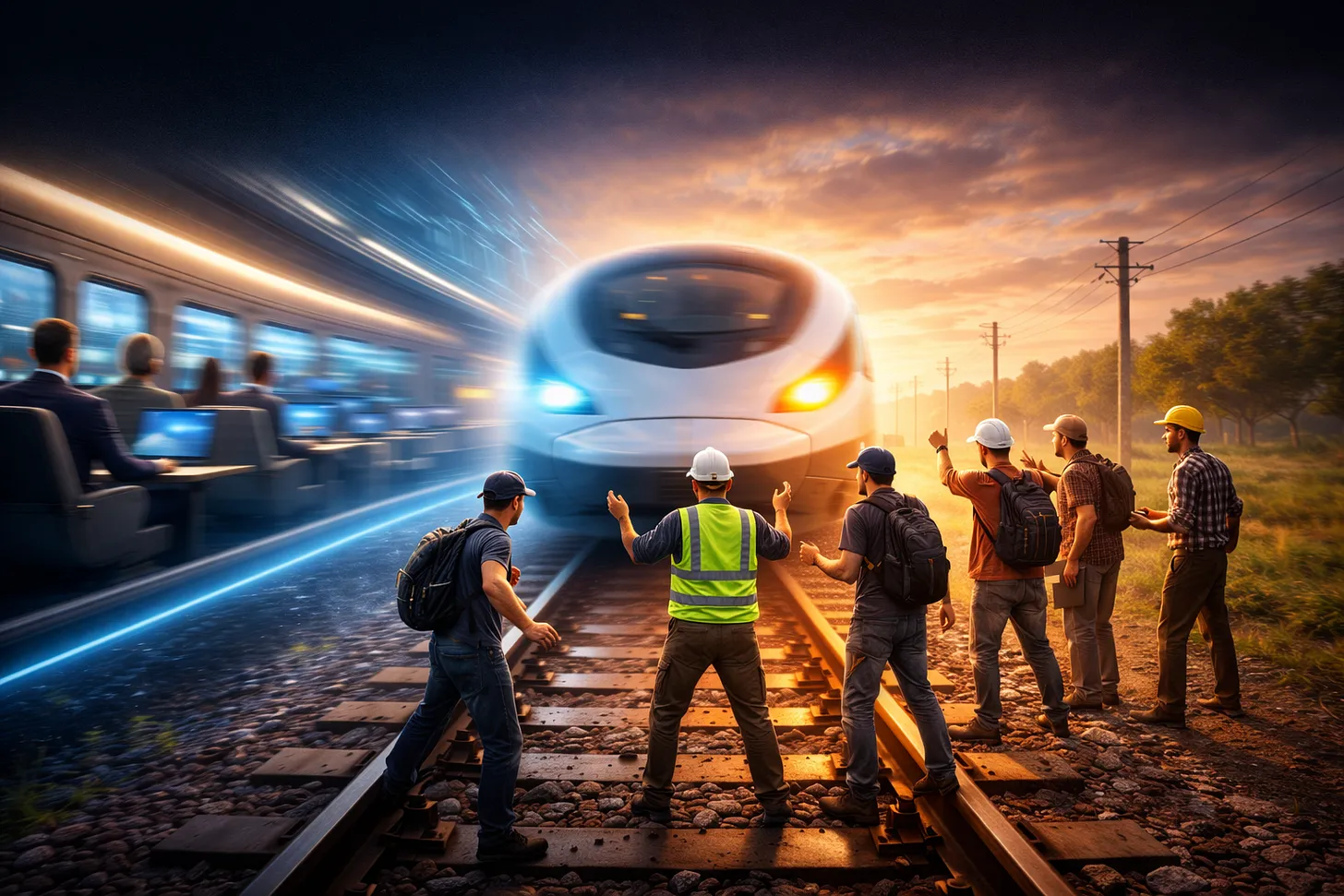
The Artificial intelligence train is accelerating. The question is whether we plan to bring the people on board with it or not.
For most of my professional life, I thought I was in the technology consulting business. In hindsight, I was in the disruption business.
I helped global companies rip out financial and supply chain systems and replace them with integrated enterprise platforms. On Powerpoint slides, these were described in consulting speak as “modernization initiatives” or “transformational changes”. In reality, they were controlled detonations.
When you replace a company’s core systems, you are not simply changing software. You are changing how thousands of people do their jobs every single day. Workflows shift. Authority structures change. Reporting lines are redrawn. Routines and muscle memory are disrupted. Most importantly, trust is unsettled.
Over time, I learned a lesson that now feels eerily relevant. The greatest risk in those projects was almost never technical. It was human.
The most successful implementation of my career was the largest Oracle payroll rollout ever attempted by a Fortune 500 retailer. It worked not because the code was flawless, but because leadership invested heavily in change management. They funded training. They hired dedicated specialists. They communicated relentlessly. They treated employees like adults navigating real disruption. They understood that when you change payroll, you are not changing math. You are changing trust.
On the other end of the spectrum, I was helping a printed circuit board manufacturer replace its entire enterprise system. The CFO proudly shared his philosophy of change management. “Either you are on the train,” he said, “or you are on the tracks.”
At first, I thought he was talking about me. He was not. He was referring to his employees and his approach to preparing them for the disruption ahead.
It sounded decisive. Tough. Efficient. But it was a warning sign. That project struggled not because the software failed, but because fear is not a change management strategy.
Which brings us to AI, artificial intelligence.
We are in the early stages of the largest cognitive systems implementation project in human history, and we are approaching it as if it were simply another app to download to your mobile phone.
Every layer of society will be touched. Work. Education. Healthcare. Transportation. Media. Entertainment. Even how we relate to one another. The scale of change will be breathtaking. And the speed may be overwhelming.
I love technology. I built a career helping organizations adopt it.
But this moment feels different.
A recent viral essay by venture capitalist and AI founder Matt Shumer compared the current moment to February 2020, when early warnings about a global pandemic felt exaggerated. His point was straightforward. Inside the technology sector, the disruption is already underway.
Engineers are watching AI systems move from helpful assistants to autonomous contributors. The latest versions of ChatGPT and Claude now write production ready code, draft legal briefs, generate financial models, analyze data, and complete complex cognitive tasks with minimal oversight. These systems are even contributing to their own regeneration and leading the development of the next generation of AI.
Meanwhile, Mustafa Suleyman, who leads Microsoft’s AI division, has suggested that a significant portion of white collar work could be automated within twelve to eighteen months. Whether or not the most aggressive timelines prove accurate, one reality is clear. Capability is compounding faster than our institutions are adapting.
Every major technological wave displaced labor. The steam engine replaced muscle. Electricity reorganized industry. The internet transformed information and distribution.
Artificial intelligence targets cognition itself.
The internet age is the closest comparison in our lifetime. It eliminated entire industries and rewired others. Travel agents disappeared. Retail hollowed out. Classified advertising collapsed. Newsrooms shrank. New jobs emerged in software, logistics, digital marketing, and data analytics, but the transition was uneven and destabilizing. Communities built around manufacturing and brick and mortar retail were left scrambling. Policymakers largely assumed that markets would absorb the shock.
There was no national transition authority for the internet era. No coordinated retraining strategy scaled to the disruption. We relied on community colleges, private initiative, and economic churn. It eventually produced extraordinary wealth and innovation. It also produced dislocation, geographic inequality, and political backlash that we are still living with today.
Artificial intelligence is moving faster than the early internet and touching more sectors simultaneously. If we struggled to manage the social consequences of e-commerce and search engines, we should be clear-eyed about what cognitive automation may bring.
Law, finance, consulting, accounting, marketing, journalism, software development, and medicine are directly exposed. Entry level white collar roles are particularly vulnerable. These positions are not merely income streams. They are training grounds where young professionals build judgment, experience, and credibility. If AI performs the research, the modeling, and the drafting, where do future leaders build expertise? You cannot remove the bottom rungs of the ladder and assume the top remains stable.
Unlike past revolutions that unfolded over decades, this one is compressed. Improvements are measured in quarters, not generations. Markets move instantly. Institutions move slowly. Humans adapt slower still.
That mismatch is combustible.
Technology companies are not designed to manage societal transition. They are designed to build. Their incentives are clear. Ship faster. Scale faster. Grow users. Increase enterprise penetration. Satisfy shareholders. Public companies optimize for growth. Venture backed firms optimize for scale. Engineers optimize for capability.
None of those incentive systems include societal pacing or large scale change management. Companies such as OpenAI, Anthropic, Microsoft, and Google are doing what they were built to do. They are building powerful tools. That is not an indictment. It is a structural reality.
But if even a fraction of projected displacement materializes, individual adaptation will not be enough. This will not be a self help problem. It will be a labor market shock.
In corporate life, when leadership underfunded change management, projects failed. You mapped stakeholders. You trained managers. You invested in communication. You hired specialists whose sole job was preparing humans for change.
Now scale that to entire industries, not just in the United States but globally.
Where is the coordinated transition strategy?
A Call for Change Management at Scale
If we are serious about balancing high tech with high touch, a phrase coined decades ago by the late futurist John Naisbitt, we need institutional architecture scaled to the technology itself.
Congress should establish a national AI Transition Authority, a public private entity focused exclusively on workforce preparation, retraining, and economic stabilization in response to AI driven disruption.
Its funding model should reflect the source of the disruption. Government sponsored. Privately funded. The largest AI developers and primary beneficiaries would contribute a modest percentage of AI related revenue into a transition fund. Not as punishment. As infrastructure.
Those funds would support large scale retraining programs aligned with AI augmented industries, rapid credentialing pathways, partnerships with universities and community colleges, and real time labor market monitoring to anticipate displacement before it cascades.
Artificial intelligence is becoming systemic infrastructure. Systemic infrastructure requires systemic guardrails.
Years ago, that CFO told me, “Either you are on the train, or you are on the track.”
You can run an organization that way for a while. You can push through resistance. You can demand compliance. But people may stay on the train without staying engaged. They do not stay loyal. They certainly do not stay innovative. And they do not stay long.
Artificial intelligence is not a system upgrade inside a single company. It is a systemic upgrade across society. If our approach to managing this transition amounts to “get on board or get run over,” we should not be surprised by the consequences.
High tech without high touch does not produce resilience. It produces fracture. Technology projects fail for human reasons. Civilizations do too.
The train is leaving the station.
The question is whether we intend to bring the people on board with it.