Grammy and Emmy nominated singer-songwriter, author, essayist
‘On War, War’s End, and New Visions: If Not Now, When?’ (essay in two parts)
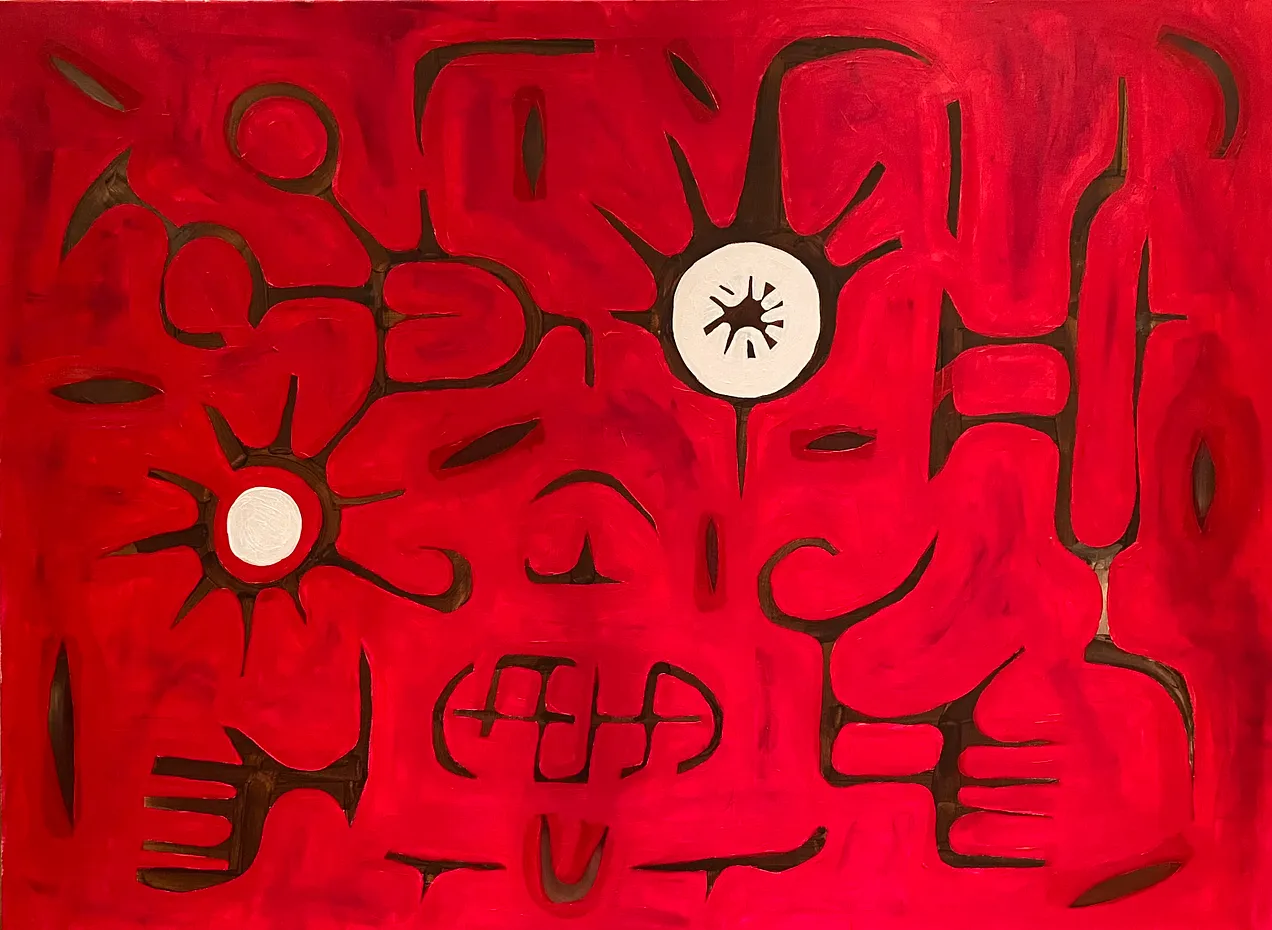
“Hieroglyphs In A Sea Of Red” painting by the author
A friend says I’m too focused on Israel.
He’s probably right.
I am focused. Whether it’s “too” focused is subjective. But to be clear, I’m not only concerned with a nation state—or allegiance to its government, flag, or a sliver of land on a map. My primary focus is on the seven million Jews who live there, in Israel; the largest concentration of Jews in the world. They are a people that, after the shedding of their blood on 10/7/23—when more than 1,200 Jews were murdered in the worst pogrom since the Holocaust—has had to face not only that, but a world that has turned against them, and more broadly, against the Jews at large.
Try to feel this as I did.
Mitchell, a friend of mine—a young, and gifted writer—recently got an email from his literary agent. The agent isn’t Jewish, which in this context, matters. The note said, rather tersely:
“Mitch, the writing’s beautiful. But maybe you haven’t heard, publishers aren’t looking kindly at Jewish authors of late. Unless you can weave in something praiseworthy about Gaza and critical of Israel, I won’t be able to get anyone to look at your book.”
Mitchell, much like me, wouldn’t brook the insult. He replied, telling the agent his services were no longer needed.
Over the last several months, I’ve been working on a new book. It’s profoundly, unabashedly Jewish. And somewhere in the background, I can hear a cynical voice—maybe even that same agent—saying: Haven’t we had quite enough of Jewish writers.
Uh huh. Right.
From Moses to King David.
From Solomon the Wise to Isaiah and Ezekiel.
From Isaac Babel to Philip Roth to Saul Bellow.
From Joseph Epstein to David Mamet.
To…
Who needs more Jewish voices?
I do.
You do.
We all do.
In these grim and frightening days, people write to me:
“I’m scared. What do I say to people who don’t understand why Israel is defending itself? What do we do in this situation?”
“Don’t fear,” I tell them. “Stay strong. Say what you feel. Speak of your love for the Jewish people and for Israel. Make it known—without anger, and without embarrassment.”
Then, I offer something more: Return, at your own pace, to the practices that have kept us alive, intact, and deeply human for 3,300 years. Shabbat. Kashrut. Prayer. Torah Study. Tzedakah. Tefillin. Mikvah. Actions that often make no rational sense—and are therefore, the perfect antidote to a hatred that also has no rational basis.
Other messages come with a darker tone:
“Why are you only concerned with Jews?”
I chose to write back.
“Dear N.,
That is a distortion of who I am and how I live. I’ve worked with under-resourced kids in Chicago’s South Side. I’ve mentored young Hispanic entrepreneurs. I’ve taught the art of songwriting to dozens of kids from all walks of life. I’ve worked for years with wounded American veterans and their families —and continue to do so. What do you know about me?”
One message made it difficult to keep my composure.
Have you ever stopped to think that maybe what Hamas did was justified?”
“Dear R.,” I wrote.
“Not for one millisecond.
Barely a month after 10/7, I watched the 47-minute film of Hamas’s atrocities. No, they were not justified. Not by any stretch of any moral person’s imagination.”
There are those who say I’m mired in antiquated fantasies of ancestral homelands and a sense of belonging that doesn’t bow to the false ethos of “I love everyone equally!”
I love everyone equally… That’s something I once heard from a well-known actress over coffee in the days after 10/7 —as if she loves her neighbors daughter the same way she loves her own! I’ve heard that I’m alarmist. Out of touch with reality. Become a monster.
“Peter, I miss the old you, who sang about love and didn’t hold genocidal beliefs.”
“The old you…”
I’ve been going against the grain most of my life. And I’m doing it again—even, and especially, in the face of contempt, mockery, and performative concern.” These outcries against the world’s only Jewish state have no purity, no veracity.
How do I know?
Because there has been no outcry for the Sudanese—slaughtered in Darfur and starved in refugee camps. Not for the Uyghurs—imprisoned, surveilled, and sterilized in Chinese re-education camps. Not for the Iranians—jailed and beaten for daring to sing, or dance, or remove their hijabs. Not for the Congolese—children forced to mine cobalt for the batteries that power our phones and cars.
But against the Jews? Suddenly the moral conscience awakens.
I live by something the Lubavitcher Rebbe—one of my greatest mentors, along with my father—once said: When your family is in danger, you don’t ask questions. In other words, you act—with decisiveness, and with moral clarity.
I get it. It’s hard to face this onslaught every day. It’s painful to feel the hatred and not look away. It’s exhausting to make the case, again and again, while still trying to hold space for others’s hardships. It’s hard not to collapse into a simplistic, self-satisfying righteous indignation. And that’s precisely when we must resist the collapse—not by minimizing anyone’s suffering, but by expanding our own hearts. By refusing to let them calcify.
To recognize that wars “must” end.
And to deliberate as to how they “should” end.
With Israel, there always seems to be a stoppage required of them—a forced surrender, an imposed ceasefire that allows sworn enemies like Hamas to regroup and rearm. And yet, evil must be defeated—just as it was with the Nazis and their supporters in Germany.
There is morality in ending a war.
And there is morality in not ending one—
when your enemies are still standing,
when your people are still held
in dungeons underground—
starved, raped,
and in many instances: dead.
When your enemies
are still capable of torture,
still committed to your destruction.
So I return, again and again, to this tragic thought:
Perhaps wars between Am Yisrael—the Jewish people—and those who seek our annihilation can only be described as “intractable.”
Intractable problems. Unsolvable issues.
At least for now.
Unless… there comes a cosmic shift. A spiritual updraft. A change that carries humanity beyond where it has been, to a place that is categorically different from any we’ve experienced before..
Let me show you what I mean.
PART TWO
(Lights Down. Curtain Opens)
Months ago, I asked my cousin—my dear friend and brilliant keyboardist, Jeff Victor—to fly to L.A. to play a gig with me. As musicians, he and I regularly speak about undefinable things. One of them is the Messiah: A human being who says something, maybe sings something, maybe dances a jig, or hop-scotches in such a way as to change the way we see reality. Who knows how it works?
EXTERIOR
On the way to shul, while crossing Santa Monica boulevard on an overcast mid-morning, Jeff and Peter are engaged in deep discussion about the nature of reality—what we’ll be serving for lunch—and the arrival of the Messiah.
Peter: Ok, let’s do something fun and weird. What would it feel like if the Messiah had come, say, like yesterday morning? Tell me how you’d be feeling.
Jeff: Wow. Um… Well, there would be no great change in the surroundings. The cars would be rolling past — and by the way, shouldn’t we be doing this on the sidewalk?
Peter: Oh yeah, you’re right. Keep going.
Jeff: So, there’d be no more wars, everything would be peaceful…
Peter: Sorry, I’ve gotta cut you off. Those aren’t feelings. You’re just telling me what’s happening. I need to know what your emotional state is.
Jeff: I don’t know… I guess, I’d look around and know that everything was just better, that the world had arrived at certain point, a point of perfection.
Peter: Nope. Don’t mean to be an asshole, but you’re not getting what I mean.
Jeff: No. Not really.
Peter: No worries. Let me show you.
Peter, still in the street gazes at Jeff, intimately. Seriously. He stares at him, looks at Jeff’s eyes. He breathes in. Smiles. And then, as cars and people pass by — right in the midst of a normal Saturday morning, joyous tears flow from his eyes. It’s a funny thing to do, it’s actorly —and he knows it. But really, it’s not really…
Peter: I love you Jeff. My love for you is unconstrained. I feel our connection in a real and visceral way. I am feeling everything now.
Peter looks at the sky. Nothing has changed, and yet everything, from the cigarette butts on the street to the seagulls soaring toward the bay, are no longer things that can be taken for granted. They have become, what in their essence, they have always been: Projections of the Thoughts the Constant Creator.
Peter laughs, as does Jeff. Jeff gets it. The two walk toward the shul, which is less than a block away.
(Lights Up. Curtain Widens)
The Messiah, ‘Moshiach’ in Hebrew, a major, if largely under-recognized tenant of the Jewish faith removes the sleep from our eyes. Nothing new happens, not at first. The world is still the same. Saltshakers haven’t turned into seraphs; No trees have torn their roots from the ground and soared heavenward. Nothing like that.
All this person does is help us see what’s already here.
We don’t see new things.
We see the old things for what they are.
And when we see in that way—when we truly see—
Who would want to kill?
Who would rape, or steal?
Who would look at another human being and not feel kinship?
When even coffee grounds become sacred,
Who would not share?
Who would cling to arrogance, or cruelty?
Who, under such circumstances, would not dance for joy at the slightest thing?
This isn’t unreachable.
This isn’t utopian fantasy.
This—
All of this—
Is within our grasp.
Even now.
As Rabbi Hillel said: If not now, when?
Related Topics
Related Posts