
In defense of Liberty and Individual Rights - Writer and Speaker
One does not negotiate with evil. One defeats it!
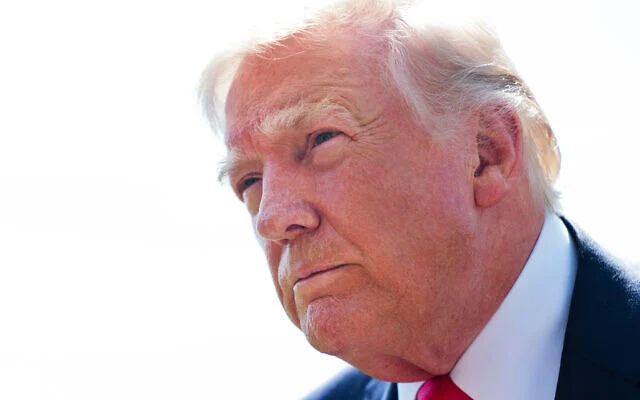
US President Donald Trump speaks with reporters before departing on Marine One from the South Lawn of the White House, Thursday, April 16, 2026, in Washington. (AP/Manuel Balce Ceneta)
The Ceasefire That Saved the Ayatollahs: How Trump, Hegseth, and the Pentagon Turned a Civilizational Victory Into a 21-Mile Strait War
One does not negotiate with evil. One defeats it.
This is not a slogan. It is the first principle of any foreign policy that takes reality seriously. Forty-six years of American diplomacy with the Islamic Republic of Iran — through Carter, Reagan, Bush, Clinton, Bush, Obama, Trump I, Biden, and now Trump II — have produced exactly one consistent result: the regime is stronger, richer, more murderous, and closer to nuclear weapons than the day it seized the American embassy in 1979. Every “deal,” every “framework,” every “off-ramp” has served the same function — to grant the ayatollahs the time they needed to survive, rearm, and kill more Jews, more Iranians, more Americans, more civilization.
On June 13, 2025, Israel broke that pattern. Operation Rising Lion did in twelve hours what American policy had refused to do in four decades. Israeli aircraft, Mossad operatives, and covert drone bases inside Iran itself blinded the air defense network, killed Hossein Salami and Mohammed Bagheri and the top IRGC command, eliminated fifteen senior nuclear scientists, crippled Natanz and Isfahan, and established air supremacy over Tehran. The regime that arms Hamas, funds Hezbollah, launches Houthi missiles at global shipping, tortures its own women for uncovered hair, and hangs homosexuals from cranes in public squares stood, for the first time in its existence, strategically naked.
Eleven days later, Donald Trump saved it.
The ceasefire that betrayed civilization
On June 24, 2025, with Israeli pilots operating freely over Iranian airspace, with ballistic missile launchers being hunted and destroyed in real time, with the regime’s command and control shattered and its population watching its tyrants die on live television, Trump announced a ceasefire. He called it an “Official END to THE 12 DAY WAR” on Truth Social. He declared victory. He went home. And he left the ayatollahs alive.
This was not statesmanship. It was the single greatest strategic capitulation of the twenty-first century — and it was committed in the name of a “deal” with a regime whose founding doctrine demands the destruction of the United States and Israel.
One does not make deals with evil. One does not negotiate with men who hang teenage girls for removing their hijabs. One does not seek “off-ramps” with regimes that have spent forty years chanting “Death to America” in their parliament and meaning it. One does not trade concessions with theocrats who believe their legitimacy flows from the twelfth Imam and their strategic patience from the promise of apocalypse. These are not negotiating partners. They are the problem to be solved.
The window Trump closed
Wars of civilizational consequence are not won by bunker-buster bombs on Fordo. They are won by regime collapse. In June 2025, every precondition for that collapse was assembled and handed to the United States on a platter Israel had prepared at enormous cost. Air defenses: neutralized. Leadership: decapitated. Nuclear infrastructure: crippled. Iranian civilian morale: openly questioning the regime. Axis of Resistance: dismembered — Hezbollah decapitated the previous autumn, Assad fallen in December 2024, Hamas reduced to remnants in Gaza.
The correct American move required no boots on the ground, no occupation, no nation-building — the empty words the Pentagon always hides behind to justify doing nothing. It required one decision: close the Strait of Hormuz to Iranian oil exports. Board the tankers. Sink the IRGC Navy’s speedboats. Strangle the regime’s last source of revenue while Israel finished dismantling its last source of violence. Let the Iranian people, whose courage has been evident in every protest since 2009, complete the liberation of their own country — from the Tigris to the Caspian to the Arabian Sea — that the mullahs have held hostage since 1979.
Trump did the opposite. He pressured Israel before the war not to strike at all, hoping for a “deal” with men whose theology commands him dead. He hesitated during the war — “I may do it, I may not do it, nobody knows what I’m going to do” — like a reality-television host playing at statecraft while Israeli pilots risked their lives over hostile airspace. And when he finally committed American bombers to Fordo, he used them as a finale rather than an opening act, declared the job done, and imposed a ceasefire while the enemy still breathed.
Hegseth and the generals
Pete Hegseth, the Secretary of Defense who came into office promising to purge the “woke generals” and restore lethal purpose to the Pentagon, presided over the most strategically incoherent American performance since the Afghanistan withdrawal. For all the bluster about restoring warrior ethos, the institutional Pentagon — CENTCOM, the Joint Chiefs, the intelligence bureaucracy — delivered the same product it has delivered for thirty years: tactical competence in the service of strategic surrender.
The generals behind Operation Midnight Hammer were not wrong about how to hit a target. They were wrong about what victory means. They treated the campaign as a nonproliferation operation rather than a regime-termination operation. They treated Iran’s oil exports — the regime’s financial bloodline — as untouchable because an oil-price spike might cost a few points of GDP. They measured success in centrifuges destroyed rather than in tyrants toppled. They gave Trump the menu of options that told him what he wanted to hear: quick strike, declared victory, dinner at Mar-a-Lago by Tuesday.
Not one of them resigned when the ceasefire was announced. Not one of them told the President that leaving Khamenei alive and the oil flowing was strategic malpractice. Not one of them reminded the Commander in Chief that deals with evil are not peace — they are the installment plan on the next war.
The bill, paid in American and Emirati and Bahraini blood
Eight months later, the installment came due. On February 28, 2026, the United States and Israel launched Operation Epic Fury — nearly 900 strikes in the first twelve hours, a campaign that is still ongoing as this is written in April 2026, with the IDF telling reporters they have “thousands of targets ahead.” And this time Iran, given eight months to reconstitute, did not limit its retaliation to Israeli territory. It reached out and struck every American position in the region.
Al Udeid Air Base in Qatar — the forward headquarters of United States Central Command itself, the nerve center of every American military operation from the Levant to Afghanistan — was hit by an Iranian missile. Al Dhafra Air Base in the United Arab Emirates, home to US Air Force and Army assets, was struck. The UAE as a whole absorbed over five hundred ballistic missiles, twenty-six cruise missiles, and more than two thousand drones — the “main target” of Iran’s retaliation campaign, according to the US embassy in Abu Dhabi. The Fifth Fleet headquarters in Bahrain, home to 8,300 American sailors and their families, took extensive damage across multiple days of missile and drone barrages. Ali al-Salem Air Base in Kuwait came under ballistic missile attack. Iran even reached Diego Garcia, the joint US–UK base in the Indian Ocean six thousand kilometers from Iranian territory, in a strike that failed only because British air defenses and distance worked in America’s favor.
Thirteen American service members are dead. One hundred and forty are wounded. A KC-135 tanker crew of six was killed over western Iraq. The Bahraini and Emirati and Kuwaiti and Qatari allies who host American forces have buried their own civilians killed by Iranian missiles and drones aimed at American bases. Brent crude trades above $109 a barrel. Global shipping has been rerouted around the Cape of Good Hope. The Strait of Hormuz — the 21-mile waterway that Trump refused to seize in 2025 because it was “too risky” — is now selectively blockaded by Iran itself, the largest oil supply disruption in history.
Every single one of these casualties, every dollar of damage, every day of global disruption is the direct, foreseeable, and foreseen cost of the June 24, 2025 ceasefire. The regime Trump spared in June had eight months to replace its leadership, rebuild its missile launchers, disperse its enriched uranium, coordinate with Russia and China on replenishment, prepare its proxy networks, and plan the exact retaliation it is now conducting against American service members. Khamenei, who could have been killed in June 2025 in a strike against a decapitated regime, had to be killed in February 2026 in an operation that cost American lives. Iranian sailors in IRGC speedboats, who could have been sunk in Hormuz before firing a shot, are now firing on tankers.
The lesson, one more time
One does not make deals with evil. One defeats it. The United States had an opportunity in the summer of 2025 — an opportunity purchased by Israeli courage and Israeli blood — to end the Islamic Republic and liberate ninety million Iranians from the tyranny that has held them since before most of them were born. Trump had the option. Hegseth had the option. The generals had the option.
They chose the ceasefire. They chose the deal. They chose the fantasy that evil can be managed, contained, negotiated with, deterred. And they left the finishing of the job to a second war now being fought at ten times the cost — in Emirati skyscrapers, in Bahraini apartment buildings, in Qatari airbases, in American coffins, in global oil markets, and in the continued existence of a regime that, even now, Washington is reportedly considering another “deal” with.
History will not be kind to them. It should not be.
Related Topics
Related Posts