
CEO of Time to Stand Up for Israel
One God, Three Faiths and Very Different Paths
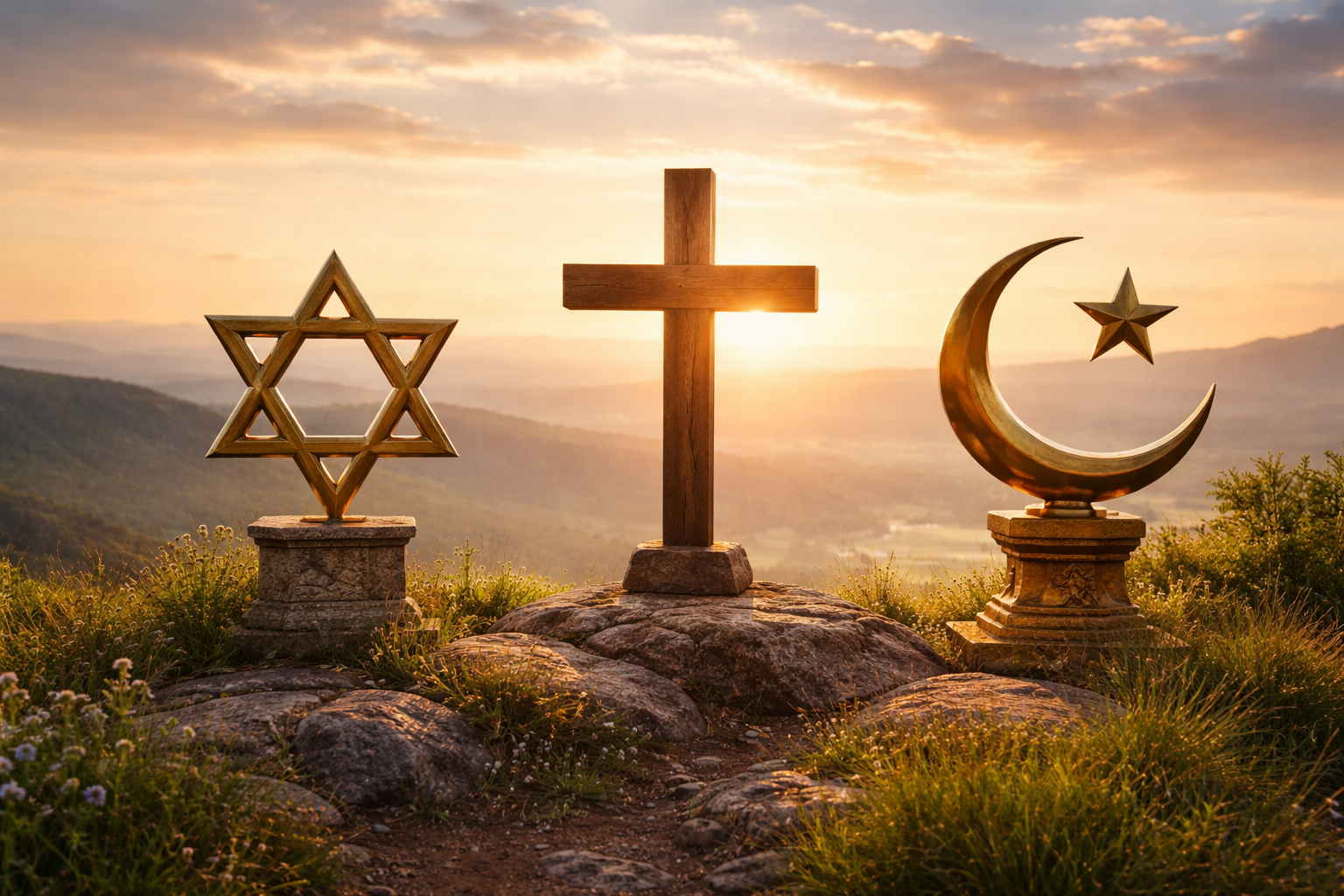
Photo Credits: Sabine Sterk(AI)
The world often speaks about Judaism, Christianity, and Islam as if they were interchangeable, three “Abrahamic religions” sharing the same moral core. While they indeed share roots, scriptures, and historical figures, their theology, political ambitions, historical development, and relationship to power and violence differ profoundly. Understanding these differences is essential, especially when Israel and the Jewish people are constantly judged through distorted moral lenses.
This is not an attack on believers. It is an honest examination of ideas, history, and outcomes.
Common Roots, Different Beginnings
All three faiths trace their spiritual ancestry to Abraham and believe in one God. Yet their origins set them on very different trajectories.
- Judaism began around 1800–1300 BCE, emerging as a covenantal faith between God and a specific people. It is the oldest of the three.
- Christianity emerged in the 1st century CE, growing out of Judaism, centered on the life and teachings of Jesus.
- Islam arose much later, in the 7th century CE, through the revelations claimed by Muhammad in Arabia.
The timeline matters. Judaism developed without imperial power. Christianity spread initially under persecution. Islam, however, emerged already intertwined with political and military authority.
Faith and Power: A Crucial Divide
Judaism: Law, Survival, and Self-Restraint
Judaism is not a missionary religion. It does not seek to conquer, convert, or dominate others. Jewish law (Halacha) governs Jewish life, not the world.
Key principles include:
- The sanctity of life
- Extreme restrictions on warfare
- Moral accountability even in self-defense
Judaism never sought global rule. For nearly 2,000 years, Jews lived as minorities, often persecuted, expelled, or massacred, yet did not respond with holy wars or forced conversions.
Christianity: From Persecution to Empire
Early Christianity was pacifist, persecuted by Rome. That changed dramatically after the 4th century, when it became the Roman Empire’s official religion.
Christian expansion through:
- Crusades
- Forced conversions
- Colonial missions
was political Christianity, not the faith’s original spiritual core. Modern Christianity has largely undergone theological reform and secularization, separating religion from state power.
Islam: Religion, Law, and State as One
Islam was born not only as a faith but as a complete political system. Muhammad was simultaneously:
- Prophet
- Military leader
- Lawgiver
- Head of state
From its earliest decades, Islam expanded through conquest, justified by religious doctrine. Classical Islamic jurisprudence divided the world into:
- Dar al-Islam (House of Islam)
- Dar al-Harb (House of War)
This worldview still influences extremist ideologies today.
Why Conquest Matters
Judaism has no command to spread by force. Christianity eventually reformed away from religious warfare. Islam, in its classical texts contains explicit mandates for expansion, subjugation, and supremacy.
This does not mean all Muslims are violent. It does mean that violent movements can easily root themselves in authoritative Islamic sources, unlike in Judaism.
That distinction is crucial.
Terrorism and Ideology: An Uncomfortable Reality
It is a documented reality that the vast majority of modern religiously motivated terror attacks are carried out by groups claiming Islamic justification.
This is not because Muslims are inherently violent. It is because:
- Extremist interpretations of Islamic texts are widely accessible
- Martyrdom is religiously glorified in some doctrines
- Jews and Christians are portrayed in classical texts as inferior or treacherous
- Reform movements within Islam are suppressed or punished
Meanwhile, Jewish terrorism is virtually nonexistent, despite Jews having endured centuries of persecution. When Jews fight, it is almost always defensive to survive.
Israel’s military actions are not religious conquest, but national self-defense in a region where annihilation has been openly called for.
The “Religion of Peace” Paradox
Islam is often described publicly as a “religion of peace,” yet:
- Antisemitic blood libels thrive across the Muslim world
- Jews are portrayed as global manipulators and child killers
- October 7 proved how ideology can turn civilians into legitimate targets
Calling Islam a religion of peace without addressing its extremist doctrines does not promote coexistence, it silences victims and empowers radicals.
Judaism does not demonize Muslims or Christians. It does not teach Jews to dominate the world. It teaches responsibility, debate, law, and life.
Israel and the Jewish Moral Compass
Israel is judged by standards no other nation faces. A Jewish state defending itself is labeled “aggression.” Jewish survival is framed as “colonialism.”
Yet Israel embodies Jewish values:
- Protecting life, even enemy civilians
- Moral restraint in warfare
- Seeking peace while preparing for defense
Judaism is not about conquest. It is about continuity, ethics, and survival.
Criticizing ideas is not hatred. Ignoring ideology is not tolerance.
Peace begins with truth.
If the world wants coexistence, it must stop demanding Jewish silence, stop excusing religious extremism, and stop rewriting history to fit political comfort.
Israel exists not to conquer but because Jews learned the hard way what happens when they cannot defend themselves.
And that lesson will never be unlearned.
Time To Stand Up for Israel
Time To Stand Up for Israel is an independent foundation dedicated to fighting misinformation, countering antisemitism, and providing clear, fact-based education about Israel. We do not engage in internal Israeli politics. We stand on two core principles: Israel has the right to exist. Israel has the duty to defend itself. Support our work: Donate and/or subscribe at: www.timetostandupforisrael.com
Related Topics
Related Posts