London based entrepreneur, cybersecurity analyst doing a PhD in AI
One Idea Tafsir No.1 – Check the Boarding Gate.
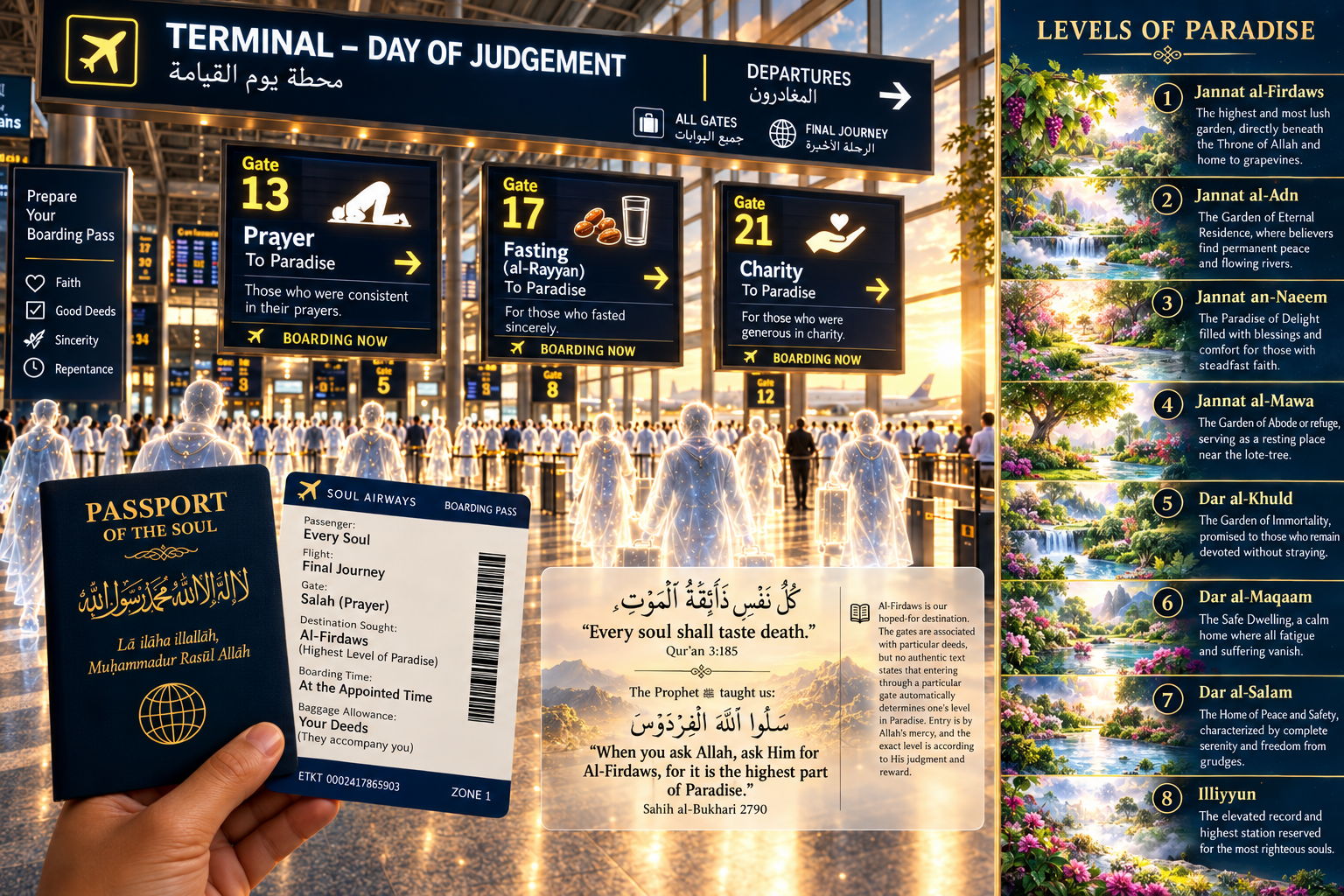
Allegory of airport, gate numbers and descriptions of paradise for illustrative purposes only. Only Allah knows best. What we do know is - the Prophet (ﷺ) said, "Allah said, "I have prepared for My righteous slaves (such excellent things) as no eye has ever seen, nor an ear has ever heard nor a human heart can ever think of.' "(Sahih Bukhari 7498).
One-Idea Tafsīr No. 1.
Why this series?
We live in perhaps the most information-rich—and attention-poor—period in human history.
A person can scroll through a war, a football result, a joke, a financial crisis, somebody’s wedding and an advertisement for trainers in less than sixty seconds. The problem is no longer simply access to knowledge. It is holding our attention on something long enough for it to change us.
The Qur’an deserves infinitely more than a thousand words, a social-media post or a contemporary analogy.
So this series is not an attempt to simplify the Qur’an into bite-sized content. It is an attempt to do something much more modest: to create a doorway. Something you can read while waiting in line to pick up your morning coffee or during your commute.
I am not an Islamic scholar, mufassir or student qualified to produce independent tafsīr. These pieces are personal reflections written by a Muslim trying to understand the Qur’an better and hopefully to pique someone else’s interest enough that they open the Qur’an, read the classical tafsīr, listen to scholars and contemplate the verses for themselves.
Each piece therefore follows one rule:
One sūrah—or part of one sūrah, or one or a few ayahs. One contemporary idea. Roughly 1,000 words.
The contemporary idea comes last, not first.
The hierarchy is:
The Qur’an → the explanation of the Prophet ﷺ → reports from the Companions → recognised classical tafsīr, particularly Ibn Kathīr → contemporary reflection.
The metaphor must fit the established meaning of the verses. The verses are never made to fit the metaphor.
And so we begin with the chapter every practising Muslim already knows better than any other.
Check the Boarding Gate – Sūrat al-Fātiḥah through one contemporary image.
At an airport, three questions matter more than almost everything else:
Who are you?
Where are you going?
And are you at the correct gate?
You may be wearing the most expensive clothes in the terminal.
You may have first-class tickets, an amex card, qualifications, followers, property, influence, arguments, ancestry and confidence.
None of it helps if your aircraft is departing from Gate 17 and you are confidently sitting at Gate 42.
Sūrat al-Fātiḥah can be contemplated through that single image.
Not because an airport explains al-Fātiḥah.
It does not. This is simply a metaphor for a repeatable experience for many of us.
It is so because al-Fātiḥah repeatedly returns the human being to a question modern life makes remarkably easy to forget:
Where am I actually going?
The passport: Who do you belong to?
Al-ḥamdu lillāhi Rabbi l-ʿālamīn.
All praise belongs to Allah, Lord of all worlds.
The journey begins with orientation.
Who owns the airport?
Who owns the aircraft?
Who owns the passenger?
Who owns the destination?
Allah.
Not my employer.
Not my nation.
Not my family name.
Not my bank.
Not another human being.
Allah is Rabb al-ʿālamīn—Lord of all worlds.
Then immediately:
Ar-Raḥmān Ar-Raḥīm.
The Most Compassionate, the Most Merciful.
The Lord before whom we are travelling does not introduce Himself only through sovereignty and power.
He introduces Himself through mercy.
And then comes the destination notice:
Māliki Yawm al-Dīn.
Master of the Day of Recompense.
Ibn Kathīr explains that Allah is of course sovereign over this world as well, but the Day of Judgment is singled out because on that Day no created being will retain the worldly appearance of independent command or ownership. His sovereignty will be unmistakable. (Quran.com)
That changes how we understand the terminal.
This terminal is temporary.
Your career is in the departure lounge.
Your house is in the departure lounge.
Your car is in the departure lounge.
Your reputation is in the departure lounge.
Your arguments are in the departure lounge.
Even the body through which you currently experience the world belongs to the departure lounge. You cannot take it past the gate.
You are travelling.
And the Prophet ﷺ gave an extraordinary description of what happens when the passenger finally leaves.
Three things accompany the deceased: family, wealth and deeds. Family and wealth return.
The deeds remain. (Sunnah)
In airport language: almost all the luggage stays behind.
The security check: What are you carrying inside?
Al-Fātiḥah then makes a remarkable transition.
Until this point we have spoken about Allah.
Now suddenly we speak to Allah:
Iyyāka naʿbudu wa iyyāka nastaʿīn.
You alone we worship, and You alone we ask for help.
The placement conveys exclusivity: worship belongs to Allah alone, and ultimate dependence is upon Him.
This may be the real security screening.
Because human beings accumulate extraordinary quantities of invisible baggage.
Pride.
Fear of people.
Need for approval.
Status.
Resentment.
Tribalism.
Intellectual vanity.
Wealth.
Religious vanity.
The desperate need to appear important.
Al-Fātiḥah strips all of this back to two truths:
I belong to You.
I need You.
And according to the Prophet ﷺ, something astonishing happens when we say these words.
Al-Fātiḥah is not merely a speech delivered by the servant.
It is a conversation.
In the famous ḥadīth qudsī, Allah says that He has divided the prayer between Himself and His servant. When the servant praises Allah, Allah responds. When the servant reaches iyyāka naʿbudu wa iyyāka nastaʿīn, Allah says:
“This is between Me and My servant, and My servant shall have what he asks.” (Sunnah)
Think about that the next time you recite al-Fātiḥah.
You are not merely repeating something memorised in childhood.
You are entering a conversation.
The way to the gate? : Ṣirāṭ
Then comes perhaps the most important request a traveller can make:
Ihdinā ṣ-ṣirāṭ al-mustaqīm.
Guide us to the Straight Path. The gate. The terminal is vast. I don’t know which way to go to my gate.
Notice that the believer asks this repeatedly.
A Muslim who already believes but still asks:
Guide me.
Because knowing that the gate exists is not the same as reaching it.
A passenger can possess the correct boarding pass and still wander into the wrong terminal. All of us, have sometimes, maybe been at a large airport like Heathrow and rushing to get to the right gate in time.
So we are not merely saying:
Show me what is true.
We are asking:
Keep me walking toward it.
Then Allah describes the people whose route we want:
The path of those upon whom You have bestowed favour.
Elsewhere the Qur’an identifies those blessed in this way as the prophets, the truthful, the martyrs and the righteous. (Quran)
Think of them as the people whose queue you want to join.
Not necessarily the richest queue.
Not the loudest queue.
Not the most fashionable queue.
The question is simply:
Who is actually heading toward the correct gate?
The wrong gates
Then al-Fātiḥah asks Allah to protect us from two ways of going wrong:
Ghayri l-maghḍūbi ʿalayhim wa lā ḍ-ḍāllīn.
Not those who have incurred anger, nor those who have gone astray.
In the narration of ʿAdī ibn Ḥātim, the Prophet ﷺ identified those associated with divine anger and those who went astray. (Sunnah). Ibn Kathīr records this classical interpretation and then draws out a broader distinction of enormous relevance to anyone reciting the verse: one path represents knowing the truth but failing to follow it, while the other represents losing the path through absence or corruption of sound knowledge. (Quran.com)
And this is where al-Fātiḥah becomes uncomfortable.
Because these cannot simply become labels we point at other communities.
These diseases can appear inside of us.
I can know backbiting is prohibited—and continue backbiting.
I can know prayer is obligatory—and repeatedly postpone it.
I can know arrogance poisons the heart—and cultivate arrogance.
That is the danger of knowledge without submission.
At the opposite extreme, a person may be deeply sincere, intensely emotional and spiritually enthusiastic, yet begin speaking about Allah or religion without knowledge.
That is the danger of zeal without guidance.
The Straight Path requires both:
knowledge and obedience.
A map is useless if you refuse to follow it.
Enthusiasm is useless if you have the wrong map.
The final announcement
Perhaps that helps us understand why al-Fātiḥah accompanies the Muslim throughout life.
Human beings drift.
Attention drifts.
Desire drifts.
Priorities drift.
Intentions drift.
Even our understanding of ourselves drifts.
So again and again, prayer brings us back to the departure board.
Who is your Lord?
Allah.
Who owns the Day of Judgment?
Allah.
Whom do you worship?
Allah alone.
Whose help do you ultimately seek?
Allah.
What do you need more than almost anything else?
Guidance.
Guidance toward what?
The Straight Path.
And there is a beautiful connection at the other end of the Qur’an’s longest chapter.
Sahih Muslim records from Ibn ʿAbbās that while Jibrīl was with the Prophet ﷺ, a gate of heaven opened and an angel descended. The Prophet ﷺ was given glad tidings of two lights: al-Fātiḥah and the concluding verses of Sūrat al-Baqarah. (Sunnah)
Al-Fātiḥah contains the request:
Guide us.
And near the end of al-Baqarah we find the response of believers to revelation:
Samiʿnā wa aṭaʿnā.
We hear and we obey.
Perhaps the journey can be condensed into that.
Know your Lord.
Know that you are travelling.
Ask for the correct path.
Recognise the correct gate.
Then walk toward it.
And do not become so distracted arranging your luggage or shopping duty free that you miss the flight.
Check the boarding gate.
Because travelling quickly is of very little value if you are travelling confidently in the wrong direction.
A note on method, scholarship and sources
These pieces should not be treated as tafsīr in the scholarly sense. “One-Idea Tafsīr” is simply the name of the series: a short-form attempt to lead the reader toward tafsīr, not replace it.
I am not an Islamic scholar, and I am not claiming independent authority to interpret the Qur’an. These reflections deliberately take only one thread from verses whose meanings are vastly richer than anything that can be represented here. You could spill much ink on just one word.
Al-Fātiḥah alone has generated centuries of commentary on theology, worship, divine names and attributes, language, law, spirituality, guidance, servitude, duʿāʾ and much more. This piece does not pretend to summarise that scholarship.
The airport, passport, security, baggage and boarding-gate language is my analogy. It is not transmitted tafsīr. Its purpose is simply to take meanings already found in the Qur’an, Sunnah and classical commentary and place one of those meanings inside a familiar contemporary picture.
The intended effect is not:
“Now I understand al-Fātiḥah.”
It is:
“I want to go towards understanding al-Fātiḥah.”
Principal references used for this instalment :-
The Qur’an: Sūrat al-Fātiḥah 1:1–7; Sūrat al-Nisāʾ 4:69; and the concluding verses of Sūrat al-Baqarah, 2:285–286. Qur’an 4:69 explicitly identifies the prophets, truthful, martyrs and righteous among those upon whom Allah has bestowed favour. (Quran.com)
Conversation between Allah and the worshipper during al-Fātiḥah: Sahih Muslim 395a–b. (Sunnah)
Those associated with anger and misguidance: the narration of ʿAdī ibn Ḥātim in Jāmiʿ al-Tirmidhī 2954, together with Ibn Kathīr’s discussion of al-Fātiḥah 1:7. (Sunnah)
The two lights—al-Fātiḥah and the ending of al-Baqarah: Sahih Muslim 806, narrated by Ibn ʿAbbās. (Sunnah)
Family, wealth and deeds accompanying the deceased: Sahih Muslim 2960; the family and wealth return while the deeds remain. (Sunnah)
Classical commentary: Tafsīr al-Qurʾān al-ʿAẓīm of Ibn Kathīr, particularly his commentary on Sūrat al-Fātiḥah.
Footnote:- This Tafsīr series will not necessarily be published daily, nor will it follow a fixed sequential order. It will appear as and when particular Qur’anic reflections arise. Alongside these pieces, other articles on AI, security, technology, and commercial themes will also be interspersed as per my regular writing.
Related Posts