London based entrepreneur, cybersecurity analyst doing a PhD in AI
One Idea Tafsir No.3 – Shakespeare’s 7 ages of man
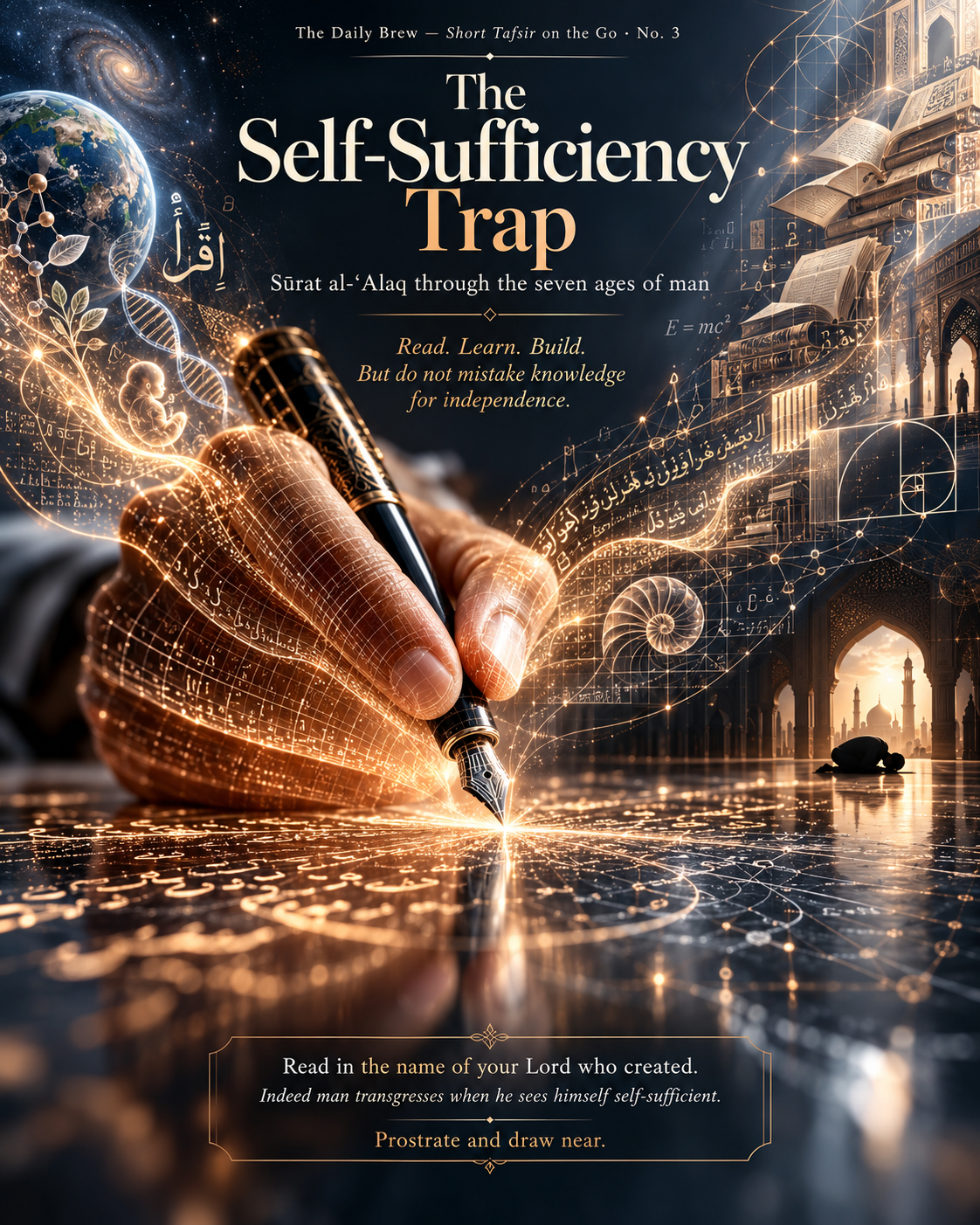
The Self-Sufficiency Trap
Sūrat al-ʿAlaq through the seven ages of man
The Daily Brew — Short Tafsīr on the Go · No. 3
Today’s article begins where God began the Quran, with the word – “Read”. The first word revealed to humanity and the first instruction is read.
In today’s article, I will first lay out the verses, then highlight attention to a key fact, then delve into the theme of the article.
ٱقۡرَأۡ بِٱسۡمِ رَبِّكَ ٱلَّذِي خَلَقَ
Read in the name of your Lord who created.
خَلَقَ ٱلۡإِنسَٰنَ مِنۡ عَلَقٍ
Created man, out of a (mere) clot
ٱقۡرَأۡ وَرَبُّكَ ٱلۡأَكۡرَمُ
Proclaim! Your Lord is the most bountiful
ٱلَّذِي عَلَّمَ بِٱلۡقَلَمِ
He Who taught (the use of) the pen,-
عَلَّمَ ٱلۡإِنسَٰنَ مَا لَمۡ يَعۡلَمۡ
Taught man that which he knew not.
كَلَّآ إِنَّ ٱلۡإِنسَٰنَ لَيَطۡغَىٰٓ
No, but man transgresses,
أَن رَّءَاهُ ٱسۡتَغۡنَىٰٓ
Once he sees himself as self-sufficient
إِنَّ إِلَىٰ رَبِّكَ ٱلرُّجۡعَىٰٓ
Verily, to your Lord is the return
أَرَءَيۡتَ ٱلَّذِي يَنۡهَىٰ
Have you seen the man who prevents
عَبۡدًا إِذَا صَلَّىٰٓ
a servant ˹of Ours˺ from praying?
أَرَءَيۡتَ إِن كَانَ عَلَى ٱلۡهُدَىٰٓ
What if this ˹servant˺ is ˹rightly˺ guided,
أَوۡ أَمَرَ بِٱلتَّقۡوَىٰٓ
or encourages righteousness?
أَرَءَيۡتَ إِن كَذَّبَ وَتَوَلَّىٰٓ
What if that ˹man˺ persists in denial and turns away?
أَلَمۡ يَعۡلَم بِأَنَّ ٱللَّهَ يَرَىٰ
Does he not know that Allah sees ˹all˺?
كَلَّا لَئِن لَّمۡ يَنتَهِ لَنَسۡفَعَۢا بِٱلنَّاصِيَةِ
But no! If he does not desist, We will certainly drag him by the forelock—
نَاصِيَةٖ كَٰذِبَةٍ خَاطِئَةٖ
A lying, sinful forelock!
فَلۡيَدۡعُ نَادِيَهُۥ
So let him call his associates.
سَنَدۡعُ ٱلزَّبَانِيَةَ
We will call the wardens of Hell.
كَلَّا لَا تُطِعۡهُ وَٱسۡجُدۡۤ وَٱقۡتَرِب۩
Again, no! Never obey him ˹O Prophet˺! Rather, ˹continue to˺ prostrate and draw near ˹to Allah˺.
We begin life unable to hold up our own heads.
Then slowly, almost unbelievably, we learn.
We learn to see.
To name.
To walk.
To ask.
To read.
To write.
To argue.
To earn.
To build.
To lead.
To think we understand the world.
And sometimes, somewhere along the way, learning itself becomes dangerous.
Not because knowledge is dangerous in itself.
But because knowledge can quietly produce a feeling far more dangerous than ignorance:
I no longer need.
That is one of the great themes of Sūrat al-ʿAlaq.
The first revelation begins with reading, learning, creation, and the pen. But then, almost immediately, it warns:
No! Indeed, man transgresses
because he sees himself as self-sufficient.
That is the trap.
And one way to understand that trap is through the stages of life itself.
Shakespeare, in his famous “seven ages of man,” describes human life as a sequence: infant, schoolboy, lover, soldier, justice, old age, and finally a second helplessness. Whatever one thinks of Shakespeare’s theology, the image is powerful: human life is not static. It unfolds in stages. And in each stage, the human being is learning, changing, gaining, losing.
Sūrat al-ʿAlaq helps us ask:
At what point does learning stop producing humility and start producing self-sufficiency?
1. The infant: created, dependent, taught
The sūrah begins:
Read in the name of your Lord who created—
created man from a clinging substance.
The first truth is not human brilliance.
It is human dependence.
Before the human being becomes a reader, he is created. Before he becomes articulate, he begins as something weak, hidden, dependent, and formed entirely by the will of Allah.
That is important.
Because the Qur’an does not begin the story of knowledge by flattering the human being. It begins by locating him.
You are not self-made.
You are created.
Before you knew anything, Allah brought you into being. Before you could ask a question, He gave you a tongue. Before you could read a sentence, He gave you sight, hearing, memory, and a mind.
Every infant is a living refutation of self-sufficiency.
2. The schoolboy: read, learn, receive
Then comes the command:
Read. And your Lord is the Most Generous—
Who taught by the pen—
taught man what he did not know.
Here the human journey opens outward.
The child learns letters.
Then words.
Then books.
Then worlds.
The schoolboy stage is one of obvious dependence. A child knows he needs to be taught. He asks questions constantly. He receives knowledge from outside himself.
That is why this stage contains a hidden purity.
A child still knows what adults often forget:
I do not know, and I need to learn.
Sūrat al-ʿAlaq dignifies that posture.
Allah is the One who teaches. The pen is one of the great tools of that teaching. Human civilisation itself—books, memory, law, science, scholarship, poetry, revelation carried through writing—depends on this chain:
Allah taught → humanity learned → the pen preserved.
Knowledge is therefore not independent of Allah. It is one of His gifts.
3. The lover: passion, longing, attachment
Then life deepens.
The child becomes emotionally alive in a new way. Shakespeare’s lover is full of passion, yearning, intensity, attachment.
This stage matters because human beings do not merely grow in knowledge. They grow in desire.
And desire affects knowledge.
A person does not always use what he knows in a neutral way. He is pulled by love, vanity, admiration, lust, hope, and social longing. He may know what is true and still follow what he wants.
This is why knowledge alone is never enough.
You can read, learn, and still lose your way if the heart becomes attached to the wrong things.
The sūrah does not spell out the lover stage in those terms, but it prepares for it by grounding learning in the name of the Lord. Knowledge must remain morally and spiritually oriented. Otherwise learning becomes another servant of desire.
4. The soldier: strength, ambition, force
Then comes power.
The soldier stage is the stage of drive, action, assertion, conquest, building, achievement. It is the age at which a human being begins to feel his own force.
This is where Sūrat al-ʿAlaq turns.
After creation.
After teaching.
After reading.
After the pen.
After learning what we did not know.
The Qur’an says:
No! Indeed, man transgresses
because he sees himself as self-sufficient.
This is one of the great psychological diagnoses in the Qur’an.
The problem is not that man learns.
The problem is what man does with the feeling produced by learning, wealth, strength, and capability.
He moves from:
I have learned
to
I know enough
to
I need no one
to
I am beyond limits
That is the self-sufficiency trap.
It is as contemporary now as ever.
A businessman who thinks wealth makes him independent.
A technologist who thinks power makes him answerable to no higher authority.
A politician who thinks office makes him untouchable.
A scholar who confuses learning with purity.
An ordinary person who becomes slightly successful and begins to believe he stands by himself.
The Qur’an says: that is precisely when transgression begins.
5. The justice: respectability, authority, certainty
Shakespeare’s “justice” is a figure of status—full of opinions, confidence, formality, and judgment.
This may be the most subtle stage of the trap.
Because by now self-sufficiency may no longer look like recklessness. It may look like maturity. Respectability. Seriousness. Influence.
The person has read widely, built a career, perhaps raised a family, gathered experience, become the one others ask.
And all of this may be genuinely good.
But here too the danger remains:
Will knowledge make this person more grateful, or more impressed with himself?
Will authority make him more humble before Allah, or more certain that he himself is enough?
Sūrat al-ʿAlaq answers with a reminder:
Surely to your Lord is the return.
That sentence breaks the illusion.
Your intelligence will return.
Your titles will return.
Your achievements will return.
Your influence will return.
You are not self-originating, and you are not self-ending.
6. The tyrant within: when self-sufficiency spills outward
Then the sūrah gives us a concrete case.
It speaks of the one who forbids a servant when he prays.
This is more than personal arrogance. This is arrogance turned outward.
The self-sufficient person does not merely forget Allah for himself. He begins interfering with another person’s submission.
That is the next stage of corruption.
First I think I do not need God.
Then I become irritated by visible submission to God.
Then I try to manage, restrict, or suppress it.
This is why the passage is so penetrating.
Arrogance is rarely content to remain internal. It seeks to dominate the environment around it.
And then comes the devastating correction:
Does he not know that Allah sees?
Human beings may watch one another.
But above every watcher is the One who sees all.
7. The final age: return, collapse, nearness
Life then bends downward again.
Strength leaves.
Certainty weakens.
The body slows.
The independent adult begins to resemble the dependent child once more.
That is one of the great ironies of human life.
We begin in dependence.
We rise into the illusion of independence.
We end by rediscovering dependence.
And so the sūrah ends with the perfect answer to the self-sufficiency trap:
Prostrate and draw near.
This is the cure.
Not ignorance.
Not anti-intellectualism.
Not the rejection of learning.
The cure is that after reading, writing, building, arguing, succeeding, and growing—
the human being places his forehead on the ground.
That is the final wisdom of Sūrat al-ʿAlaq.
The first revelation does not tell us to choose between knowledge and God.
It teaches us how knowledge should lead us back to God.
Read.
Learn.
Think.
Write.
Build.
Discover.
But do not let what you have been taught persuade you that you are self-sufficient.
Because the one who truly understands creation should be the first to bow before the Creator.
The story of human life is not simply that we learn.
It is whether, through all the ages, learning makes us more humble or more deluded.
Sūrat al-ʿAlaq gives its answer clearly:
The human being is taught.
Then tested.
And the one who escapes the trap is the one who still knows how to make sujūd.
Note on method, sources, and limits
This piece is not scholarly tafsīr and is not intended to replace study of the Qur’an, Arabic, the Sunnah, or the explanations of qualified scholars. I am not a scholar. The Daily Brew simply takes one established thread from a sūrah and places it alongside a familiar contemporary or literary frame so that interest in the Qur’an may be increased.
Here, the Shakespearean “seven ages of man” is an illustrative framework, not a source of tafsīr. It is used only as a literary scaffold to reflect on the human movement from dependence to perceived self-sufficiency and then back to need.
The method remains:
Qur’an → Prophetic Sunnah → reports from the Companions → classical tafsīr → contemporary reflection.
Principal references behind this piece
- Sūrat al-ʿAlaq (96:1–19), especially:
- Read in the name of your Lord who created
- Who taught by the pen
- Taught man what he did not know
- Indeed man transgresses when he sees himself self-sufficient
- Surely to your Lord is the return
- Prostrate and draw near
- Ṣaḥīḥ al-Bukhārī — the first revelation in the Cave of Ḥirāʾ
Narrated by ʿĀʾishah رضي الله عنها; includes Jibrīl’s command “Read” and the opening of Sūrat al-ʿAlaq. Sunnah
Ṣaḥīḥ al-Bukhārī 3 — Sunnah.com - Ibn Kathīr on Sūrat al-ʿAlaq — human transgression through perceived self-sufficiency
Ibn Kathīr comments on 96:6–7 that man becomes transgressive when he regards himself as self-sufficient and abundant in wealth. Quran.com
Ibn Kathīr on Sūrat al-ʿAlaq 96:6–19 — Quran.com - Abū Jahl threatening the Prophet ﷺ while he prayed
Ibn ʿAbbās رضي الله عنهما reports that Abū Jahl said that if he saw the Prophet ﷺ praying at the Kaʿbah, he would tread on his neck. Sunnah
Ṣaḥīḥ al-Bukhārī 4958 — Sunnah.com - Ṣaḥīḥ Muslim — the servant is nearest to Allah while in prostration
The Prophet ﷺ said: “The nearest a servant comes to his Lord is when he is prostrating.” Sunnah
Ṣaḥīḥ Muslim 482 — Sunnah.com
Important qualification
This article does not claim that Sūrat al-ʿAlaq is “about Shakespeare,” nor that Shakespeare explains revelation. The literary parallel is merely used to illuminate one powerful thread in the sūrah: human beings are taught and elevated by Allah, yet they are in danger of mistaking growth, knowledge, and power for independence.
Related Topics
Related Posts