
Defense & National Security Policy Analyst
One Month Out: Welcome to Israel’s Latest “Most Important Election in History”
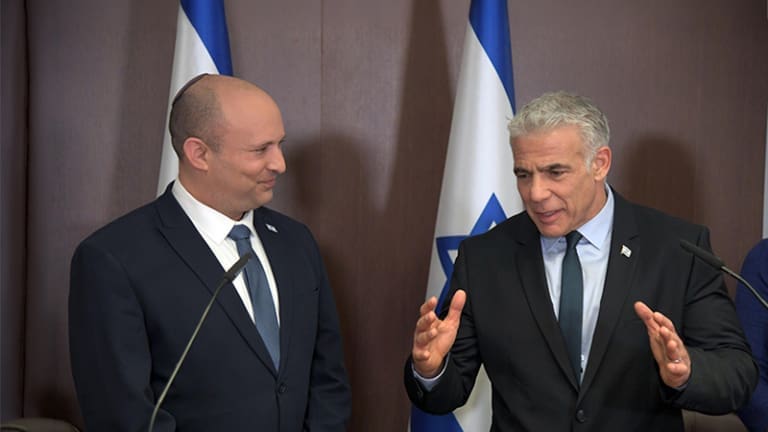
Former Israeli prime ministers Naftali Bennett, left, and Yair Lapid hold a joint press conference announcing that their parties will run together in the upcoming elections, in Herzliya, Israel, April 26, 2026.
We have officially arrived at that sacred, recurring Israeli ritual: the thirty-day countdown to what every news anchor, political analyst, and campaign operative assures us is the single most decisive, history-altering, existential election in the nation’s 78-year history. Again.
It feels like only yesterday—or perhaps three election cycles and a lifetime ago—when Yair Lapid, Naftali Bennett, Gadi Eisenkot, and the rest of the anti-Netanyahu opposition were taking to podiums from Haifa to Ashdod to Jerusalem. Back then, the battle cry was clear, crisp, and sweeping: “We are the Government of Change.” They promised to sweep away the old guard, heal deep-seated social divides, and usher in a brand-new political era.
Fast forward to today, with election day fast approaching, and a subtle yet highly telling linguistic pivot has quietly taken place. The “Change” brand has been unceremoniously retired, presumably sent to live on a farm alongside forgotten coalition agreements and signed campaign pledge cards. The new buzzword echoing through television studios and press briefings is “Repair”—as in the “Government of Repair and Reconstruction”. We are no longer being offered a grand societal transformation; we are being handed a contractor’s mechanics invoice. The opposition has rebranded itself as a coalition of political handymen coming to patch the cracked drywall of Israeli democracy.
And what, precisely, is listed on this proposed repair bill? The opposition’s unified campaign platform has coalesced around four primary pillars:
-
Mandatory Conscription for the Haredim: Legislative reform to draft the ultra-Orthodox, a political third rail that has wobbled every fragile coalition for decades.
-
A State Commission of Inquiry: A full, legally binding judicial investigation into the massive intelligence, political, and military failures surrounding October 7, 2023.
-
A Formal National Constitution: An extraordinarily ambitious effort to finally draft a foundational constitution for a state that has operated without one since 1948.
-
Prime Ministerial Term Limits: A policy constructed with all the subtlety of a sledgehammer, aimed squarely at Benjamin Netanyahu’s record-breaking tenure.
It is an impressive, high-minded agenda. But before anyone starts measuring the drapes in the Prime Minister’s Office, a quick look at the polling numbers provides a sobering cold shower.
The parliamentary map remains as stubbornly, maddeningly frozen as ever. The anti-Netanyahu opposition bloc—comprising a wide spectrum ranging from Yair Golan’s Democrats on the left to Naftali Bennett and Yair Lapid’s Beyachad, Eisenkot’s Yashar, and Avigdor Liberman’s Yisrael Beytenu—hovers in most surveys around 50 to 59 mandates. Sitting directly across the aisle, Netanyahu’s Likud and its right-wing, religious allies command an almost identical 50 to 57 seats. Neither side can reach the magic 61-seat majority required to form a stable government on its own.
That leaves the remaining 10 to 12 seats in the hands of the Arab-majority parties, including Mansour Abbas’s Ra’am and the newly reconstituted Joint List. And this is precisely where the opposition’s grand “Repair” blueprint hits an immovable wall of political arithmetic.
To reach 61 without Likud or the ultra-Orthodox, the opposition would inevitably need either the direct inclusion or the external parliamentary confidence votes of Ra’am. But Avigdor Liberman—whose secular, right-wing Yisrael Beytenu is mathematically essential to any anti-Netanyahu coalition—has repeatedly made his position crystal clear: he will not sit in, nor rely upon, a government supported by Ra’am. Eisenkot and Bennett have similarly tried to project strict “Zionist statesmanlike” boundaries to protect their right-leaning flanks.
Netanyahu’s campaign managers, naturally, are exploiting this exact dilemma. The Prime Minister’s messaging strategy is simple: relentlessly accuse the opposition of plotting a secret deal with Arab factions, forcing opposition leaders to issue ever-stricter boycott pledges that render their own math impossible.
The result is a classic Israeli political paradox. By refusing to cooperate with Arab slates while simultaneously ruling out any partnership with Netanyahu, Liberman and key opposition figures lock themselves out of their own majority. If the opposition won’t rely on Ra’am, and Netanyahu cannot break opposition ranks to reach 61, neither side possesses a viable path to power.
Which brings us right back to the ghost of 2021.
If no candidate can present 61 signatures to the President after election night, Israel risks tumbling straight into the familiar doom-loop of systemic political paralysis: immediate snap elections. We run the exact same campaign, with the exact same talking points, while an exhausted public watches the electoral clock reset for round two, round three, or round four.
The opposition insists that a “Government of Repair” is ready to fix the nation’s foundational cracks. But unless someone invents brand-new mathematical laws before election day, the most likely outcome of this “most critical election in history” isn’t a bold constitutional revolution. It is a return ticket to the polling booth six months from now, waiting for a exhausted electorate to finally give up.
Related Topics
Related Posts