
One Mother Buried a Portrait. Another Left a Song.
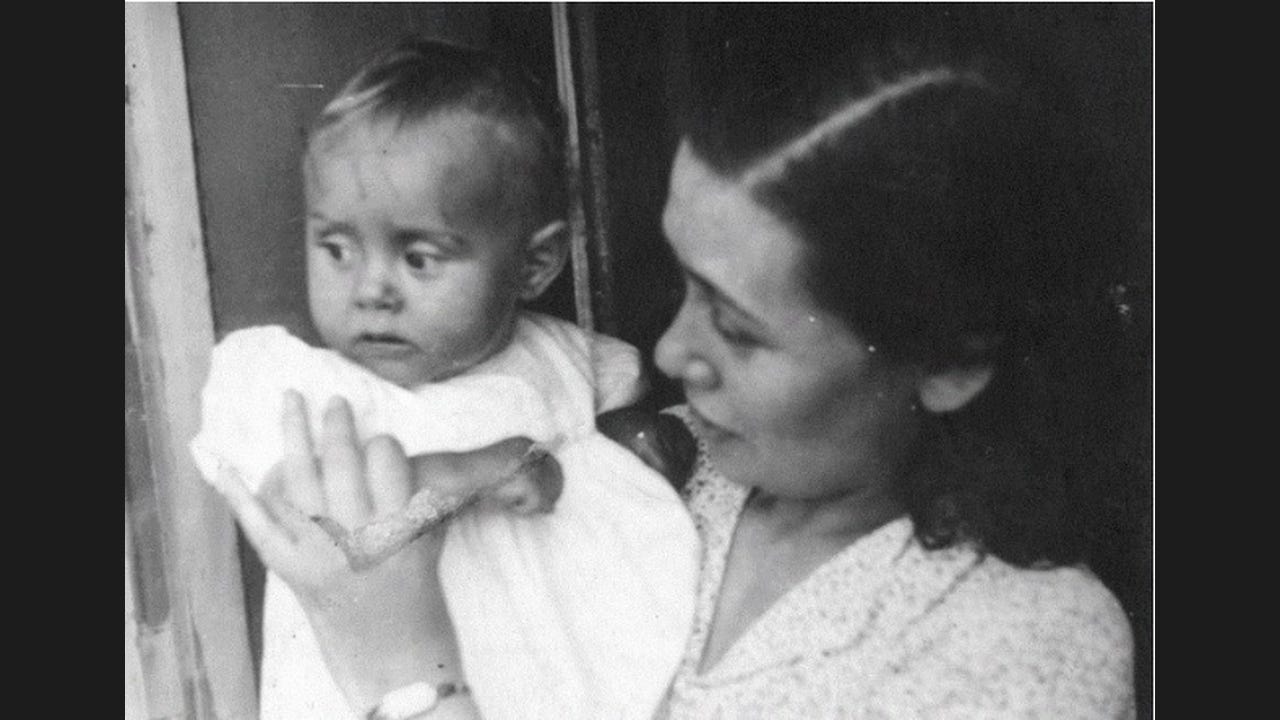
There is a photograph I keep returning to.
A woman holds a baby in a white gown. The child looks beyond the frame; her mother looks only at her. They are Gela Seksztajn and her daughter, Margolit.
There is nothing in the picture to tell you what is coming. No armband. No wall. Only a mother holding her daughter as the child discovers the world.
Margolit was born on November 4, 1940, shortly before the Germans sealed the Warsaw Ghetto. She would never know a world without its walls.
Margolit never knew a world without walls.
The painter
Gela was born in Warsaw in 1907, the daughter of a cobbler. Her mother died when she was eleven. She studied art in Kraków and became a gifted watercolorist. At children’s camps in Kazimierz Dolny, she painted girls with braids, solemn boys, faces full of mischief and hope. She dreamed of an exhibition devoted to the Jewish child.
I think about another Jewish child living in Warsaw then: my mother-in-law, Edna. She was six when Margolit was born. I cannot know whether their families ever met. What I do know is that both girls’ lives were being enclosed by the same wall.
In 1938, Gela married Izrael Lichtensztajn, a teacher and writer. Inside the ghetto, she continued to draw and to teach children. He helped preserve the secret archive assembled by Emanuel Ringelblum’s circle, Oyneg Shabes. They recorded the hunger, the deportations, and the lives the Nazis intended to erase.
The girl in the blue shawl
Look at Gela’s work and you understand what she was trying to save.
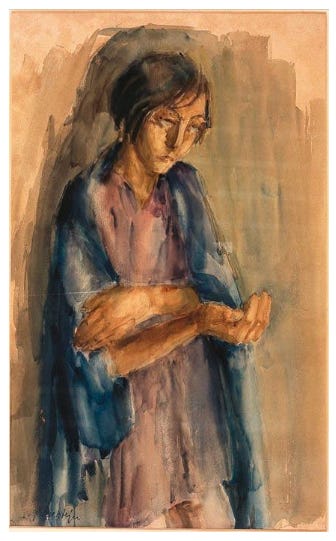
The girl’s eyes are lowered. One arm folds across her body. Her other hand is open, palm up, waiting.
I do not know her name. She could have been a child Miriam and Edna passed on those streets. Some children begged for food. Others slipped through openings in the ghetto wall and returned with bread hidden under their coats.
Edna and her older sister Miriam were among the smugglers. Every crossing could have been their last. They went because their family was starving.
An open hand. A passage through the wall. Neither offered safety.
What Gela buried
In the summer of 1942, as the Germans deported thousands of Jews from the ghetto to Treblinka, Izrael and two former students buried part of the underground archive in metal boxes beneath a school at 68 Nowolipki Street.
Gela entrusted her paintings, drawings, photographs, and a farewell letter to the archive. Among her works was a sketch of Margolit’s face.
In her testament, Gela asked for no praise. She asked that she and her daughter be remembered.
In April 1943, the Warsaw Ghetto Uprising began. Gela, Izrael, and Margolit were killed.
Margolit was two and a half years old.
Edna survived. She escaped to the Aryan side, where she passed as a Catholic orphan named Stefcia. At nine she served in the Polish Home Army during the Warsaw Uprising. She was decorated on her tenth birthday.
Margolit never reached her third.
What Edna’s mother left
When I look at Gela holding Margolit, I think of Edna’s mother.
She could not leave a box of paintings. She left a song: “Oyfn Pripetshik,” the Yiddish song she sang to her children.
Years after the war, Edna was living at a convent school in England. She had spent so long as Stefania that she resisted her brother Yakov’s attempt to reach her. Then he sang their mother’s song.
The song cracked the wall Edna had built around her childhood. It helped her begin to remember her family and the Jewish life she had known before the war. Her return to Judaism would take years. This was the first step on that long road.
Gela placed her daughter’s likeness in an archive, hoping someone would find it. Edna’s mother could not have known that a song she sang at home would one day help her children find each other. Each left something of her daughter’s life in the keeping of memory.
One mother preserved her daughter’s face. The other left a song that helped her daughter remember.
Remembering
The boxes buried at Nowolipki Street were recovered from the rubble in September 1946. Gela’s work survived. So did her request.
Edna lived to hold her own children and grandchildren. In 1989, she stood at Auschwitz-Birkenau with her husband and their first grandchild. She lived a life Margolit was denied, along with one and a half million Jewish children murdered in the Holocaust.
Had Margolit lived, she would turn eighty-six this November.
So I return to the photograph. A mother looking at her baby girl. The baby looking at something we cannot see.
And I do what Gela asked.
I remember them.
Janet Bond Brill, PhD, is the author of Little Edna’s War, based on her mother-in-law’s Holocaust testimony, published on January 27, 2026, on International Holocaust Remembrance Day. Order Now.