Working to protect people and our shared planet.
One Year In, Federation’s Voter Guide Advances Local Security & Democracy
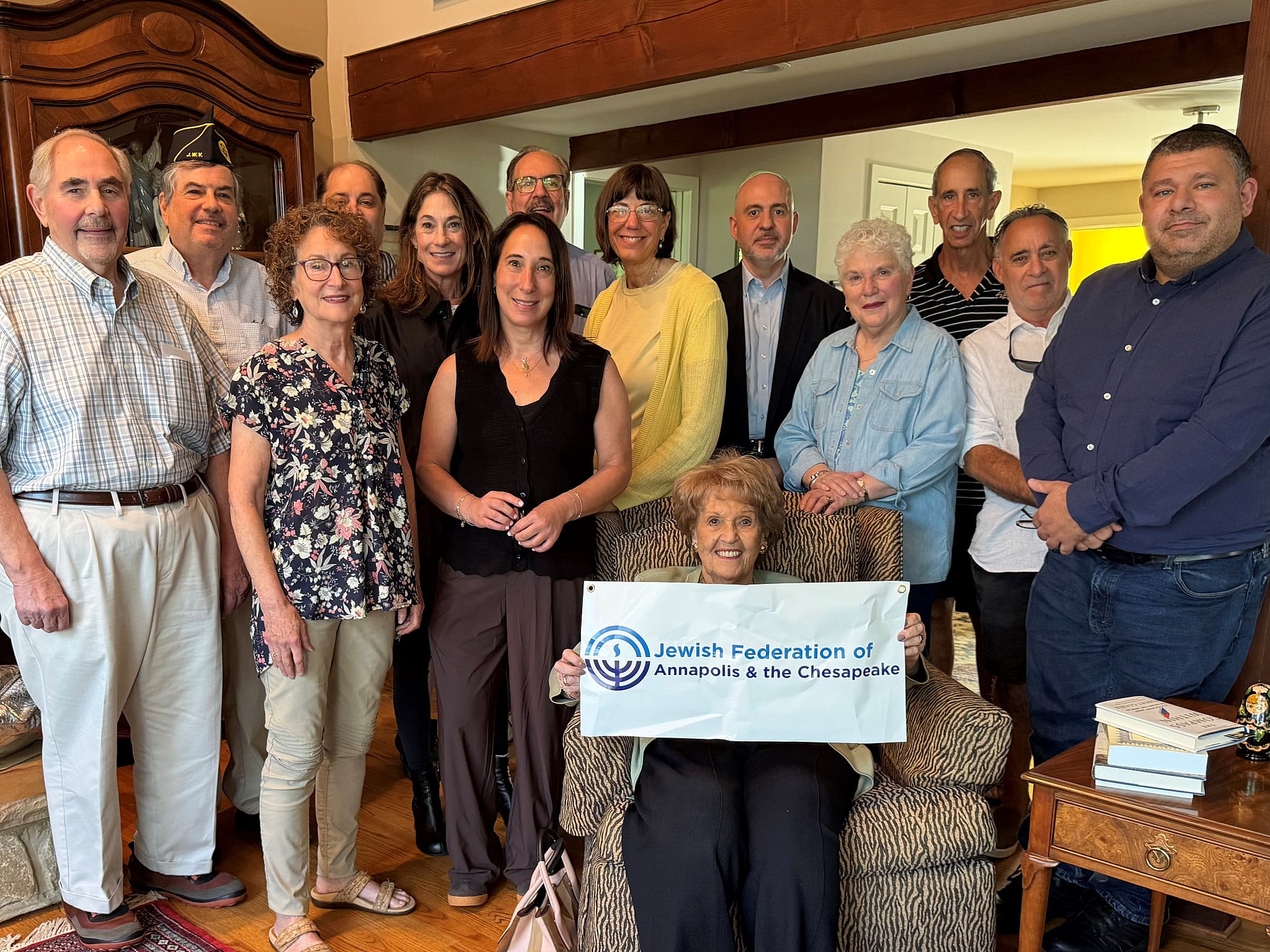
On our first anniversary, leaders from the Jewish Federation of Annapolis & the Chesapeake gather to plan for a stronger future. Photo by and courtesy of JFedA-C.org
One year ago, while enjoying being together in a sukkah, the Jewish Federation of Annapolis & the Chesapeake was created with a straightforward goal: to bring Jewish organizations and people together to build a stronger, more connected, safe, caring and inclusive Jewish community.
Today, as we mark our first year, we are taking another step in that direction: releasing our first Nonpartisan General Election Voter Guide for Anne Arundel County.
The guide focuses on an issue that has become increasingly important to Jewish communities and to many other communities as well: how we create safe communities where people can worship, gather, educate their children and participate in civic life without fear.
While our new Federation covers many counties, we started with a focus on just one: Anne Arundel County – the home to many of our organizations and the state capitol. Thus, the guide covers the two candidates for Anne Arundel County Executive in the general election and candidates for all seven Anne Arundel County Council districts. It is available at the Jewish Federation of Annapolis & the Chesapeake website.
Why create a voter guide?
For a new Federation, this is about more than an election.
Our community interacts every day with local government — on public safety, education, community relations, emergency preparedness, nonprofit services and the protection of houses of worship and other Jewish institutions.
So we asked candidates a series of questions about issues that are particularly relevant to our community.
The questionnaire addressed antisemitism and other forms of hate, security grants for faith-based and nonprofit institutions, discrimination and hate incidents, religious freedom and inclusion, community relations, and the appropriate role of local government when international events affect people living here.
We also asked candidates whether there were additional experiences, actions or initiatives they wanted the Jewish community to know about.
The questions were the same for candidates in each race, with the same word limits. The Federation published candidate responses as submitted, without editing them for grammar, spelling, accuracy or content. The guide does not endorse, rate or rank candidates.
Seeing security challenges firsthand
One of the most meaningful parts of this process has been the opportunity to meet with many of the candidates in person.
Candidates met with Federation leadership and, in several cases, visited Jewish institutions, including a synagogue and a Jewish childcare program. These visits gave candidates an opportunity to see firsthand some of the security challenges that Jewish institutions face.
Security is not simply about cameras, locks or having a police officer present.
It can involve entrances and exits, access control, communications, protecting children, responding to threats, coordinating with law enforcement, training staff and volunteers, and making sure that people can continue to participate in Jewish life while feeling secure.
Seeing those challenges in person creates a different kind of conversation than simply answering a questionnaire.
It also gave us an opportunity to explain that security concerns are not limited to one building or one congregation. They affect synagogues, schools, childcare programs, community centers and other Jewish organizations — as well as many other faith-based and nonprofit institutions.
Different approaches, shared questions
The candidates’ responses demonstrate that there are different ways of thinking about these issues.
Some emphasized law enforcement, security and public safety. Others placed greater emphasis on education, community engagement, reporting systems, inclusion or relationships among different communities.
Candidates also expressed different views about the circumstances in which local elected officials should comment on international issues.
The Federation’s role is not to tell voters which approach is right. Our role is to make it easier for members of the community — and indeed anyone interested in Anne Arundel County — to see what candidates themselves chose to say.
That distinction matters.
A nonpartisan voter guide should not become another campaign advertisement. It should provide information, give candidates an equal opportunity to respond to the same questions and allow readers to consider the answers for themselves.
A first-year milestone
Launching a voter guide is particularly meaningful during our first year because it reflects what we hoped this Federation could become.
The Jewish Federation of Annapolis & the Chesapeake was created to bring people and organizations together across the region and strengthen Jewish life. Our work has included community programming, advocacy, security, combating antisemitism, connections among Jewish institutions and engagement with the broader community.
Civic engagement is part of that work.
Jewish communities have a long history of participating in civic life and working with people of different backgrounds to make our communities stronger. In Annapolis and throughout the Chesapeake region, that means building relationships not only within the Jewish community but also with elected officials, law enforcement, educators, nonprofit leaders, other faith communities and our neighbors.
Our first voter guide is one expression of that broader commitment.
It is also a snapshot of a community asking important questions at an important moment.
How can we make Jewish institutions safer? How can we respond effectively to antisemitism and other forms of hate? How can we protect religious freedom and inclusion? What role should local government play? And how can different communities work together when they face common challenges?
Those are questions that will remain important after Election Day.
As we begin our second year, I am proud that our young Federation and its wonderful team of volunteers is already helping create opportunities for those conversations.
Our goal is not simply to have a Jewish community that survives. It is to help build one that is safe, caring, inclusive, engaged and strong — and a community that is an active and constructive part of the larger community.
That is what this first year has been about.
And it is a foundation for the work ahead.
Related Topics
Related Posts