


Open Letter to the Arab and Muslim Peoples
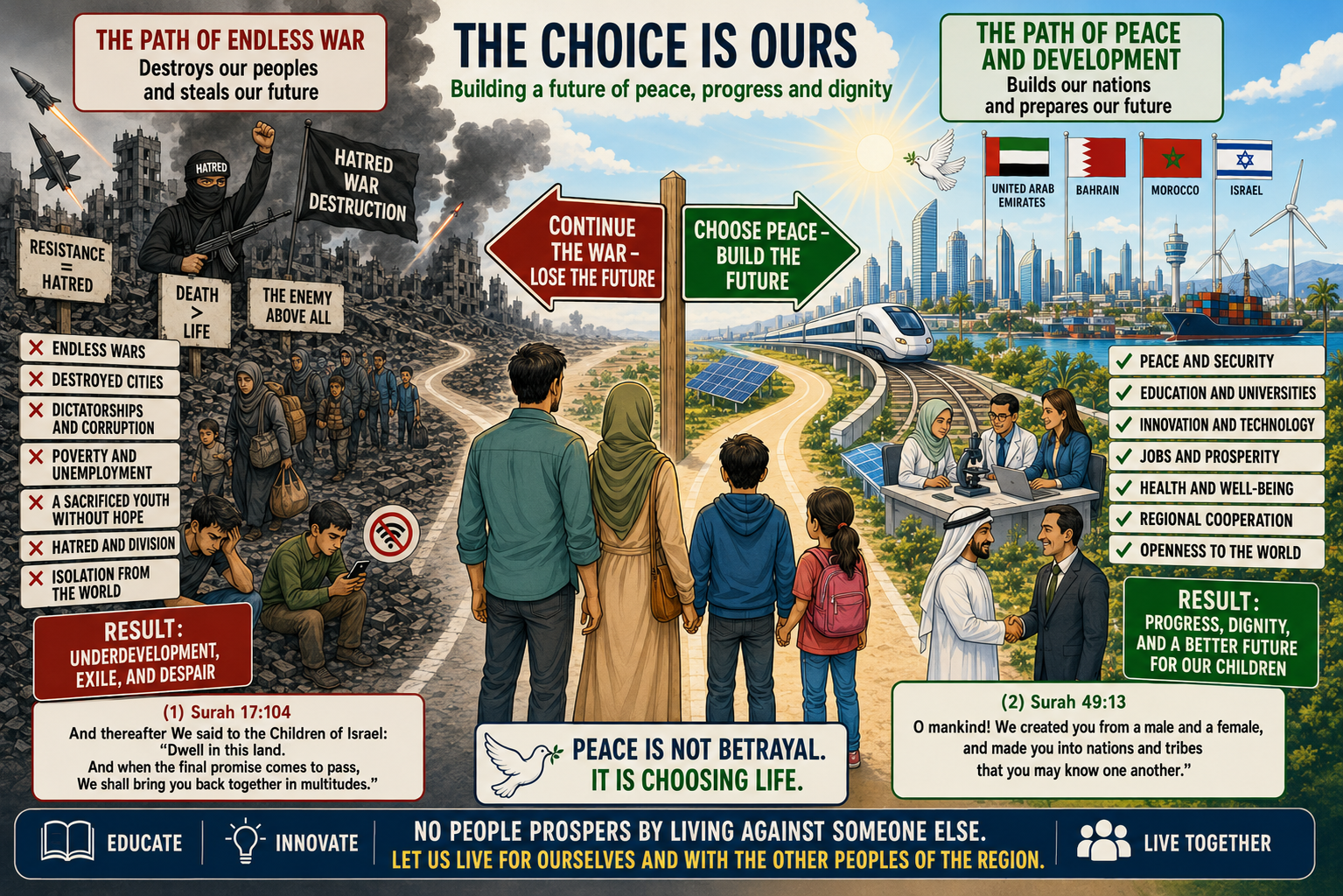
For decades, you were promised greatness through war, dignity through hatred, unity through the designation of an absolute enemy: Israel.
You were told that every path led through “resistance,” that every failure was caused by Zionism, and that every frustration would ultimately be redeemed through the disappearance of the Jewish state.
And yet, let us look honestly at our region.
Which peoples have paid the price of endless wars?
Which peoples have seen their cities destroyed, their elites leave, their economies collapse, and their freedoms crushed?
Which peoples have heard the same slogans repeated for seventy years while their rulers accumulated wealth through corruption and restricted their freedom and opportunities for development?
Lebanon was supposed to become the “fortress of resistance”; it has become a shadow of itself.
Syria was meant to lead the rejectionist front, yet the fall of Assad’s regime — which had made the struggle against Israel the central pillar of its legitimacy — ultimately left behind only a fragmented, ruined country emptied of much of its youth.
Iran was supposed to “liberate Jerusalem” and erase Israel. But after the strategic setbacks suffered by Iran and its proxies, we now see Gaza in ruins, southern Lebanon emptied of its inhabitants, Iran itself devastated, and the overwhelming majority of Iranians — suffering from water shortages, electricity cuts, internet blackouts, and inflation — longing for the fall of the regime.
Meanwhile, another path has emerged.
Quietly at first. Then more and more clearly.
The Abraham Accords are not merely diplomatic agreements. They raise a historic question addressed to the Arab and Muslim world:
Do you want to continue organizing your societies around an endless war, or do you finally want to build?
Build universities, ports, research centers, and economies capable of offering your children something other than martyrdom or exile as their horizon?
This question is not only political. It is also spiritual.
A large part of the Muslim world has grown accustomed to viewing the return of the Jews to their land as an anomaly of history, even as a religious offense.
And yet, the Quran itself deserves to be reread without the filters of modern hatred.
Surah Al-Isra (17:104), which recalls the Exodus from Egypt and Pharaoh’s disappearance in the sea, continues:
“And thereafter We said to the Children of Israel:
‘Dwell in this land.
And when the final promise comes to pass,
We shall bring you back together in multitudes.’”
وَقُلْنَامِنبَعْدِهِلِبَنِيإِسْرَائِيلَاسْكُنُواالْأَرْضَفَإِذَاجَاءَوَعْدُالْآخِرَةِجِئْنَابِكُمْلَفِيفًاوَقُلْنَا مِن بَعْدِهِ لِبَنِي إِسْرَائِيلَ اسْكُنُوا الْأَرْضَ فَإِذَا جَاءَ وَعْدُ الْآخِرَةِ جِئْنَا بِكُمْ لَفِيفًاوَقُلْنَامِنبَعْدِهِلِبَنِيإِسْرَائِيلَاسْكُنُواالْأَرْضَفَإِذَاجَاءَوَعْدُالْآخِرَةِجِئْنَابِكُمْلَفِيفًا
For centuries, commentators have debated the exact meaning of this verse.
But it is difficult to deny that the text speaks of a collective return of the Children of Israel to their land.
Should the contemporary history of Israel be treated as a non-event unworthy of examination?
Should the return of the Jewish people after two thousand years be regarded as having no spiritual significance whatsoever?
Should such a unique event in human history be interpreted only as a “colonial aggression”?
To seek the total erasure of Israel from the Middle East is to place oneself in conflict with part of the Quranic text itself.
The hour of choice is approaching: if the Iranian axis continues to weaken, two competing visions of the region’s future will essentially remain.
On one side, extremist Islamist ideologies, in which entire societies remain permanently mobilized for confrontation, within a worldview shaped by revolutionary jihad, rejection of the other, and the sacralization of conflict.
On the other, an Islam of construction, prosperity, and sulh — reconciliation rather than endless war — faithful to the Quranic idea that God created peoples and tribes “so that they may know one another.”
يَاأَيُّهَاالنَّاسُإِنَّاخَلَقْنَاكُممِّنذَكَرٍوَأُنثَىٰوَجَعَلْنَاكُمْشُعُوبًاوَقَبَائِلَلِتَعَارَفُوايَا أَيُّهَا النَّاسُ إِنَّا خَلَقْنَاكُم مِّن ذَكَرٍ وَأُنثَىٰ وَجَعَلْنَاكُمْ شُعُوبًا وَقَبَائِلَ لِتَعَارَفُوايَاأَيُّهَاالنَّاسُإِنَّاخَلَقْنَاكُممِّنذَكَرٍوَأُنثَىٰوَجَعَلْنَاكُمْشُعُوبًاوَقَبَائِلَلِتَعَارَفُوا
This choice does not mean renouncing Arab or Muslim dignity.
On the contrary, it means breaking free from a logic in which several generations have been sacrificed to a war with no horizon.
Normalization with Israel does not mean the humiliation of Arabs. It means the end of a deeper humiliation still: watching the Arab world remain trapped in a conflict that has become a mental structure while other regions move forward.
No people prospers by living only against someone else.
No civilization shines sustainably by turning hatred into a collective project.
Younger Arab generations can see that the cooperation brought by the Abraham Accords with the United Arab Emirates, Bahrain, and Morocco has not destroyed those countries; it has strengthened them.
And many are beginning to ask the forbidden question:
What if perpetual war is not our destiny?
What if our energy could finally be used to build rather than destroy?
What if recognizing the reality of Israel were not a betrayal of Islam… but perhaps the lucid acceptance of a history that God Himself has allowed to unfold?
The Middle East can remain imprisoned in an ideological century built on permanent revenge.
Or it can enter another age.
One in which Arab and Muslim peoples are no longer asked to die for hatred, but are finally allowed to live for themselves — and alongside the other peoples of the region.
- In the text, Surah 17:104:
وَقُلْنَا مِن بَعْدِهِ لِبَنِي إِسْرَائِيلَ اسْكُنُوا الْأَرْضَ فَإِذَا جَاءَ وَعْدُ الْآخِرَةِ جِئْنَا بِكُمْ لَفِيفًا - In the text, Surah 49:13:
يَا أَيُّهَا النَّاسُ إِنَّا خَلَقْنَاكُم مِّن ذَكَرٍ وَأُنثَىٰ وَجَعَلْنَاكُمْ شُعُوبًا وَقَبَائِلَ لِتَعَارَفُوا
