
CEO of Time to Stand Up for Israel
Operation Moses: When Israel Chose to Save Lives While the World Looked Away
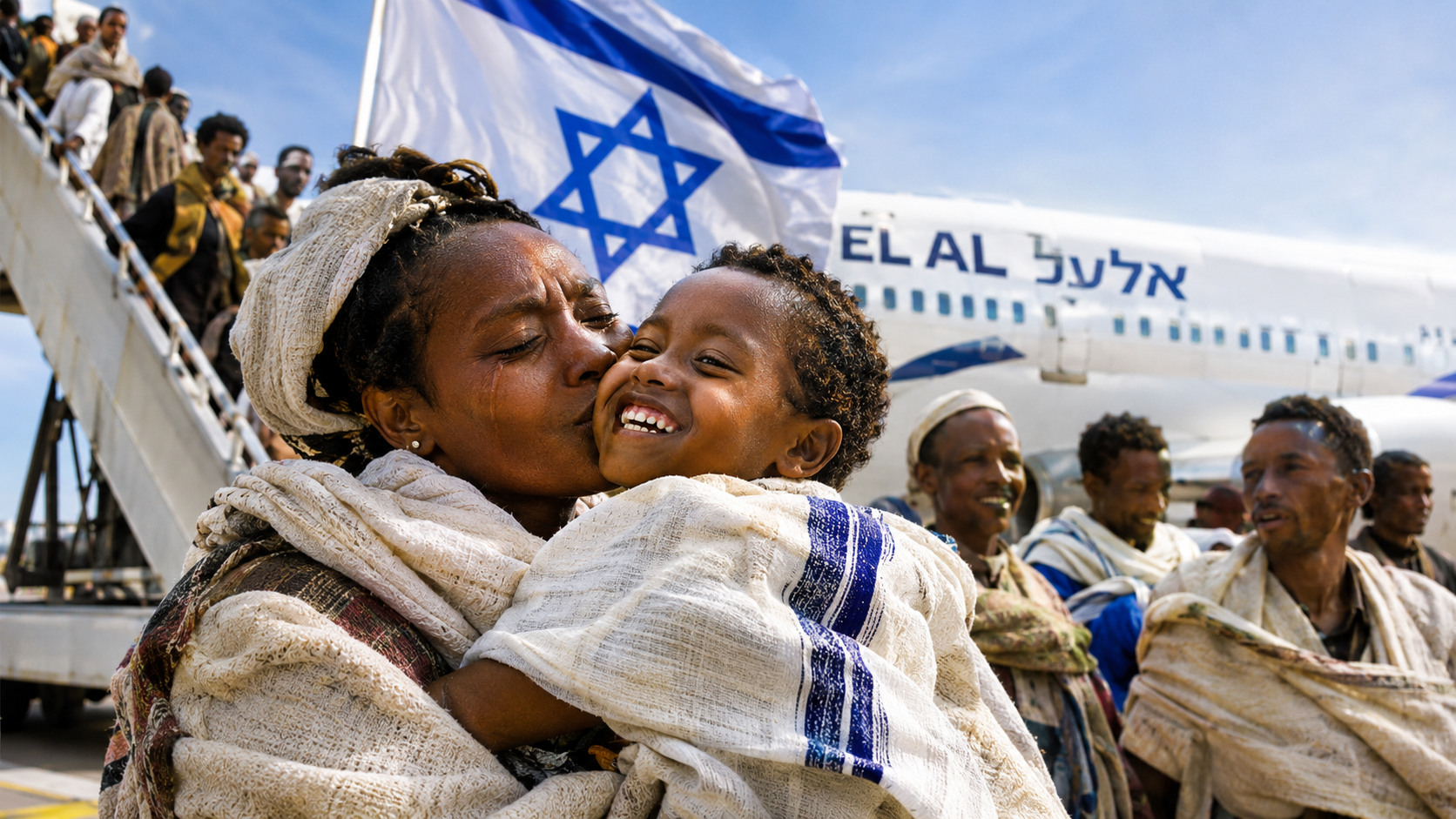
Photo Credits: Sabine Sterk (Ai)
November 21, 1984. A date that should remind the world what the Jewish State truly represents. Not conquest, not hatred, not the endless accusations directed at Israel, but the extraordinary determination of a nation to bring its people home.
There is something profoundly disturbing about the way the world judges Israel. A country that has repeatedly demonstrated its willingness to undertake extraordinary risks to save human lives is constantly portrayed as a nation without compassion. Its enemies accuse it of racism, oppression and indifference to human suffering, while conveniently ignoring some of the most remarkable humanitarian rescue operations in modern history. Operation Moses is one of those stories. It is a story that deserves to be told, remembered and celebrated, particularly in an era when historical ignorance has become a convenient weapon against the Jewish State.
On November 21, 1984, Israel began one of the most extraordinary rescue operations in its history. Thousands of Ethiopian Jews, descendants of a Jewish community that had preserved its identity through centuries of isolation, were stranded in desperate circumstances. Ethiopia was suffering from devastating famine, political instability and persecution. Many Ethiopian Jews had undertaken dangerous journeys on foot to reach refugee camps in Sudan, hoping that one day they might finally reach Jerusalem. They crossed hostile territory, endured hunger, disease and exhaustion, and watched loved ones die along the way. Their destination was not Europe, America or some wealthy country promising economic opportunities. Their destination was Israel, the homeland they had carried in their prayers and traditions for generations.
What happened next should have become one of the defining humanitarian stories of the twentieth century. Through a secret operation involving Israeli intelligence, international cooperation and extraordinary logistical planning, thousands of Ethiopian Jews were flown from Sudan to Israel. Between November 1984 and January 1985, approximately 7,000 to 8,000 people were rescued through Operation Moses. They were not wealthy investors, influential politicians or individuals whose arrival would bring economic advantages to Israel. Many arrived exhausted, traumatised and carrying almost nothing. Israel knew that integrating them would require enormous resources, housing, healthcare, education and long term support. Yet the fundamental question was never whether these people would be economically useful. The question was whether they were Jewish people in danger who needed a home.
And Israel answered that question with action.
Now consider the hypocrisy. How often do we hear Israel accused of being a racist state? How frequently do activists, politicians and self appointed human rights experts confidently repeat the accusation that Zionism is fundamentally based on racial superiority? Yet here was a Jewish nation undertaking an immensely complicated rescue mission to bring thousands of Black African Jews to safety. Their skin colour did not disqualify them from belonging to the Jewish people. Their poverty did not diminish their right to seek refuge. Their geographical isolation had not erased their connection to Jewish history. They were part of the Jewish people, and Israel recognised that responsibility.
Of course, this does not mean that Ethiopian Israelis subsequently experienced a perfect society without discrimination, inequality or painful struggles. They did not. Racism and failures of integration have existed, and acknowledging those realities is necessary. But those problems do not erase the extraordinary significance of the rescue itself. A country can be imperfect while still accomplishing something profoundly admirable. Apparently, however, Israel is expected to meet a standard of perfection that no other nation on earth has ever achieved.
What makes Operation Moses particularly significant is the historical context in which it occurred. Israel was still a relatively young country, surrounded by security threats and carrying the enormous financial and social responsibilities of absorbing Jewish immigrants from across the world. Its existence had already been challenged through repeated wars. Nevertheless, Israel continued to regard the rescue of endangered Jewish communities as a national obligation. The Jewish State was not created merely to establish another flag, parliament or government. It emerged from the understanding that Jewish survival could never again depend entirely upon the goodwill of others.
That distinction matters enormously.
For centuries, Jews lived as minorities in societies where their safety depended upon political circumstances, religious tolerance and the decisions of rulers who could change their minds overnight. Jewish communities were expelled, persecuted, dispossessed and murdered. The Holocaust demonstrated with horrifying clarity what could happen when Jews had nowhere to turn and when supposedly civilised nations closed their borders. Israel fundamentally changed that reality. It created a place where Jewish refugees could arrive not as unwanted strangers begging for permission to exist, but as members of a people returning to their national homeland.
Operation Moses embodied that principle.
And yet, where are the demonstrations celebrating this remarkable rescue? Where are the university lectures explaining the diversity of Jewish history? Where are the activists demanding that students learn about Ethiopian Jewry, the rescue missions and the extraordinary sacrifices made to preserve Jewish lives? Too often, the same people who loudly proclaim their commitment to diversity appear remarkably uninterested when Jewish diversity contradicts their political narrative.
There is an uncomfortable truth here. Israel’s history is far more complicated, diverse and inspiring than the simplistic image promoted by its most determined opponents. Jewish communities came to Israel from Europe, North Africa, the Middle East, Asia and Africa. They brought different languages, traditions, cuisines and experiences, yet shared a historical and spiritual connection to the same homeland. That reality cannot be reduced to the fashionable accusation that Israel is merely a European colonial project. Ethiopian Jewish history alone should encourage anyone making such claims to reconsider how little they understand about the Jewish people.
Operation Moses was not the end of the story. In 1991, Operation Solomon brought more than 14,000 Ethiopian Jews to Israel in approximately 36 hours, demonstrating once again the lengths to which Israel was prepared to go to rescue its people. These operations were not ordinary immigration programmes. They were extraordinary undertakings driven by a conviction that Jewish lives mattered and that the existence of a Jewish homeland carried responsibilities extending far beyond its borders.
Today, as Israel continues to face threats, terrorism, international hostility and relentless attempts to delegitimise its existence, remembering Operation Moses is more important than ever. It reminds us that the story of Israel cannot be understood solely through conflict. It is also the story of rescue, refuge, survival, innovation and the determination to build a future for people whose ancestors spent generations dreaming of returning home.
I refuse to accept the distorted image of Israel presented by people who have little interest in understanding its history. I refuse to allow the achievements of the Jewish State to disappear beneath an avalanche of accusations, selective outrage and political propaganda. Israel deserves criticism when criticism is justified, as every democracy does. But it also deserves recognition when it accomplishes something extraordinary.
Operation Moses was extraordinary.
Thousands of people who had endured unimaginable suffering finally stepped onto Israeli soil. For them, Israel was not an abstract political argument or a fashionable subject for international condemnation. It was safety. It was belonging. It was the fulfilment of a dream preserved across generations.
And perhaps that is what Israel’s enemies find so difficult to understand. The Jewish State is not merely a political experiment that can be dismantled when international opinion changes. It represents the restoration of Jewish national independence and the determination that Jewish survival should never again depend entirely upon the mercy of others.
On November 21, we should remember those who risked everything to reach Israel, those who never survived the journey, and those who worked tirelessly to bring thousands of Ethiopian Jews to safety.
Because when the world debates whether Israel has the right to exist, history reminds us why Israel must exist.
Israel did not simply offer these people a refuge. Israel brought them home.
עם ישראל חי ????????
Related Topics
Related Posts