Other Waze Around
Waze was born in Israel, which makes sense to anyone who has driven there, including me. Around 2006, software engineer Ehud Shabtai started a community project called FreeMap Israel. The idea was that the country’s drivers, stuck in some of the world’s heaviest traffic and never shy with an opinion, could build a better map than any official source. In 2008, Shabtai, Uri Levine, and Amir Shinar turned the project into a company, Waze.
The idea was simple. Every cell phone running the app reported its speed and position. Every driver could flag a crash, a pothole, or a police car. The map updated constantly as traffic moved, and the app sent you around a traffic jam before you knew it was there. The engineers wrote very little of the map. Instead, the drivers built it. Google bought the company in 2013 for a reported $1.1 billion, and hundreds of millions of people now use it. Waze succeeded because it offered what nearly every driver wants: to be done driving. On July 13, 2026, Waze rolled out its major integration with Google’s Gemini AI assistant.
I use Waze often, and it does exactly what it promises: the fastest route. I want to say something against that, but not against Waze. My complaint is with what it promises, and with how thoroughly we have agreed that it is the only thing worth promising.
A navigation app needs a number to optimize. Waze’s number is time. It can weigh distance, tolls, highways, and, since this past summer, your own habits. Thanks to AI, it now suggests routes based on your past trips. Consider what that means. The app learns the driver you have already been and gives you more of it. It is efficient, but it is also a closed loop.
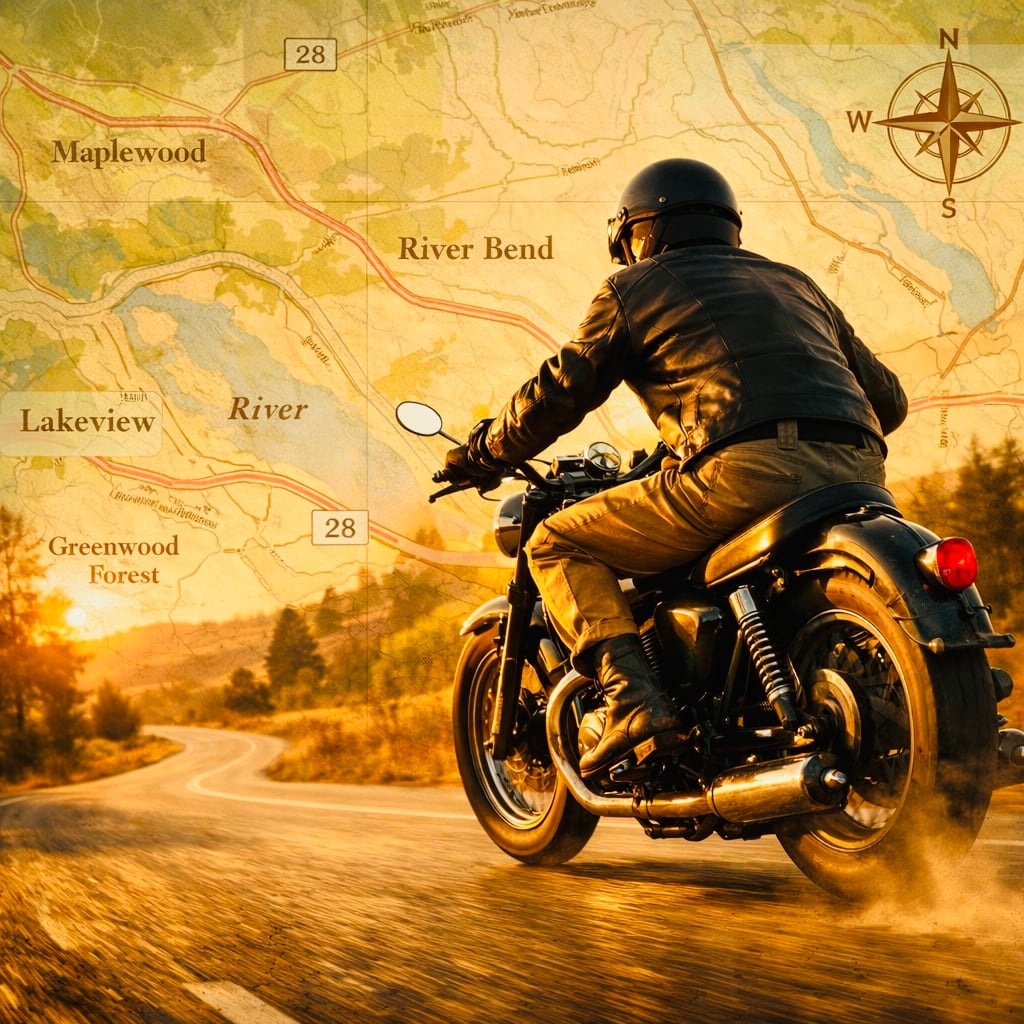
What no navigation app can optimize for is the part of travel that is ineffable. This is the part that also can’t be turned into a number. I ride a motorcycle, and the thing I can least explain to non-riders is the smell. In a car, you smell the car. On a motorcycle, a stretch of road is a sequence of smells. First, fresh-cut grass, then a creek, then someone’s BBQ, then the sharp mineral smell of rain on hot asphalt. You ride down into a hollow, and the air cools and turns green and wet. Then you climb out, and it’s dry again.
None of this is on any map. None of it would appear in the data even if every rider on earth logged every trip, because a route has these smells only when someone is riding it, and they change every time.
Robert Pirsig understood this fifty years ago. Zen and the Art of Motorcycle Maintenance opens with Pirsig and his son riding across the Dakotas on back roads, deliberately avoiding the interstates. My own love of motorcycles comes directly from my earlier read of Pirsig’s book. He explains that a car keeps you inside a compartment, looking at the landscape as if it were television, while on a motorcycle there is no frame and you are in the scene itself. For Pirsig, travel was not the gap between departure and arrival. It was the point.
Waze assumes the opposite, and the navigation apps that promise a “scenic” alternative mostly accept Waze’s framework and swap in another number. They count curves and measure elevation changes. They route you past places tagged as scenic overlooks. These are real improvements, and sometimes I use them. But a curve count is not the feeling of a curve, just as a restaurant’s rating is not the meal. Avoiding highways doesn’t produce the experience either. It only removes one thing that gets in its way.
A motorcycle naturally encounters the world around it, but a car or a van may also suffice. In Blue Highways, author William LeastHeat-Moon drove 13,000 miles around the US in a van he called Ghost Dancing. The book’s name comes from old Rand McNally road maps, which printed major highways in red and small back roads in blue. If the author had used Waze, his trip would have been much shorter. In this rejection of efficiency, the detours, the small towns, and the conversations along the way are the whole point.
Adding AI to Waze has altered the user experience, but this is where I think the argument about artificial intelligence goes wrong, in both directions. Enthusiasts assume that with enough data and a smart enough model, AI will eventually give us the perfect drive, the perfect meal, the perfect life. Opponents of AI point out that machines can’t feel, which may be true, but it is a metaphysical claim that neither side can settle.
The more useful point is plainer. AI can only optimize what can be measured, and the most valuable parts of many experiences can’t be measured, because they don’t exist until someone lives them. I can’t write down in advance the smell of that fresh-cut grass in a way that would let a system route me to it. I didn’t know I wanted it until it was there.
That doesn’t make AI useless, any more than it makes Waze useless. I’ll use Waze on the way to the airport and be glad of it. The danger is subtler. When every trip is scored on the same measure, the measure starts to shape what we want. We come to think of driving as time lost, a cost to reduce, because that is the only way our tools can describe it. The five minutes saved become the whole story, and we stop noticing what else was on the road.
Pirsig’s book is famously not much about motorcycle maintenance. It is about what he called Quality. This is the thing we recognize before we can define it and lose once we try to measure it. Waze made the fastest route something anyone could have. What it can’t give us, and what no model trained on our past trips can, is a reason to take the long way. We must supply that ourselves, preferably with the windows rolled down.