A Moroccan Journalist
Our problem is that we have never met an Israeli/Palestinian in our lives
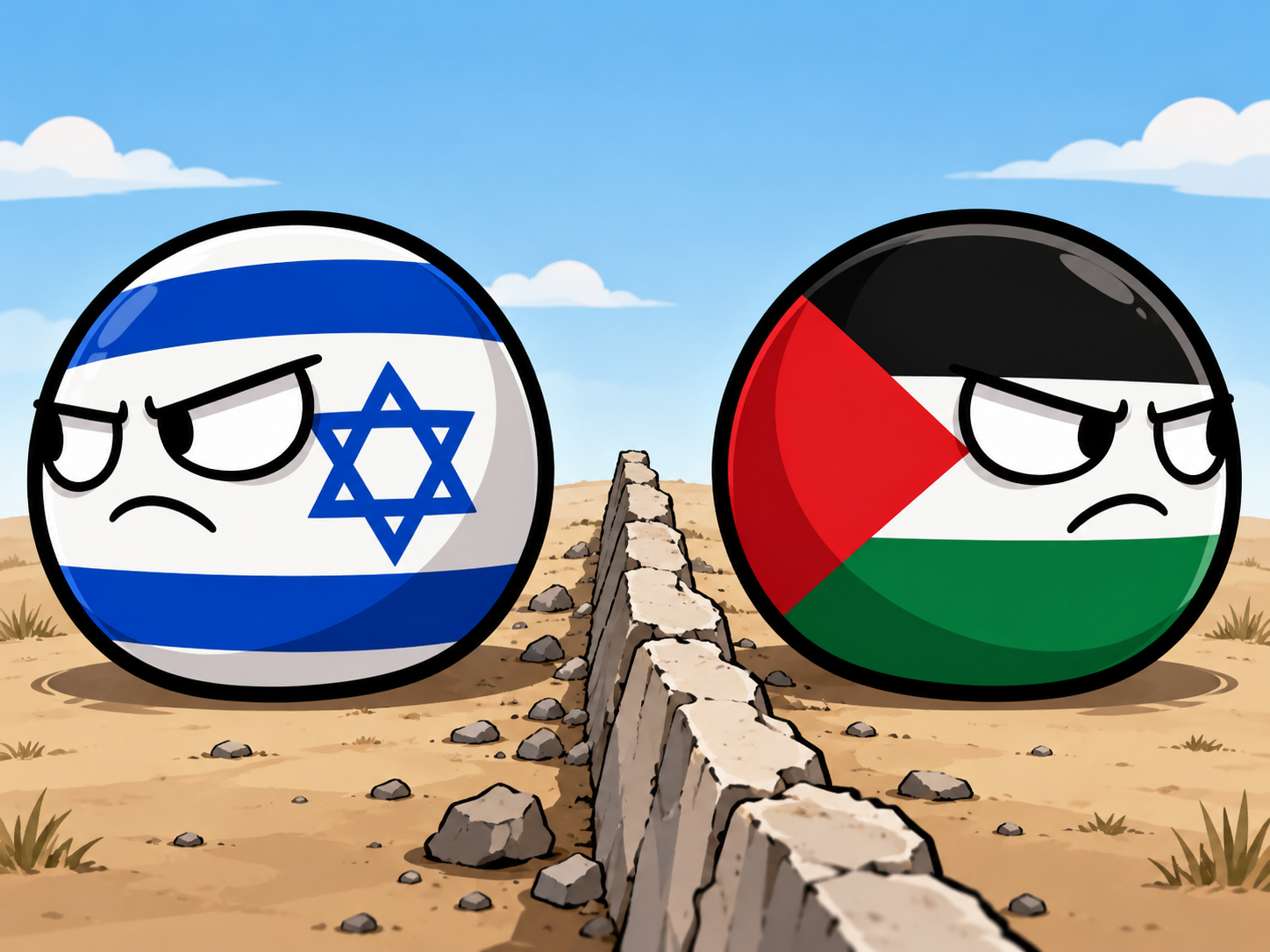
An AI-generated cartoon illustration depicting Israeli and Palestinian flag characters glaring away from each other, separated by a cracked barrier symbolizing their deep divisions and mutual distrust.
Most of us have never met an Israeli.
Not once. Not in a classroom, not on a bus, not across a dinner table. And yet we have opinions about them. Strong ones. We have inherited a whole people the way you inherit a language you never chose to speak.
This should frighten us more than it does.
Because here is the quiet truth under all the noise: almost everything the average Arab knows about Israelis was learned from a screen. From footage. From headlines written to be clicked. From men on television who are paid to be angry on our behalf. An entire relationship with half of this conflict is a relationship with a camera lens.
And the people on the other side are in exactly the same prison. The Israeli who has never met a Palestinian knows them only as a masked figure, a slogan, a statistic of fear. He inherited them too.
So both sides spend their lives arguing about each other without ever having looked at each other.
People love to warn about hasbara, Israeli propaganda, the machine that polishes a state’s image. And they are not wrong that it exists. But the same people rarely admit that propaganda is not an Israeli invention or an Arab one. It is a human one. There is Palestinian messaging too, crafted and curated, because every grieving nation needs a story simple enough to carry. Both sides have learned to speak in a language built for the outside world rather than for each other.
And while everyone audits each other’s propaganda, the actual human beings slip out of the frame entirely.
Let me say something that will anger people on both ends of the timeline.
Among Israelis, there are people who simply want to live. Who wake up, take their kids to school, worry about rent, fall in love badly, grow old. They are not all soldiers. They are not all settlers. They are not all the far-right ministers who make the news. Most of them are just people who were born into a place and a fear they did not design.
And the exact same sentence is true of Palestinians.
They are not all fighters. They are not all the cartoon the Israeli evening news needs them to be. They are students, farmers, mothers, poets, people who would trade the whole mythology of the land for one ordinary decade of peace and electricity.
Both of these things are true at once. That is the part we refuse.
We have built a vocabulary designed to stop us from thinking. Apartheid. Occupation. Terrorism. Antisemitism. These words carry real weight and real pain, and this is not to pretend they point at nothing. But watch what happens when they are used. The conversation ends. The human being in front of us disappears behind the label, and we are relieved, because now we don’t have to see him. The word does our looking for us.
A word that saves you from meeting a person is not a truth. It is a wall.
Step back far enough and the whole thing starts to look absurd. Not funny. Absurd.
Because this life is short. Catastrophically short. We get a few decades, most of them spent tired, and then we are gone, every last one of us, the general and the refugee buried in the same indifferent ground. Nobody has ever won against that. Nobody has ever negotiated an extra century.
And we have taken this one brief, impossible gift of being alive and we have poured it into a quarrel over lines on a map.
Generations have now passed without living. Think about that literally. There are people who were born into this, grew old in it, and died inside it, who never once got to experience a single year without the conflict as the background hum of their existence. Their whole life was the waiting room. That is not a cause. That is a theft.
It is not hard to understand why humans do this. We crave the drama. War gives a flat life a plot, a villain, a reason to feel important. It is intoxicating to belong to a holy struggle. But intoxication is not meaning, and a flag is a poor thing to have been alive for.
Here is the thing worth returning to. The state, as a concept, was invented for a boring and beautiful purpose. To organize life. To make it easier to feed people, school them, keep them safe, let them sleep. That is all it was ever supposed to be. A tool.
And in this one place, the tool turned on everyone. The idea of the state did not make life easier here. It made it harder, and not only for Israelis and Palestinians, but for the entire region, and arguably for the world, which has spent eight decades orbiting this wound.
When a tool keeps cutting the hand that holds it, you are allowed to ask what it is for.
The land itself is not the problem. The land has room. Drive through it and you will see space, emptiness, hills that could hold far more people than claim them. The scarcity is not in the soil. It is in the heart. It is the jealousy that says this earth may hold my people but not yours, as if the sun could be deeded, as if olive trees check passports.
This is not naive. A column does not dissolve a siege or raise the dead. This is not a peace plan. It is something smaller and harder.
Meet one of them.
The next time you are certain about an entire people, stop and notice that your certainty was manufactured somewhere, by someone, for a reason that was never your happiness. Before you decide what Israelis are, meet one. Before an Israeli decides what Arabs are, let him meet one of us.
Not the symbol. The person. The tired, frightened, ordinary, mortal person who, like you, did not ask to be born into a war and would give almost anything to simply be left alone to live.
Because the real problem was never the land, or the holy books, or even the propaganda.
Our problem is that we have never met each other.
And we are running out of life in which to try.
Related Posts