

Our Table Was Full
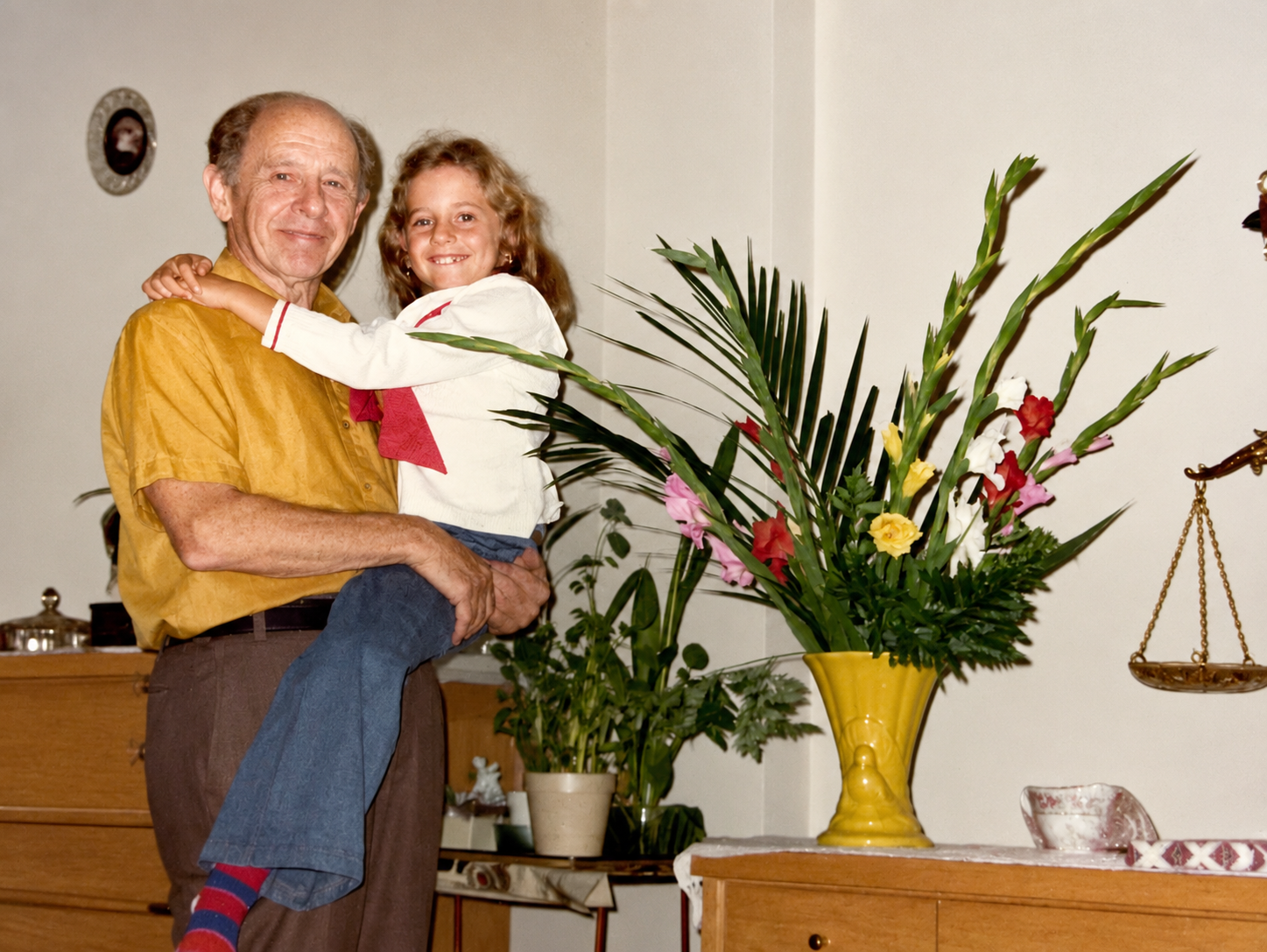
I don’t remember this particular Rosh Hashanah, although I know exactly who would have been there.
There were five of us in my family: my parents, my two brothers, and me, along with my grandparents Karl and Mathilde and my paternal grandparents. Nine people. That was pretty much our family, and year after year, the holiday table rarely changed.
I never thought of it as small. It was just our family.
And I certainly wasn’t thinking about any of that in this photograph. I was a little girl with my arms wrapped around my grandfather’s neck, happy to be held by him. For most of my life, that is what I saw when I looked at it.
Rosh Hashanah is usually described as the Jewish New Year, which is true, but doesn’t quite explain it. It isn’t the Jewish version of New Year’s Eve, a celebration of putting one year behind us and starting fresh. Rosh Hashanah begins the High Holy Days, a time when we look back at the year we have lived, reflect on who we have been, and consider what we want to carry with us into the year ahead. Ten days later comes Yom Kippur, when we say Yizkor, a prayer of remembrance for those who have died.
Looking at this photograph now, I find myself thinking about what had already been carried to that table.
My grandparents had fled Vienna because they were Jewish. The parents they left behind were later deported and murdered. Their photographs sat on the dresser in my grandparents’ bedroom for years, although I don’t actually remember seeing them there.
I must have walked past them. Maybe I looked at them without knowing who they were. Maybe I once asked. I have no idea.
What I do know is that I never looked around our Rosh Hashanah table and wondered who wasn’t there.
There were only nine of us, but to me the table was full.
Decades later, the papers my grandparents left behind would tell me what I couldn’t have known then. I have letters, passports, and photographs. I can trace where people lived, when they left, and what happened to them.
But there are things no document can tell me, and lately those are the things I find myself wondering about.
Did my grandmother make something for Rosh Hashanah because her mother, Hermine, had made it before her? Was there a melody my grandparents heard around our table that they had first heard as children in Vienna?
I don’t know. I probably never will.
There are no documents for those things.
We tend to think of inheritance as something tangible. A piece of jewelry. A photograph. A recipe card in someone’s handwriting. But so much of what families pass down isn’t labeled. We do something because our mother did it, and perhaps she did it because her mother did it. Somewhere along the way, the explanation disappears, but the thing itself remains.
It doesn’t feel like history when you are living it. It feels like home.
My grandparents had celebrated Rosh Hashanah in Vienna. Years later, they were celebrating it in America with us.
My mother was there. My brothers were there. I was there.
And nobody around that table was thinking, Look at this extraordinary act of continuity.
It was just what we did.
Later in the High Holy Days, when we say Yizkor, I think about those photographs on the dresser. The parents who weren’t at our table. The people whose names I didn’t yet know.
And then I look again at the photograph.
My arms are around my grandfather’s neck. His are around me. Somewhere nearby are my grandmother, my parents, my brothers and my paternal grandparents. In the bedroom are the photographs of the parents Karl and Mathilde had left behind.
I didn’t know their names. I didn’t know about the letters or the trains or what had happened to them.
I only knew it was Rosh Hashanah.
I knew this was my grandfather.
And I knew I loved being in his arms.