
When Moral Certainty Meets Jewish History: Carter, Obama, and Israel
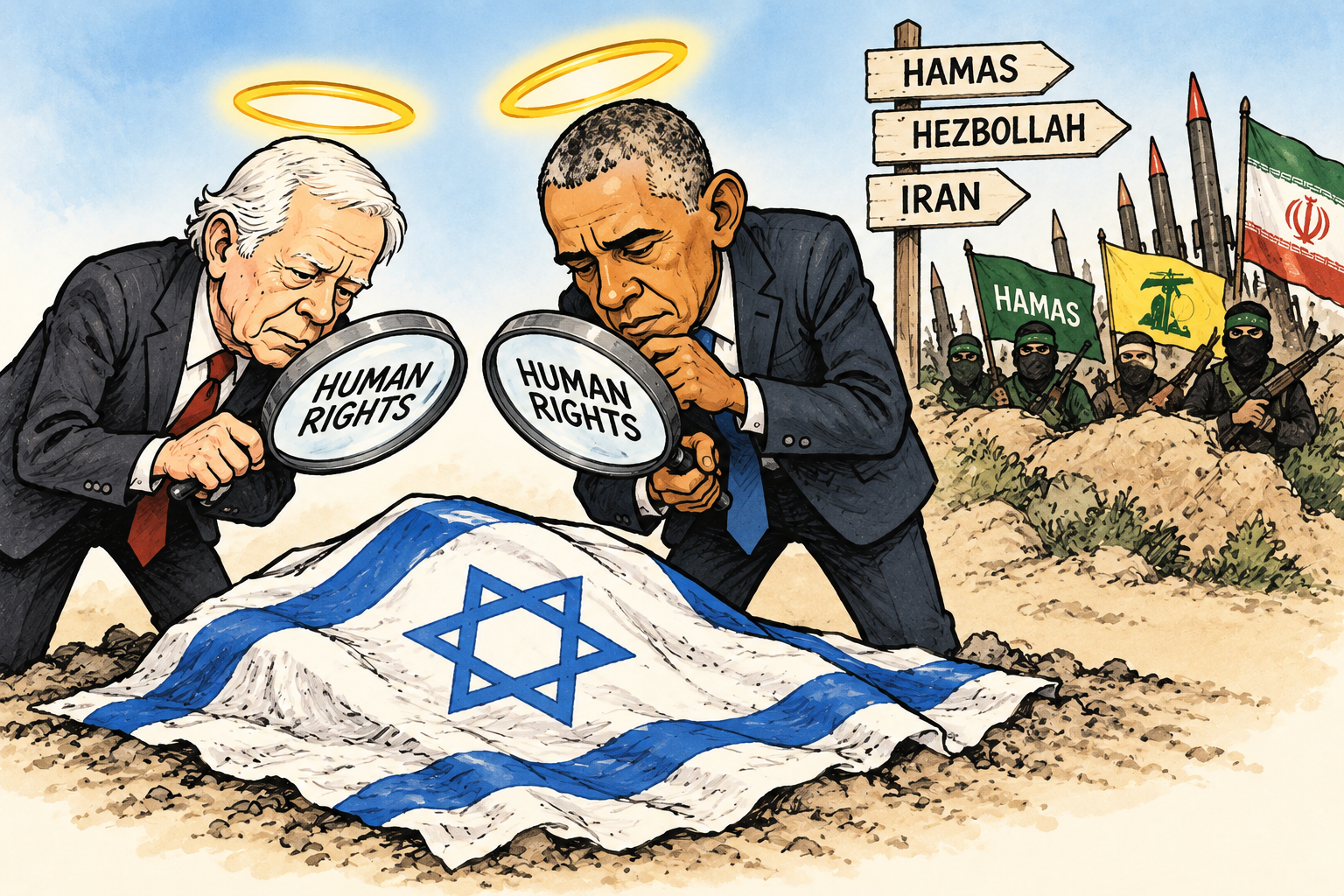
When Barack Obama recently told an audience in Belfast that Israel had taken land from Palestinians and that people had been expelled, he offered a profoundly incomplete account of Israel’s establishment. Although he acknowledged centuries of Jewish persecution and the Palestinian sense of injustice, his emphasis on Palestinian dispossession gave insufficient weight to the Jewish people’s historical claims and the circumstances surrounding Israel’s founding.
Jews did not arrive in a foreign land to which they had no historical connection. Despite conquest, persecution, and expulsion, Jews maintained a continuous presence in their land of origin and an enduring religious and national attachment to it. Modern Zionism was not simply a response to European antisemitism or the Holocaust, but the modern expression of an ancient people’s enduring aspiration to return to their ancestral homeland, a land central to the Hebrew Bible and Jewish religious tradition.
Nor did Israel emerge in a historical vacuum. Jewish leaders accepted the United Nations partition proposal of 1947; Arab leaders rejected it, and war followed. The ensuing conflict cost approximately 6,000 Jewish lives—nearly one percent of the Jewish population—and threatened the survival of the newly established state. Hundreds of thousands of Palestinians also fled or were expelled, a tragedy that deserves acknowledgment. But the suffering of both peoples cannot be understood responsibly without recognizing Jewish history, the Arab rejection of partition, and the circumstances of the war.
The setting made Obama’s remarks particularly troubling. Days earlier, Irish soccer players had refused customary handshakes with Israeli opponents and bowed their heads during Israel’s national anthem. Although Obama spoke in Belfast, Northern Ireland, rather than the Republic, the controversy illustrated the charged atmosphere surrounding Israel.
Why would a former president who repeatedly condemned antisemitism present such a one-sided historical account? Jimmy Carter offers an instructive precedent.
Carter, Begin, and the Price of Peace
Carter’s achievement in brokering the Camp David Accords and the 1979 Egyptian-Israeli peace treaty deserves enduring recognition. He helped end three decades of war between two bitter enemies.
Yet Carter’s admiration for Egyptian President Anwar Sadat contrasted sharply with his antipathy toward Israeli Prime Minister Menachem Begin. While Sadat displayed extraordinary courage by recognizing Israel, defying much of the Arab world, and accepting enormous political risks, Begin made equally consequential concessions that Carter appeared to undervalue. Israel surrendered the entire Sinai Peninsula, dismantled settlements, relinquished strategic military installations, and gave up valuable oil resources. For a small country repeatedly forced to fight for its survival, this was an immense gamble. Israel had little strategic depth and faced hostile neighbors. For Begin, the Holocaust was not an abstract moral lesson: much of his family had been murdered by the Nazis. That experience shaped his understanding of what could happen when Jews lacked the means to defend themselves.
Carter failed to appreciate the distinction between a leader’s desire for peace and the risks his country could safely accept. His dealings with Begin reflected a broader weakness critics perceived in his foreign policy: an excessive faith in diplomacy and an insufficient appreciation of the threats posed by determined adversaries. The Iranian hostage crisis and Soviet invasion of Afghanistan raised similar questions about whether Carter had underestimated the importance of deterrence.
Carter’s approach to Israel became even more controversial after he left office.
In his 2006 book, Palestine: Peace Not Apartheid, Carter accused Israel of practicing apartheid. While he maintained that the accusation concerned the occupied territories, not Israel itself, critics argued that his account placed overwhelming responsibility on Israel while minimizing Palestinian terrorism and rejectionism. This book prompted the resignation of longtime adviser Kenneth Stein and fourteen members of a Carter Center advisory council.
In 2008, Carter met with Hamas leaders, defending the engagement as necessary for peacemaking despite the organization’s commitment to Israel’s destruction, its explicitly antisemitic founding charter, and its deliberate attacks on Israeli civilians. Carter’s willingness to confer diplomatic legitimacy on such an organization raised serious questions about whether his pursuit of peace adequately recognized the nature of the adversary Israel faced. When a former American president and Nobel Peace Prize laureate portrays Israel principally as an oppressor, his words carry extraordinary authority. Such rhetoric can be appropriated by movements that regard Jewish sovereignty itself, rather than particular Israeli policies, as illegitimate.
Obama, Netanyahu, and the Limits of Diplomacy
Obama’s relationship with Benjamin Netanyahu was complicated, and responsibility for its deterioration cannot be assigned to one side. Netanyahu’s decision to address Congress in 2015 against Obama’s emerging Iran nuclear agreement, without coordinating with the White House, was unnecessarily provocative.
Obama also demonstrated a substantial commitment to Israel’s military security, including missile-defense cooperation and a ten-year, $38 billion assistance agreement. Nevertheless, his Iran policy raises serious questions. The 2015 nuclear agreement imposed meaningful restrictions and inspections, but several major limitations would expire after ten to fifteen years. In exchange, Iran received substantial sanctions relief. Obama predicted that most of the approximately $56 billion in newly accessible Iranian funds would support domestic economic needs. While he acknowledged that some resources might benefit Iran’s military activities, he considered that risk acceptable in exchange for constraining its nuclear program.
Yet Iran continued financing, arming, and training Hamas, Hezbollah, and other organizations threatening Israel. By October 7, 2023, Hamas had developed the capabilities to launch a devastating assault, while Hezbollah possessed an enormous arsenal. While the extent to which sanctions relief contributed to those capabilities cannot be fully established, subsequent developments raise serious questions about whether Obama adequately weighed the danger that Iran would use its enhanced financial position to strengthen its regional proxies.
For Israel, the danger was not merely Iran’s nuclear ambitions but the possibility that an agreement temporarily constraining those ambitions would leave Tehran better positioned to strengthen its regional proxies. Although Netanyahu presented his objections provocatively, the underlying security concerns were legitimate.
A related dilemma arose in Gaza. Obama pressed for ceasefires to reduce civilian suffering, a legitimate humanitarian objective. But Hamas survived successive conflicts, rebuilt its forces, expanded its tunnel networks, and ultimately perpetrated the October 7 massacre. Responsibility for that catastrophe belongs to Hamas. Israeli governments, including Netanyahu’s, also pursued policies of containment, and different American decisions cannot be assumed to have prevented the attack. Yet the strategic question remains:
Does a ceasefire that leaves a terrorist organization capable of rebuilding its forces advance peace, or merely postpone another, more devastating war? Hillary Clinton, who helped negotiate a Gaza ceasefire as Obama’s secretary of state in 2012, acknowledged after October 7 that the earlier truce had failed to prevent renewed violence and warned that leaving Hamas in power would allow it to rearm. Her warning underscored the difference between stopping immediate violence and removing the conditions for its recurrence.
What Shaped Their Judgments?
What might explain the increasingly critical attitudes of two former presidents toward Israel?
Carter’s Southern Baptist upbringing raises one possibility. Traditional Christian theology long included supersessionism, the belief that the Church had replaced the Jewish people as God’s chosen people. Carter’s religious outlook also emphasized compassion for the oppressed and Christian ideals of forgiveness and nonviolence.
His understanding of Israel was sometimes explicitly theological. Carter questioned Golda Meir about whether Israel’s secular government had departed from biblical principles. Did his religious worldview make it more difficult to appreciate Jewish sovereignty as a legitimate national aspiration, rather than primarily a matter of biblical obligation? The connection cannot be established conclusively, but the question deserves consideration.
Carter’s frustration over his inability to achieve a broader Israeli–Palestinian peace may also have contributed to his increasingly hostile attitude toward Israel. Having successfully brokered peace between Egypt and Israel, did he come to regard Israeli resistance to further concessions as the principal obstacle to extending that achievement?
Obama spent two decades attending Jeremiah Wright’s church, where he was exposed to a pastor whose views on Israel and associations with antisemitic figures had already generated controversy during the 2008 presidential campaign. Although Obama repudiated Wright’s inflammatory views and ultimately broke with him, one might still ask whether that longstanding relationship influenced Obama’s understanding of Israel.
Another possible influence is the oppressor–oppressed framework prominent in parts of the progressive left. Applied simplistically, it risks portraying Jews as powerful outsiders rather than a people with an enduring presence in their ancestral homeland, while diminishing Palestinian responsibility for the conflict.
Obama’s investment in the legacy of his Iran agreement may also be relevant. His failure to achieve a lasting Israeli–Palestinian peace, compounded by Netanyahu’s opposition to his Iran policy, may have contributed to his frustration with Israel. Could his increasingly critical portrayal of Israel also reflect a reluctance to confront the possibility that his signature diplomatic achievement strengthened a regime whose support for Hamas and Hezbollah posed grave dangers to Israel?
These questions cannot establish either president’s motives. Yet both men achieved important diplomatic successes while failing to secure a lasting Israeli–Palestinian peace. Their frustration with that failure, compounded by ideological convictions and difficult relationships with Israeli leaders, may help explain why their criticism of Israel became increasingly pronounced.
The Consequences for Jews Everywhere
The deeper problem is a moral framework that places disproportionate responsibility on the stronger party. Israel possesses a powerful military, and Palestinian suffering is real and undeniable. But military superiority does not establish primary moral responsibility for a conflict.
Arab leaders rejected the 1947 partition plan accepted by Jewish leaders. Hamas’s founding charter embraced virulent antisemitism, including conspiracy theories about Jewish control and religious exhortations to kill Jews. On October 7, Hamas-led terrorists massacred civilians, abducted hostages, and committed atrocities subsequently documented as war crimes and crimes against humanity.
These realities are indispensable to understanding Israel’s security concerns. Compassion for Palestinian civilians must coexist with recognition of the responsibility of armed movements that perpetuate the conflict and expose those civilians to repeated suffering.
For some American Jews, the disappointment was particularly painful because they had supported Carter and Obama and shared their commitments to civil rights, human dignity, and peace. The sense of betrayal of some Jewish supporters arose from the perception that leaders they admired judged Israel’s failings harshly while giving insufficient weight to the threats directed against it.
Neither Carter nor Obama can fairly be described as indifferent to antisemitism. Both condemned it and acknowledged the Holocaust. Yet remembering Jewish persecution is not necessarily the same as recognizing the contemporary threats that make Jewish sovereignty and security so important.
Rabbi Jonathan Sacks warned that antisemitism repeatedly adopts the prevailing moral language of its time. In an age when human rights and opposition to oppression are defining moral imperatives, his warning is particularly relevant to Carter and Obama. Both regarded themselves as champions of human rights, yet Carter’s accusation of apartheid and Obama’s portrayal of Israel’s establishment primarily through Palestinian dispossession risk turning those very principles into arguments against the legitimacy of Jewish self-determination. Neither president advocated Israel’s destruction, but their moral authority can lend credibility to narratives that portray the Jewish state itself as an injustice.
That is why Obama’s Belfast remarks matter. Carter and Obama both sought peace, yet their tendency to place disproportionate responsibility on Israel while minimizing the intentions and actions of its adversaries risks undermining the very peace they pursued. Such one-sided judgments can fuel antisemitism, weaken recognition of Jewish self-determination, and perpetuate the conflict by obscuring the responsibilities of those who reject reconciliation with the Jewish state.