
Pakistan, the first two state solution…and its failure
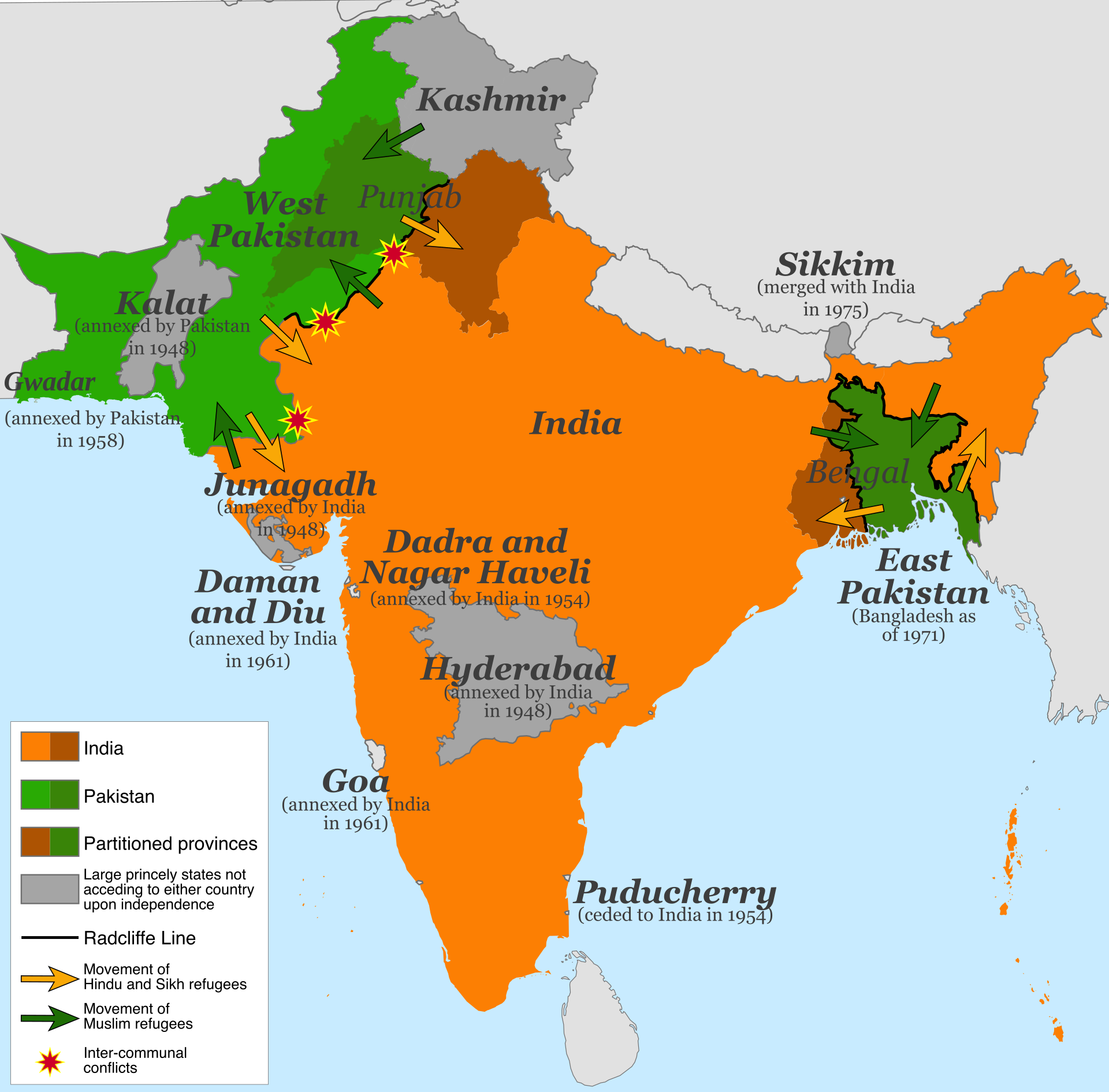
While most of the world insists that the only solution possible in the Middle East is the two-state solution, we are at an anniversary where, almost 80 years ago, the two-state solution was implemented in another part of the world.
The result was Pakistan.
To understand modern Pakistan better, a state which glorifies its army and has recently received considerable international attention because of its role as an intermediary between the United States and Iran, it is useful to return to the circumstances of its birth. Pakistan has simultaneously signed a defense pact in Mecca, the holiest of places for Islam, binding itself to Saudi Arabia and Turkey, two Sunni powers which have, in different ways, claimed leadership of the wider Muslim world.
For a country that has spent much of its existence searching for an identity beyond opposition to India, this is a moment of considerable pride. Pakistan can present itself as diplomat, military power and, most importantly, the only nuclear-armed Muslim state. Its nuclear arsenal can therefore be portrayed not simply as Pakistan’s deterrent against India, but potentially as a strategic asset for the wider Islamic world.
There is an uncomfortable contradiction here. The day Pakistan’s nuclear deterrent actually has to be used in defense of another state is the day Pakistan itself risks destruction. Field Marshal Asim Munir has therefore helped construct an arrangement in which Pakistan enjoys considerable prestige in peacetime but could face an impossible choice in wartime. Refuse to honor the commitment and the prestige disappears. Honor it in an existential conflict and Pakistan itself risks annihilation.
There is something strangely familiar about this contradiction. Pakistan was itself born from another political solution intended to settle an apparently irreconcilable communal conflict.
The origins go back much further than 1947. The All-India Muslim League was founded in Dhaka in 1906, initially not as a movement demanding a separate Muslim country but as an organization intended to defend Muslim political interests within British India. British policy helped institutionalize the divide. Separate electorates for Muslims, introduced under the Morley-Minto reforms of 1909, encouraged Indians increasingly to negotiate with the colonial state as members of political communities rather than simply as citizens of a future India.
Muhammad Ali Jinnah himself was not initially the prophet of partition. A Gujarati Shia ended up the founder of a Sunni state. For much of his early political career he argued for Hindu-Muslim cooperation and constitutional safeguards for Muslims within India. By 1940 the argument had changed fundamentally. At its Lahore session that year, the Muslim League adopted the resolution that became the political foundation of Pakistan, calling for Muslim-majority areas in India’s northwest and east to be grouped into independent political entities.
Over the next six years ambiguity hardened into demand. The Muslim League increasingly presented itself as the sole political representative of India’s Muslims, and its spectacular performance in Muslim constituencies in the 1945-46 elections strengthened Jinnah’s claim enormously.
But Indian Muslims were not unanimous in demanding partition. Important Muslim organizations and religious scholars opposed the creation of Pakistan. Much of the senior Deobandi establishment rejected the two-nation theory and argued for composite Indian nationalism. However sections of the ulema, influential pirs and particularly Barelvi religious networks threw their weight behind the Muslim League. Pakistan becoming a Muslim homeland.
Jinnah then turned to what became one of the darkest moments preceding partition. The Muslim League declared 16 August 1946 “Direct Action Day” to demonstrate Muslim determination to achieve Pakistan.
The consequences were catastrophic. Calcutta descended into communal killing. Violence spread through Bengal, Bihar, Punjab and elsewhere. Hindus, Muslims and Sikhs became both perpetrators and victims in an accelerating cycle of revenge.
Gandhi continued trying to prevent the division of India. His objective was still to preserve cooperation. But Gandhi failed.
Nehru and Patel entertained the possibility that partition might not be permanent. Nehru spoke publicly of the possibility that division could ultimately lead India back towards unity. Leaders of the Congress accepting partition did not necessarily believe they were creating an irreversible geopolitical reality.
Lord Mountbatten’s role remains equally controversial. He accelerated a British withdrawal originally envisaged for no later than June 1948 and instead transferred power in August 1947. A subcontinent of nearly 400 million people was divided in a matter of months by Cyril Radcliffe, a British lawyer who had never previously visited India. He was given barely five weeks to divide Punjab and Bengal. The final boundary award was not made public until after independence. A quick Brexit.
Pakistan was born on 14 August 1947. India became independent the following day.
Then came the human catastrophe. Trains arrived at stations carrying corpses instead of passengers. Women were abducted, raped and forcibly converted to Islam. Families that had lived beside one another for generations suddenly found themselves on opposite sides of an international frontier.
The precise number of dead will probably never be known. Modern estimates have now grown to around two million. Six million Jews died in the Holocaust in over five years, two million Indians in the partition in a few months, the two-state solution. Somewhere between ten and fifteen million people were uprooted.
The contemporary numbers initially told a much smaller story. Nehru acknowledged within months that the military casualty figures being supplied to him represented a gross underestimate. The sanitization began almost simultaneously with the event itself. Mountbatten, then India’s governor general, Nehru and other leaders needed a narrative and Pakistan needed a founding story. Britain needed an orderly story of imperial withdrawal. None had much incentive to emphasize that the political solution they had just implemented had produced a humanitarian catastrophe on a continental scale.
Pakistan survived, but it did not survive intact. In 1971, after political discrimination, repression and finally war, East Pakistan broke away and became Bangladesh. The supposedly common Muslim identity that had justified partition proved insufficient to hold together Bengalis and West Pakistanis separated by language, culture, economic interests and geography.
If Pakistan was simply a homeland for South Asian Muslims, tens of millions of Muslims remained in India after 1947. If Islam alone constituted sufficient nationhood, Bangladesh should never have separated.
The problem of Pakistani identity was visible almost immediately in its choice of language. Urdu became the national language despite not being the majority mother tongue of any of the principal regions that formed Pakistan. Its cultural heartland lay largely in northern India, particularly Uttar Pradesh, Delhi and Lucknow, and it arrived with the Muhajir political and bureaucratic elite. The contradiction was greatest in East Pakistan, whose Bengali speakers were the country’s largest linguistic population. Yet in Dhaka in 1948 Jinnah insisted that Urdu alone would be the state language. In 1971, Bangladesh demonstrated the limits of religion as a substitute for language, culture and identity.
There was a similar irony in religion. The Deobandi movement, which became enormously influential in Pakistan’s religious life and later Afghanistan, was born at Darul Uloom Deoband in Uttar Pradesh. More remarkably, leading Deobandis such as Husain Ahmad Madani and the Jamiat Ulema-e-Hind had rejected the two-nation theory and opposed partition.
The paradox is difficult to miss. The new Muslim homeland adopted a national language whose cultural heartland remained in India and came increasingly under the influence of a religious tradition founded there, while Punjabi, Sindhi, Pashto, Balochi and Bengali identities were centuries old. “Pakistani” identity had to be constructed over them.
The institutions best able to do so were Islam and the army. The vacuum was progressively filled by the institution with the strongest organization, hierarchy and sense of purpose: the military. The new old elite. Pakistan became an army which had a country. Islam supplied ideological legitimacy and the military supplied institutional continuity.
This helps explain the significance of Asim Munir’s present moment. Pakistan’s mediation between Washington and Tehran has restored international relevance, while the Mecca defense agreement with Saudi Arabia and Turkey allows the country born as a homeland for Indian Muslims to imagine itself as the military and nuclear guarantor of a much wider ummah-the Islamic strategic space.
Yet the history of Pakistan itself should make it cautious about grand political projects built around religious identity. The two-state solution of 1947 did not end Hindu-Muslim hostility. Nor did it create a unified Muslim nation: Pakistan itself broke in two within twenty-four years.
Almost eighty years later, Pakistan is again attaching its security to an ambitious political idea built partly around Muslim solidarity. For Asim Munir, Mecca is a diplomatic triumph. A nuclear deterrent is extraordinarily valuable when its purpose is to ensure that it never has to be used. Pakistan gains status from the suggestion that its power protects a wider community, but the moment that promise is seriously tested it must choose between credibility and survival. That is the paradox at the heart of Asim Munir’s achievement.
History has an unpleasant sense of irony. The first two-state solution did not end the conflict it was designed to solve. The second one, which is being psuhed for the holy land will unfortunately fare no better.
While Pakistan celebrates its independence and new found glory some of us mourn for those unnamed millions, Hindus, Muslims, Sikh- Indians all, on the last day of united India, who perished for Jinnah’s obstinacy which is now Munir’s ambition.