
Pakistan’s Case for Joining the Board of Peace
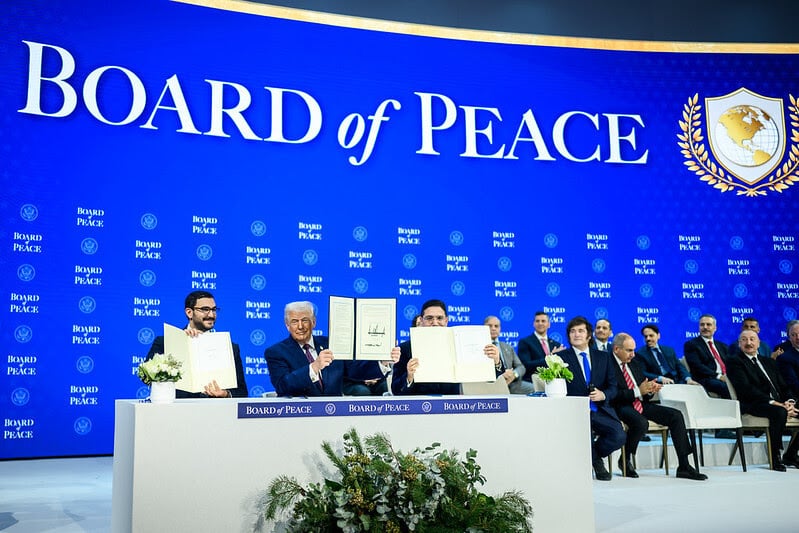
In international diplomacy, it’s rare for decisions to be made in ideal situations. More often, leaders have to settle for the most practical option rather than the perfect one. Pakistan’s choice to join the Board of Peace should be seen in this realistic light. Given the unprecedented humanitarian crisis in Gaza and the struggles of traditional methods to produce results, engaging with the Board of Peace is the most viable way for Pakistan to push its long-standing principles into action rather than just talk.
Prime Minister Muhammad Shehbaz Sharif signs charter of Board of Peace on the sidelines of 56th Annual meeting of the World Economic Forum. pic.twitter.com/MGCrMhe852
— Government of Pakistan (@GovtofPakistan) January 22, 2026
The federal cabinet’s approval of this move shows that it wasn’t a hasty or one-sided decision. Prime Minister Shehbaz Sharif has been clear and consistent about Pakistan’s goals: to work towards peace in Gaza, to ensure that Palestinians are treated with dignity and receive their rights, and to support rebuilding efforts once the violence ends. These aims fit perfectly with Pakistan’s diplomatic history and its moral stance on the Palestinian cause.
Davos: Pakistan Prime Minister Shehbaz Sharif inks Board of Peace charter pic.twitter.com/gTMtd8Sc4K
— Pakistan TV Digital (@PakistanTVcom) January 22, 2026
Importantly, this decision has also found resonance beyond the government benches. Pakistan Peoples Party Chairman Bilawal Bhutto Zardari has framed the move as a collective and strategic choice rather than an isolated political act. From a Pakistani perspective, he noted, the decision to join the Board of Peace was taken collectively with other brother Muslim countries, within the broader context of peace in the Middle East. His remarks underline a key point: Pakistan’s participation is not about acting alone, but about standing alongside regional partners to pursue a shared objective of stability and peace.
The board of peace from a Pakistani perspective, from what I understand, we’ve taken a collective decision along with other brother Muslim countries, with the broader context of peace in the Middle East, and within the context of this board. So as far as this board is concerned,… pic.twitter.com/O9lyXw8HGa
— PPP (@MediaCellPPP) January 23, 2026
Critics argue that the Board of Peace is an untested entity and that joining it could stir up controversy. While that concern is valid, it overlooks a vital truth about the current situation. The suffering in Gaza requires immediate and coordinated international action. Waiting for consensus within slower, overloaded systems might provide procedural comfort, but it does little to alleviate the plight of those on the ground. In these circumstances, the Board of Peace offers a practical platform—focused on implementing ceasefires, ensuring humanitarian access, and rebuilding after conflict—where real outcomes matter more than mere symbolism.
By participating, Pakistan ensures it’s not just a bystander in the decisions that will impact Gaza’s future. Effective diplomacy happens when you’re part of the conversation, not when you’re watching from the sidelines. Joining the board gives Pakistan a direct voice to advocate for humanitarian assistance, rebuilding efforts, and a political process that aligns with international law and United Nations resolutions. If Pakistan had chosen to step back, it would have diminished its influence at a pivotal time; staying engaged helps to keep that influence intact.
What’s also crucial is the collaborative nature of Pakistan’s role. With key Muslim nations like Saudi Arabia, Türkiye, Qatar, the United Arab Emirates, Egypt, and Jordan involved, Pakistan finds itself in a coordinated group that wields both moral authority and diplomatic strength. This united front not only enhances Pakistan’s position but also reinforces the idea that the decision is driven by solidarity, not just practical considerations.
#Statement | The Foreign Ministers of Saudi Arabia, Türkiye, Egypt, Jordan, Indonesia, Pakistan, Qatar, and the UAE welcome the invitation extended to their leaders by the President of the United States of America, Donald J. Trump, to join the Board of Peace. pic.twitter.com/z0w2X0xdDJ
— Foreign Ministry ???????? (@KSAmofaEN) January 21, 2026
The government’s stance has also been defended domestically by senior ministers who have described the move as a diplomatic gain. Planning Minister Ahsan Iqbal’s assertion that Pakistan is now “centre stage” reflects a practical truth: influence flows to those who participate meaningfully. In an interconnected world, foreign policy success is often measured by relevance and access, not by isolation.
Ahsan Iqbal on Gaza Peace Board:
'If we hadn’t joined the Gaza Peace Board, the opposition would have accused us of diplomatic isolation. Now that we have joined, they are uncomfortable. Pakistan’s participation includes our fellow Islamic brother countries, does that mean we… pic.twitter.com/zxdZFE3xnU
— Pakistan Connect (@Pak_Connect) January 23, 2026
Beyond Gaza, Pakistan’s broader diplomatic engagements during the same period—including constructive discussions with the International Monetary Fund—suggest a government attempting to balance economic stabilization with active global engagement. This balance matters. A country seeking recovery cannot afford diplomatic detachment, nor can it ignore humanitarian responsibilities that resonate deeply with its public conscience.
Dr. Anila Ali, President and CEO of the American Muslims Multifaith Women Empowerment Council (AMMWEC), welcomed Pakistan’s decision to join the Board of Peace, calling it a moment of honor and responsibility for the country.
“It is an honor for Pakistan to be among the league of nations actively working to build peace,” Dr. Anila Ali said. She described Pakistan’s participation as a positive and timely step, reflecting the country’s commitment to dialogue, stability, and constructive international engagement at a critical moment for global peace efforts.
It’s an honor for Pakistan to be among the league of Nations building peace @POTUS
— Anila Ali (@anilaali) January 23, 2026
Dr. Ali praised US President Donald Trump for initiating the Board of Peace, noting that leadership and political will are essential for transforming ceasefires into lasting peace. She also commended Pakistan’s civilian and military leadership for presenting a unified and responsible approach on the international stage, saying that such cohesion strengthens Pakistan’s credibility and effectiveness in global peace initiatives.
Highlighting the broader significance of the move, Dr. Ali said Pakistan’s presence on the Board of Peace sends a strong message that Muslim countries can play a proactive and principled role in shaping peace, reconstruction, and humanitarian cooperation. She expressed hope that the board would translate intent into meaningful action, particularly for the people of Gaza, and contribute to a more stable and just international order.
The Board of Peace in the present environment represents the best available option to translate concern into coordinated action. Pakistan’s decision to join reflects realism, responsibility, and an understanding that principled diplomacy must adapt to changing global conditions.
In essence, Pakistan’s argument for joining the Board of Peace is pretty straightforward. At a time when Gaza needs more than just words and the international community is searching for effective solutions, engaging isn’t a retreat from its principles—it’s actually the most practical way to uphold them.