
Pakistan’s Stand Against Terror and Its Emerging Role in Gaza Peace
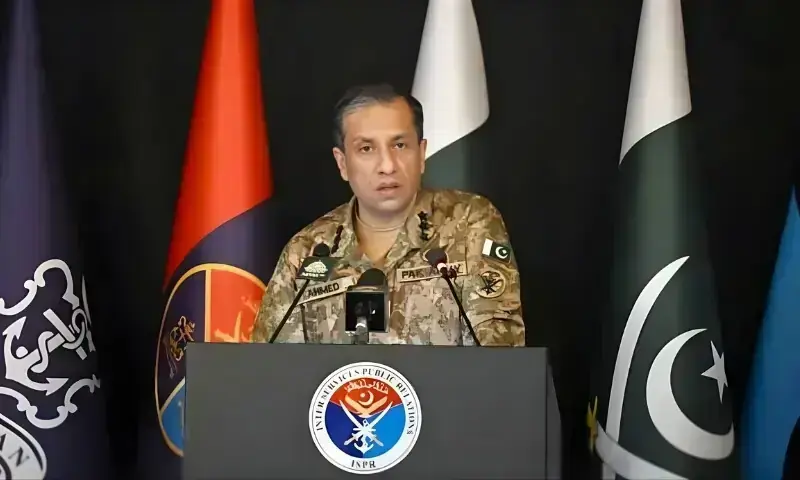
Pakistan today stands at a defining crossroads — one marked by renewed clarity, confidence, and conviction. The categorical statement by Director General Inter-Services Public Relations (ISPR) Lieutenant General Ahmed Sharif Chaudhry that there will be “no negotiations with any terrorist outfit” reflects not just a tactical shift, but a strategic transformation in Pakistan’s approach to national and regional security.
In a single declaration, the state’s position became unmistakable: there will be no compromise with those who target innocent lives or challenge the writ of the nation. It is a message of moral clarity and institutional resolve — one that reasserts Pakistan’s sovereignty, stability, and sense of purpose in an increasingly turbulent world.
A Clear Line, A Confident Nation
Lt. Gen. Ahmed Sharif also reaffirmed that any decision regarding the deployment of Pakistani troops to Gaza for peacekeeping duties will be made solely by the government and parliament. His remarks, coming amid speculation about Pakistan’s potential participation in the Gaza peace mission, reflect a deep respect for constitutional process and institutional discipline.
This posture is not only about military clarity — it is about Pakistan’s redefined national character. The new Pakistan emerging under the leadership of Prime Minister Shehbaz Sharif and Field Marshal Asim Munir is principled, pragmatic, and peace-oriented — a nation seeking to play a constructive global role while safeguarding its own security interests.
A Nation Rediscovering Its Purpose
This stance mirrors a broader shift in national thinking. Defense Minister Khawaja Asif, in a recent address at the Institute of Regional Studies in Islamabad, spoke of a Pakistan that is reasserting itself with confidence — diplomatically, economically, and strategically. He credited Prime Minister Shehbaz Sharif’s “sustained outreach” for rebuilding Pakistan’s credibility on global platforms like the United Nations, SCO, OIC, and the World Economic Forum.
Asif noted that Pakistan’s foreign policy today reflects a “forward-looking maturity” rooted in cooperation rather than confrontation. The renewed ties with Saudi Arabia, Qatar, and the UAE — now entering what he called a “new era of mutual confidence and economic cooperation” — are early indicators of that evolution. With the United States, Pakistan seeks a “broad-based partnership” focused on trade, technology, climate resilience, and counterterrorism. And the long-standing relationship with China, Asif said, remains an “anchor of regional peace and prosperity.”
This measured diplomacy has helped Pakistan transition from being perceived as a reactive state to one that is actively shaping the regional agenda.
Pakistan’s Expanding Diplomatic Horizon
The new diplomatic outreach extends well beyond traditional allies. Relations with Saudi Arabia, Qatar, and the UAE are witnessing a new era of mutual confidence and investment, while Pakistan’s renewed partnership with the United States has emerged as a cornerstone of its global engagement — reflecting shared interests in trade, technology, and regional stability.
Pakistan’s engagement with Central Asian republics through projects like CASA-1000, TAPI, and the Trans-Afghan Railway showcases its ambition to serve as a gateway for regional connectivity and trade — a bridge between South and Central Asia.
Pakistan and the Gaza Question
The Gaza Peace Process has opened an unexpected diplomatic window for Pakistan. Foreign ministers from Qatar, Saudi Arabia, the UAE, Jordan, Pakistan, and Indonesia gathered in Istanbul this Monday to discuss the fragile ceasefire in Gaza and explore the creation of an international peacekeeping force to enforce it.
The talks — hosted by Turkey — follow earlier meetings in New York, where Muslim leaders, including those from Pakistan, endorsed a U.S.-brokered ceasefire plan. The truce, though delicate, has momentarily halted the devastation in Gaza. Still, questions remain unresolved: the disarmament of Hamas, the timeline for Israeli withdrawal, and the governance of a post-war Gaza.
It is within this uncertain landscape that Pakistan’s new character could play a pivotal role. Having participated in numerous successful UN peacekeeping missions, Pakistan brings credibility and experience to any potential Gaza deployment. More importantly, its clarity on the use of force — rejecting terror but embracing peacekeeping — could help build confidence among skeptical international partners.
Clarity, Character, and Contribution
Pakistan’s dual message — no compromise with terrorism, and readiness to contribute to global peace — represents more than policy; it marks a redefinition of national character. It signals a country ready to act with principle, not just rhetoric.
Field Marshal Asim Munir’s leadership has been instrumental in setting this tone. His emphasis on internal stability, regional engagement, and global credibility has helped align Pakistan’s security and diplomatic priorities. Under his stewardship, the armed forces have reinforced their commitment to peace and order — not only within Pakistan but also as potential contributors to global peacekeeping missions, should the state decide so.
The Defense Minister’s reminder that Pakistan’s diplomacy is now driven by “clarity of purpose and coherence of policy” is not just an assessment — it is a statement of intent. Whether in confronting extremism at home or supporting peace abroad, Pakistan’s choices increasingly reflect a disciplined and confident state, aware of its responsibilities in a turbulent world.
Towards a Role of Responsibility
As deliberations in Istanbul unfold, the debate in Pakistan over joining the Gaza peace mission will continue. Some will see risks in involvement; others will recognize opportunity. But what stands out is the broader message Islamabad is sending — that Pakistan, after years of uncertainty, is ready to shoulder its share of responsibility in pursuit of regional peace.
The shift from reaction to resolve, from ambiguity to assurance, may well define Pakistan’s next chapter — one in which its clarity at home becomes the foundation of its credibility abroad.