
A Moroccan Journalist
Palestine as Performative Trend
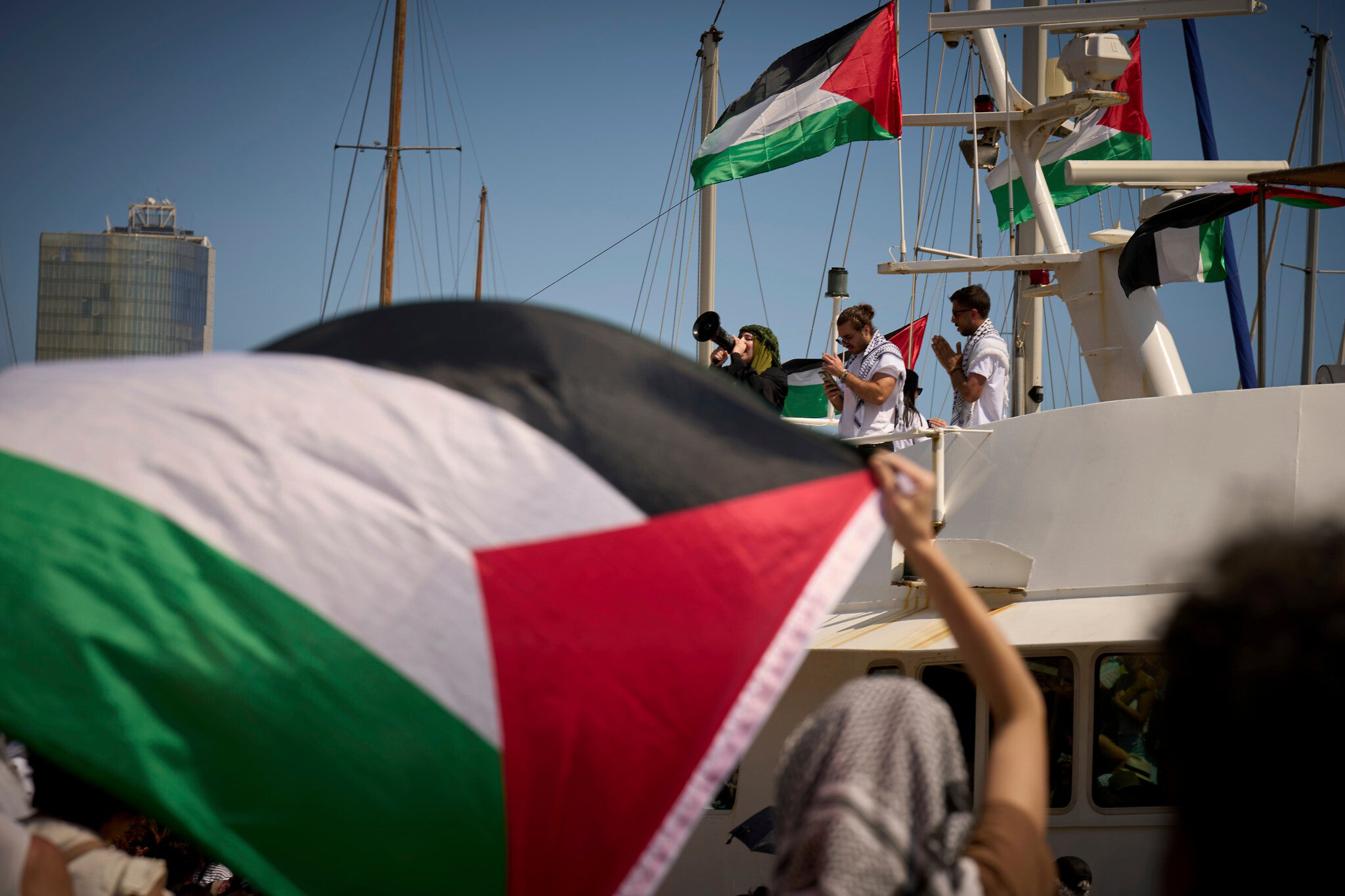
Demonstrators shout slogans on a boat ahead of the launch of a civilian flotilla bound for Gaza, aiming to break the Israeli blockade and deliver humanitarian aid in Barcelona, Spain, Aug. 31, 2025. (AP/Emilio Morenatti)
Amid the crowded marketplace of global causes, the Palestinian issue stands out as one that has been spectacularized – turned into performance, stripped of substance, and repurposed for trend and applause. In other words, it has been transformed less into a project of resolution and more into a theatre of performance. What was once a complex geopolitical conflict with deep historical roots has, in many quarters, devolved into a series of hollow gestures, vapid celebrity endorsements, and superficial demonstrations of solidarity that accomplish little beyond social signaling.
Consider the international artist who suddenly discovers their passionate commitment to Palestine – conveniently timed with their album release or exhibition opening. Their carefully crafted statements, often devoid of nuance or historical understanding, serve primarily to align them with prevailing cultural currents rather than contribute meaningfully to resolution. These performative declarations rarely translate into substantive action or genuine engagement with the complexities at hand.
In an age where attention has become the scarcest political currency, the Palestine cause increasingly risks collapsing into a succession of symbolic performances – celebrity proclamations of solidarity, viral slogans, and high-visibility flotillas that announce their moral intent at scale – while too rarely converting that visibility into the unglamorous, iterative work that actually changes material conditions.
Equally problematic are the much-publicized “humanitarian” flotillas that purport to break blockades or deliver aid. While these generate considerable media attention and dramatic imagery, their practical impact on Palestinian lives often remains questionable at best. The theatrical confrontation becomes the end rather than the means, with the actual welfare of Palestinians relegated to a secondary concern.
These much-publicized aid flotillas, departing with celebrities and hundreds of activists, present a spectacle that is undeniable and a humanitarian intent that is sincere. Yet the real test of seriousness is whether these caravans are nested inside credible diplomatic frameworks that secure predictable corridors, monitoring, deconfliction, and enforcement. Without that, they remain episodic voyages – easily intercepted, briefly celebrated, and just as quickly forgotten – producing another cycle of short-lived enthusiasm without securing durable access for civilians under siege.
Another revealing aspect is the way Palestine has become a fashionable symbol of rebellion, particularly among younger university generations in the West and segments of the radical left. For many of these students, chanting “Palestine” or draping themselves in its imagery is less about the actual conflict and more about projecting an oppositional identity against mainstream society. It functions as a badge of defiance, a convenient shorthand for being “anti-system” or “against the establishment.”
This is not new – each era finds its cause to embody dissent, from Vietnam to South Africa to Iraq – but in 2025, the banner is Palestine. The effect, however, is that the cause becomes another vessel for generational posturing, emptied of local realities and filled instead with symbolic gestures that serve primarily to announce one’s rebellion rather than advance meaningful solutions.
One of the clearest indicators of performance over substance is the so-called “solidarity” that manifests primarily as ritualized attacks on individuals or institutions deemed “complicit” with Israel. These campaigns of public shaming and cancellation substitute genuine political engagement with moral grandstanding. They offer participants the fleeting burst of satisfaction of righteous indignation without demanding the difficult work of understanding or resolving the underlying conflict.
The vocabulary for this drift exists – “moral grandstanding” and “virtue signaling” name the status-seeking use of moral talk – and while these labels are often wielded cynically, the underlying diagnosis matters: when the primary payoff is to look righteous before one’s tribe, causes devolve into theatre, and theatre, however emotionally gratifying, rarely forces policy movement.
The irony is palpable: those geographically, culturally, and politically removed from the conflict often perform the most aggressive displays of Palestinian identity and solidarity. Meanwhile, many Palestinians themselves maintain a more nuanced, pragmatic approach to their circumstances – one that acknowledges the complexity of their situation and the need for practical, sustainable solutions rather than inflammatory rhetoric.
This dynamic is precisely what social-movement scholars have warned about for years: public, low-cost gestures – what is often called “slacktivism” – can satisfy the actor’s self-image and audience expectations, creating the sense that one has “already done something.” That sense of contribution can, counter-intuitively, depress subsequent costly support and thereby displace capacity-building with reputation-building.
This discrepancy reveals much about the nature of contemporary activism. For many self-proclaimed allies, the Palestinian cause has become less about Palestinians and more about positioning oneself within a particular ideological framework. It offers a ready-made identity, complete with prescribed opinions, enemies, and symbolic gestures. Attention is the oxygen of movements, yes, but without institutions, leverage, and negotiated mechanisms, attention burns bright and burns out, leaving the hardest problems untouched.
What is lost in this performative approach is precisely what matters most: the genuine welfare of Palestinians and the prospects for a lasting resolution. Real solidarity would prioritize effective strategies over emotional displays, pragmatic solutions over rhetorical purity, and the actual needs of Palestinians over the desire for moral validation.
If we want the word “Palestine” to mean more than a trending signal of virtue, we should demand fewer declarations and more design: measurable commitments to sustained funding tied to verifiable outcomes; agreements that trade symbolic peaks for institutional plateaus; incentives that align local governance, regional guarantors, and international agencies around specific deliverables (hours of electricity, tonnage through crossings, functioning schools and clinics); and political advocacy that prefers cumulative wins to cathartic hashtags.
The Palestinian cause deserves better than to be reduced to a hashtag, a slogan, or a fashion statement. It deserves advocates who engage with its complexities, who prioritize results over righteousness, and who recognize that genuine support means more than simply echoing the trending sentiments of the moment. Until then, much of what passes for solidarity remains little more than an empty echo, signifying commitment but achieving little beyond self-satisfaction. Because causes that reward performance over progress become brands, and brands do not liberate people.
Related Topics
Related Posts