
Middle East Analyst
Why Gaza Is Waiting on the Strait of Hormuz
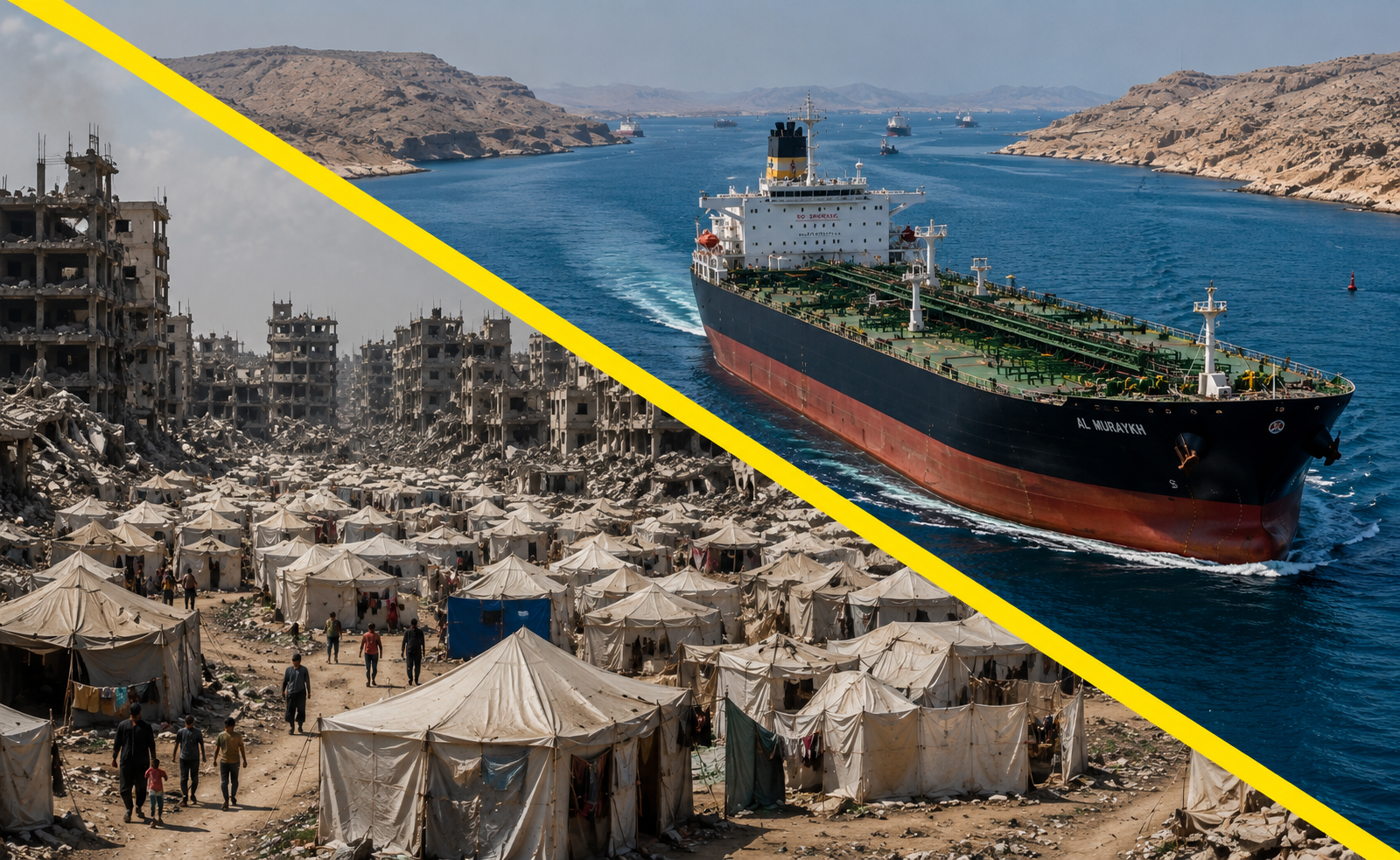
by author (AI)
This is the third in a series on the Board of Peace Road Map for Hamas Disarmament
Every week now brings at new dispatch on the Gaza disarmament standoff — a Board of Peace clarification that isn’t quite a clarification, an anonymous Israeli official contradicting an anonymous Arab diplomat, a 14-day clock that may or may not have started. Readers of the Israeli and Arab press can be forgiven for concluding that the story is the ambiguity itself: who moved the Yellow Line, whether Israeli troops actually withdrew from it, what “decommissioning” requires before what.
That is the wrong story, or at least an incomplete one. The more useful question is not why the Board of Peace can’t seem to settle these disputes. It is why Washington appears to have no urgent interest in settling them. Once that question is asked, the ambiguity stops looking like process failure and starts looking like a choice.
A pattern of managed drift, not stalled diplomacy
Set the specific disputes aside for a moment and look at how the Trump administration has actually behaved toward them. A senior US official waved off Netanyahu’s public rejection of the disarmament plan as campaign theater aimed at his right flank, while crediting the quiet, unannounced halt in Israeli strikes as the thing that actually mattered. A Board official floated that Hamas’s approval had triggered the Roadmap’s 14-day implementation clock, then walked that back a day later — and an Arab diplomat now suggests the clock’s start may simply never be announced, so mediators aren’t held to a deadline they can’t meet. Mladenov’s own definition of the Yellow Line manages to affirm Israel’s current positions while insisting nothing has changed.
None of this reads like an administration racing toward resolution. It reads like one keeping every option open and every deadline soft. That is a defensible strategy — but only if the administration has a reason not to force the issue yet. It does.
The keystone was never Gaza alone
Part One of this series argued that Gaza functions as the keystone of Trump’s regional architecture — the piece that unlocks Saudi normalization, expands the Abraham Accords, and further erodes the legitimacy of Iran’s resistance axis. That framing still holds, but it implies something the last several weeks of reporting have made concrete: Gaza’s value to Washington is instrumental. It is not currently the prize. It is the precondition for a larger deliverable, and preconditions can wait if the larger deliverable itself is still in motion.
Right now, the larger deliverable in motion is Iran. The Hormuz and nuclear-file negotiations running in parallel to the Gaza dispute are not a separate story competing for the administration’s attention. They are very plausibly the reason the Gaza story hasn’t been forced to a conclusion.
Why an Iran deal would move more than Iran
The case for treating Iran as the actual gating variable is not merely that Trump is distracted. It is that a semi-resolution of the Iran War would restructure the incentives of nearly every other actor in this standoff, through at least three distinct channels rather than one.
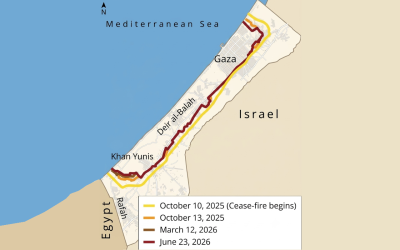
Gaza itself becomes more tractable as a deliverable, not less.
If Trump were able to achieve a negotiated reopening of the Strait of Hormuz, he is likely to declare victory and claim his war objectives have been achieved. That narrative may be acceptable to his base but recent polling showed that 79% of the American public does not believe the war has been worth the cost. Consequently, Trump will likely try to shift attention away from Iran directly and reframe it has part of the U.S.’s Gaza and broader regional peace strategy rather than a standalone concession extracted under pressure. That might also reduce the domestic political cost to Netanyahu — he could reasonably argue he is not bending to Hamas or the Board of Peace alone, rather he would be cautiously giving the U.S. space to to demonstrate that its regional peace structure can stabilize Lebanon, Syria, and Yemen.
Lebanon moves largely independent of Gaza — but both are tied to Iran.
It is tempting to assume that semi-resolution of the Iran would free Tehran to reinvest in Hezbollah, and that this reinvestment would show up in Beirut regardless of anything happening in Gaza. That assumption gets the direction of Iranian capacity right and the direction of Hezbollah’s trajectory wrong. Hezbollah reconstitution is not on the table — because three separate actors with three separate levers are converged against it.
Israel enforces the constraint militarily. It has demonstrated since 2024 that it will strike reconstitution attempts on a rolling basis, war footing or not, and there is no indication that calculus changes with an Iran deal — if anything, a freed-up Tehran gives Israel more reason to strike should either Hezbollah or Hamas attempt to reconstitute with Iranian assistance.
Saudi Arabia enforces the constraint economically, and enforces it directly rather than by proxy. It is a mistake to read Riyadh’s Iran calculus through the Houthi file alone. Hezbollah is arguably the more central Saudi grievance: Hezbollah played a central role in undermining the Saudi-backed Hariri government in Lebanon, it trained the Houthis in the first place, and it has cultivated real inroads into Shia communities in Saudi Arabia’s own Eastern Province. Riyadh is not going to fund Iranian reconstruction while Tehran is simultaneously funding the group most responsible for undermining Saudi interests in the Levant and, by extension, in Yemen. The Houthi file and the Hezbollah file are not two separate gates — the Houthi threat is substantially downstream of the Hezbollah relationship.
Washington’s role in this convergence is not enforcement but pacing. The likely US posture is pressuring Israel toward patience with a phased, benchmarked disarmament process run through the Lebanese state — leaning on Beirut’s own government, which has its own incentive to press the issue, and on a strengthened Lebanese Armed Forces as the vehicle — rather than letting Israel act unilaterally every time reconstitution is suspected. That is a management problem for Washington, not a substantive disagreement with Israel or Saudi Arabia about the end state. All three want the same outcome; they differ only on tempo and method.
That makes Lebanon a genuinely testable branch of this thesis, not a loose analogy to Gaza. If Iran semi-resolves and Hezbollah shows visible signs of rearming, the convergence argument is wrong. If Hezbollah reconstitution stays suppressed — through some mix of Israeli strikes, Lebanese state pressure, and Saudi economic discipline — while Gaza implementation continues to lag, that is a meaningful data point in the thesis’s favor: it would show Washington and its partners can hold a hard line on Lebanon without needing Gaza resolved first, reinforcing that the Iran file, not the Gaza file, is the actual variable driving regional sequencing.
Syria is the weaker link, and probably a narrative one rather than a mechanical one.
Damascus’s post-Assad government has a much thinner relationship to Tehran than Hezbollah does — the old supply corridor through Syrian territory is largely gone regardless of the nuclear file’s outcome. Syria’s trajectory looks more tied to its own internal consolidation, Turkish and Gulf involvement, and a separate sanctions relief calculus. Its place in Trump’s sequence is more likely to be rhetorical — a second or third deliverable to round out the “broader regional architecture” narrative — than causally linked to Iran the way Lebanon is.
What would prove this wrong
None of this should be read as inevitable. This is a probability-weighted read of actor incentives, not a forecast of outcomes, and it carries real obstacles: Iranian unpredictability in its own negotiations, Hamas’s demonstrated willingness to walk away from terms it finds unacceptable, Netanyahu’s coalition constraints ahead of an October 27 election that only get harder as the sequence moves toward Abraham Accords expansion — which likely requires exactly the kind of Palestinian-statehood-adjacent progress his government cannot survive conceding.
For now, the pattern is consistent: an administration managing Gaza’s ambiguity downward in urgency, holding every deadline soft, and crediting quiet compliance over public commitment — the behavior of a White House waiting on a bigger deliverable before it spends political capital forcing a smaller one closed.
Related Topics