
Where Objectivity Meets Reality
Palestinian leaders are billionaires. Why is the West still paying?
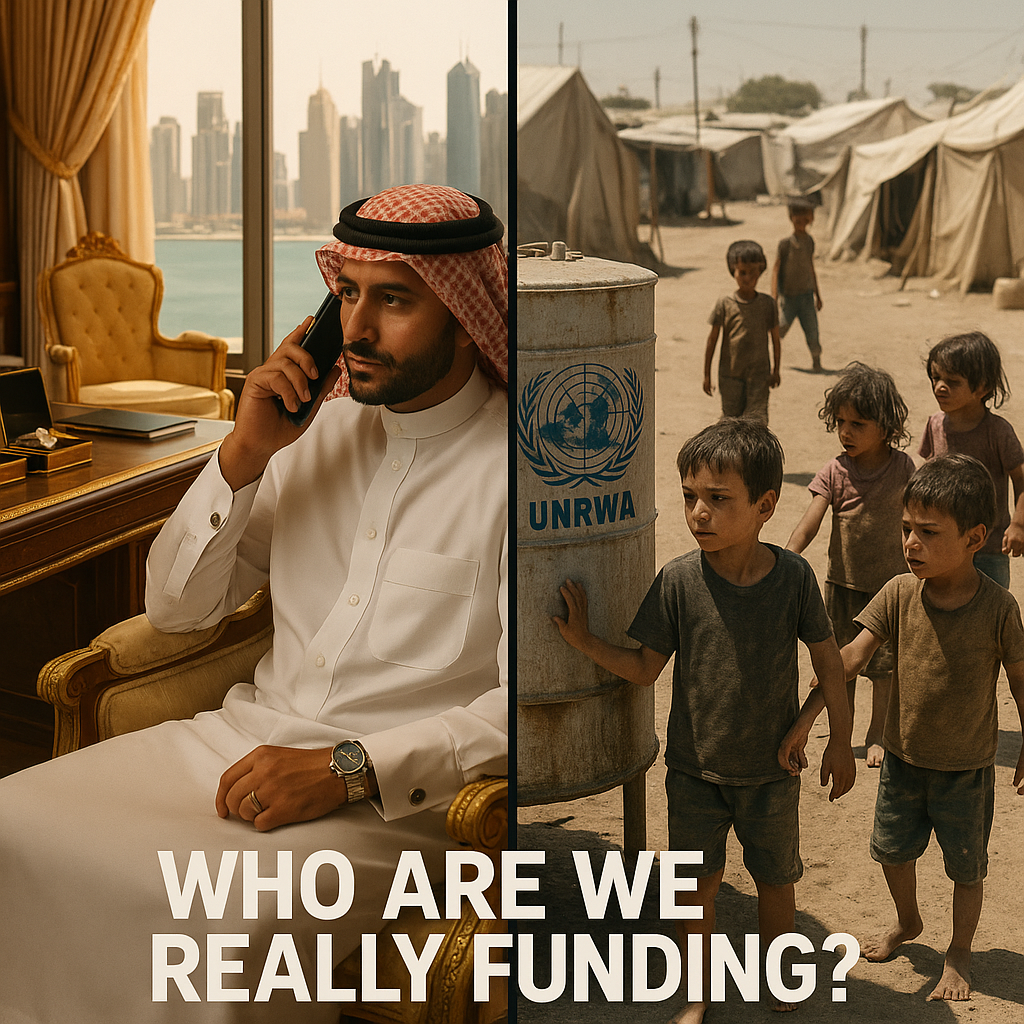
AI-generated illustration: On the left, a wealthy Palestinian leader in exile; on the right, a UNRWA-supported refugee camp in Gaza.
There are few conflicts in the world where the gap between perception and reality is as wide as in the Israeli-Palestinian case. While Western governments pour billions in aid to support a supposedly impoverished Palestinian population, its leadership is living in astonishing luxury. The question we should be asking is not how much more we need to give — but who exactly we are giving it to.
Take Ismail Haniyeh, the Hamas political chief. Often portrayed as a humble leader of resistance, Haniyeh in fact lives between luxury residences in Qatar and Beirut. His personal wealth is estimated at $4 to $5 billion. His sons in Gaza cruise around in sports cars and manage real estate and high-end businesses that the average Palestinian could never dream of affording.
Then there’s Khaled Mashaal, the former Hamas leader abroad, worth an estimated $2.5 to $5 billion, and Mousa Abu Marzook — another senior figure sitting on at least $2 billion. These are not freedom fighters. They are kleptocrats in keffiyehs. Hamas has turned Gaza into a rentier economy, taxing everything from food tunnels to tomatoes, while a clan-based business network siphons off foreign aid before it ever reaches the people.
And the Palestinian Authority? Supposedly the “moderate” alternative? Just as rotten. Mahmoud Abbas, who has ruled by presidential decree since 2005 without elections, presides over a regime riddled with nepotism and secrecy. His sons, Yasser and Tarek Abbas, head major firms in construction, telecom, energy, and finance — all funded through contracts with the very PA their father controls. Their combined worth is estimated in the hundreds of millions.
President Abbas himself is also wealthy — with properties in Jordan and Ramallah, personal security units, diplomatic jets, and undisputed control over government funds. What was once meant to be a national administration has morphed into a family enterprise.
And yet, every year, Western money keeps flowing. UNRWA receives more than $1.6 billion annually, primarily funded by the United States, Germany, the EU, and yes — Belgium. That’s roughly equivalent to Haniyeh’s personal wealth alone. The combined assets of the top leaders of Hamas and the PA? Over $10 billion. Enough to fund Gaza and the West Bank for years without a single cent from Brussels or Washington.
And in return? No transparency. No audits. No reform. Just the same familiar refrain: “If you don’t fund us, our children will starve.”
The moral blackmail is institutionalized.
What’s worse — and bitterly ironic — is that even Israel contributes to keeping the Palestinian Authority afloat. Israel collects and transfers tax revenues to the PA, which are used to pay civil servant salaries — sometimes even when the EU is late with its own payments. In times of instability, Israel effectively acts as a buffer to prevent the PA from collapsing. Yes, the very state so often accused of “oppressing” Palestinians helps bankroll the corrupt elite that rules them.
In any other context — Congo, Haiti, Afghanistan — this would be a scandal. If a national leader looted billions while the West kept funding schools and hospitals, there would be outrage. Newspapers would cry corruption. Legislators would demand a halt to aid. Governments would impose conditions.
But in the case of the Palestinians? Silence. To criticize the leadership is to be accused of “abandoning the people.” And so the West keeps paying — not out of solidarity, but out of fear.
Is it really so controversial to demand transparency as a condition for aid? Is it too much to ask that billionaires claiming to represent their people dip into their own pockets before asking European taxpayers to fill the gap?
Let’s say it clearly: this system is broken. The leaders enrich themselves, the children go hungry, and the donors look the other way.
Why must the West keep paying for a people whose leaders are richer than some countries?
Bibliography
- CBS News. (2003, November 6). Arafat’s Billions. https://www.cbsnews.com
- SFGate. (2004, November 13). Who will get Arafat’s millions? https://www.sfgate.com
- Al Arabiya English. (2007, August 22). Suha Arafat’s fortune in Tunisia. https://english.alarabiya.net
- Times of Israel. (2021, May 9). Meet the billionaire sons of PA President Mahmoud Abbas. https://www.timesofisrael.com
- UNRWA. (2023). Annual Operational Report. https://www.unrwa.org
- Transparency International. (2021). Corruption in the Palestinian Territories. https://www.transparency.org
- Reuters. (2020). Israel transfers tax funds to Palestinian Authority despite tensions.
- The Guardian. (2004, November 8). Arafat secretly diverted $900m in public funds. https://www.theguardian.com
- The Meir Amit Intelligence and Terrorism Information Center. (2022). Hamas’ control of Gaza’s economy: taxation and monopolies.
- Jerusalem Post. (2023). Hamas leaders’ wealth raises questions about corruption and foreign aid.
Related Topics
Related Posts