
The De-escalation Trap
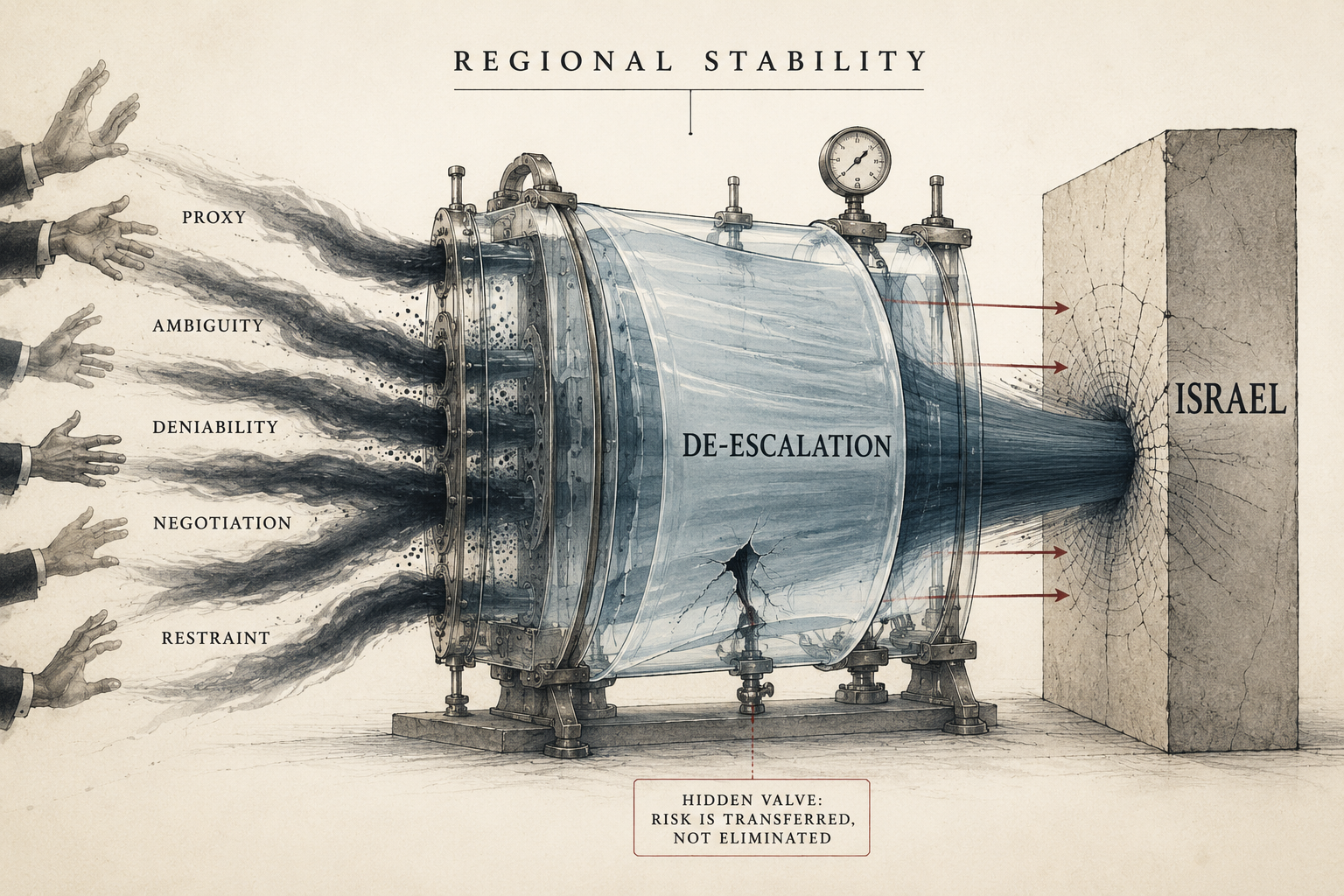
The De-escalation Trap
When peace does not remove danger, but transfers it.
A ceasefire can be a moral achievement. It can also be a technology for moving danger from one body to another. This is the uncomfortable distinction hidden inside much of today’s language of de-escalation. The word sounds clean. It carries the moral perfume of restraint, prudence, diplomacy, and responsibility. It allows statesmen to appear sober, commentators to appear humane, and international institutions to appear necessary. But de-escalation is not automatically peace. Sometimes it is only the reduction of visible violence at the price of transferring its future cost to someone else.
Israel knows this mechanism too well. When Hezbollah fires, when Iran negotiates, when Lebanon declares its inability to control the armed force operating from its territory, and when Western diplomacy searches for a regional arrangement that must not be disturbed, Israel is assigned a very specific role. It is not merely asked to defend itself proportionally. It is asked to absorb instability so that others may call the situation stable.
This is not peace. It is risk transfer. And beneath that transfer lies a deeper asymmetry of responsibility.
The international system often treats the aggressor’s dispersed violence as a complexity to be managed, while treating Israel’s response as an action to be judged with absolute precision. Iran may operate through distance, proxies, ambiguity, and deniability. Hezbollah may embed itself inside the political and territorial weakness of Lebanon. But Israel is expected to act with perfect granularity, perfect restraint, and perfect predictability under conditions deliberately designed to make such perfection impossible.
That is the hidden injustice. The actor that multiplies uncertainty is interpreted through context. The actor that must survive that uncertainty is judged through control. De-escalation then becomes the forced stabilization of the system at the expense of the exposed border of one of its parts.
The moral problem begins when restraint is detached from responsibility. Restraint is a virtue when it arises from judgment, discipline, and a real reduction of danger. It becomes something else when it is imposed on the actor already exposed to danger, while the source of violence remains structurally intact. In that case, restraint no longer means ethical self-limitation. It means enforced passivity spoken in the language of maturity.
The international vocabulary is full of such disguises. “Avoid escalation” often means: do not respond in a way that makes the hidden architecture visible. “Preserve the diplomatic track” often means: do not interrupt the arrangement by which the violent actor gains time, depth, legitimacy, or leverage. “Give peace a chance” often means: accept a future threat today so that someone else may announce success tonight.
This is the false morality of de-escalation. It treats the absence of immediate explosion as if it were already a moral order. But not every silence is peace. Not every pause is repair. Not every reduction of fire means a reduction of violence. A threat can become quieter because it has been dismantled. It can also become quieter because it has been relocated, deferred, legalized, or placed under the protection of diplomatic language.
That distinction matters because an agreement may reduce open confrontation between major powers while leaving Israel facing an armed proxy system on its border. In that case, the agreement has not removed violence. It has redistributed exposure. If a ceasefire requires Israel to stop acting while Hezbollah keeps the strategic benefit of its embeddedness, then the ceasefire does not end the problem. It freezes it in a more convenient form. If Iran can use Lebanon as a bargaining chip while claiming the dignity of diplomacy, then de-escalation becomes not the opposite of war, but one of war’s administrative techniques.
This is why the moral grammar must be rebuilt. The central question is not simply who fired last, nor who risks derailing the agreement. The deeper question is where the cost of the agreement has been placed. If the cost is placed on the actor whose civilians remain exposed, then the language of peace has become morally corrupt.
If the burden of “responsibility” means that Israel must tolerate the conditions that make the next attack possible, then responsibility has been inverted. The exposed party becomes responsible for maintaining the appearance of calm, while the aggressor retains the infrastructure of future violence. That inversion is especially dangerous because it flatters the conscience of outside observers. They can condemn escalation without asking what made response necessary. They can praise diplomacy without asking who has been made vulnerable by it. They can speak of regional stability while treating Israel as the shock absorber of everyone else’s contradictions.
This is not only a strategic error. It is an ethical failure. A Jewish grammar of responsibility cannot confuse the sanctity of life with the obligation to absorb threat. The sanctity of life does not require a people to become the passive surface on which others test their diplomatic theories. Responsibility is not self-erasure. Restraint is not the same as consent to future attack. Peace is not achieved by asking the threatened party to lower the visibility of its own danger.
There is also a warning here for both right and left. The right can mistake force for solution, as if every strike were already a transformation of the field. It is not. A response that does not alter the conditions of recurrence remains trapped inside the logic it tries to defeat.
But the contemporary liberal and left vocabulary often commits the opposite error. It mistakes the reduction of visible force for moral progress. It sees restraint and assumes justice. It sees negotiation and assumes repair. It sees quiet and assumes peace. This is a dangerous superstition. Quiet may be only the sound made by a threat after it has been successfully transferred into the future.
Real peace must pass a stricter test. It must not merely lower the temperature of the present. It must change the conditions under which violence becomes possible again. It must not merely demand Israeli restraint. It must remove the structures that turn Israeli restraint into someone else’s strategic opportunity. It must not preserve the fiction that Lebanon is separate from Hezbollah when Hezbollah can still determine the terms under which Lebanon becomes part of a regional arrangement. It must not allow Iran to bargain through proxies and then present the result as responsible diplomacy.
A peace that leaves the mechanism of threat intact is not peace. It is a pause with excellent public relations. The question, then, is not whether Israel should prefer war to diplomacy. That is a false choice, and a cheap one. The real question is whether diplomacy is being used to dismantle the machinery of violence or to protect it from interruption.
If diplomacy dismantles the machinery, it deserves support. If it only relocates the burden of danger onto Israel, it deserves suspicion. And if the world calls that relocation “de-escalation,” then the word itself has become part of the problem. Peace is not the absence of Israel’s response. Peace begins when the source of violence is no longer allowed to outsource its consequences.
Yochanan Schimmelpfennig