
Palestinian Recognition or Trump-Style Tactic?
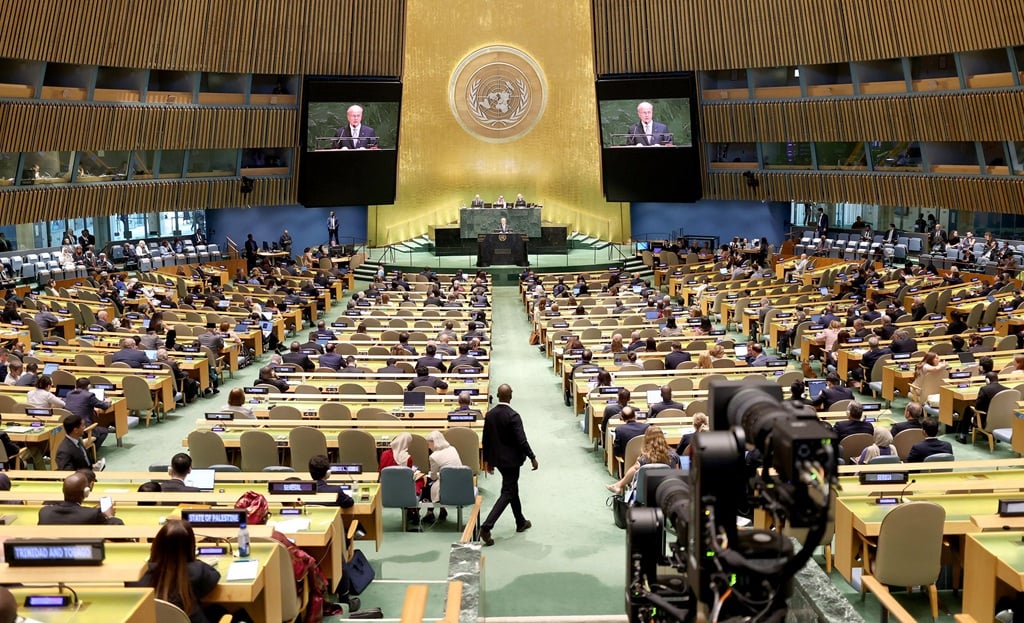
The recent international momentum to recognize a Palestinian state before September 9 is not merely a matter of moral principle—it increasingly resembles a calculated negotiation tactic. The approach echoes a well-known strategy: set the bar extremely high, only to later retreat to a more acceptable compromise. It’s a method most famously used by Donald Trump in his trade wars: impose unattainable tariffs as a first move, and then renegotiate a more favorable deal. Today, Western diplomacy toward Israel appears to be following a similar path.
This parallel becomes clearer when examining recent diplomatic shifts. British Prime Minister Keir Starmer, who marked one year in office on July 5, is leading a coalition poised to recognize a Palestinian state—but only if three conditions are not met: an end to the war in Gaza, significant humanitarian improvement, and an Israeli step toward a two-state solution.
France has announced it will formalize recognition at the upcoming UN General Assembly. They are joined by countries like Norway, Ireland, and Spain—which recognized Palestine in May—and others including Australia, Canada, Finland, Luxembourg, Belgium, Slovenia, Malta, and New Zealand, all considering similar moves. While publicized as a moral stance, recognition is functioning more as a diplomatic lever than a transformative decision.
Israel’s Firm Response and a Fragmented Coalition
Israel reacted quickly and firmly. UN Ambassador Danny Danon dismissed these initiatives as “hypocrisy” that legitimizes terrorism while ignoring the plight of the 50 Israeli hostages still held by Hamas. The Hostages Forum echoed this sentiment, calling it “dangerous to recognize Palestine before their release.”
Inside the Israeli government, divisions are growing. While some moderate voices cautiously explore diplomatic channels, hardliners like Finance Minister Bezalel Smotrich openly promote resettling parts of northern Gaza as a strategy to weaken Hamas. Yet some analysts suggest that Smotrich may ultimately settle for international recognition of Israeli sovereignty over Judea and Samaria (West Bank), using Gaza maximalism as a bargaining chip.
A recent request by 22 ministers and lawmakers—including Itamar Ben Gvir and Shlomo Karhi—called on the Defense Minister to allow a settler tour of northern Gaza to assess new settlement locations. The Nachala movement, behind the initiative, posted on social media: “It’s time to resettle the northern sector as the first step toward reconquest, expulsion, and full settlement of Gaza.”
A Shift in the Arab World: Pressuring Hamas
Meanwhile, a surprising development came from Arab capitals. Qatar, Saudi Arabia, and Egypt—backed by 14 other countries—issued a joint statement urging Hamas to lay down its arms and hand over Gaza to the Palestinian Authority. The statement aims to pave the way for a ceasefire, hostage release, and a two-state resolution. However, Hamas continues to reject any handover of power, stalling progress in Doha.
Recognition or Leverage?
Beyond symbolism, Palestinian recognition has become a tool of political pressure. Just as Trump used extreme opening demands to steer negotiations, many Western governments are presenting immediate recognition as a “first offer”—not a final destination. A humanitarian gesture, ceasefire, or minimal Israeli concession might be enough to de-escalate the diplomatic pressure.
Domestic Consensus: From Right to Center-Left
Domestically, there is near-unanimity. No Israeli government official currently supports recognizing a Palestinian state under current conditions. The prevailing position is that such a move would reward terrorism and undermine Israeli deterrence.
Even in the opposition, support for immediate recognition is rare. While some lawmakers within Arab parties, the left-wing Hadash-Ta’al, and the “Democratim” party led by Yair Golan support a two-state solution, most opposition leaders—including Yair Lapid and Benny Gantz—oppose the international timeline and tactics. The disagreement is less about the end goal, and more about the timing, trustworthiness of interlocutors, and security conditions.
An Open Ending to a Familiar Game
In this landscape, Palestinian statehood recognition appears less like a political conclusion and more like a negotiation trigger. It’s a high-stakes opening move designed to reshape the conversation.
Just as Trump’s unreachable tariffs were never meant to be permanent, the London–Paris–UN axis may not expect full recognition to materialize immediately. Instead, it is applying maximum pressure to extract incremental concessions from Israel. The real aim is to shift the center of gravity in international diplomacy—because, like any hard negotiation, the first move isn’t necessarily meant to end the game… but to force it open.