
Greek Jewish roots. New York voice. Unfiltered perspective.
Paradise Has a Passport Problem
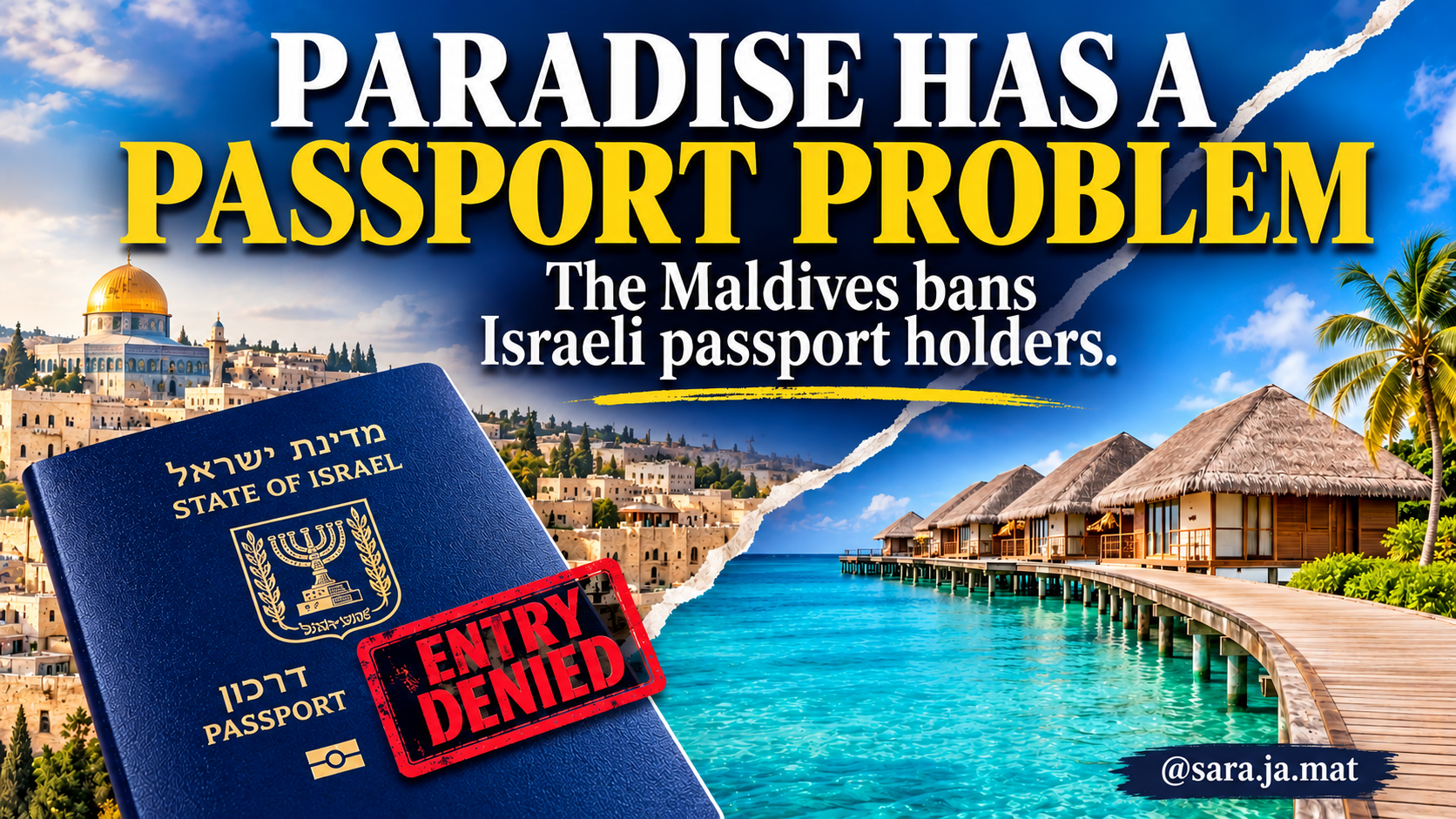
The Maldives bans Israeli passport holders while its constitution prohibits non-Muslims from becoming citizens. Now it wants to make the Israeli ban unconditional. But the most uncomfortable question is not who the Maldives excludes. It’s why.
Terminology note: In this article, I use “Gazans” when referring specifically to residents of Gaza. Where “Palestinian” appears, it may reflect official terminology, source material, or a broader geographic or political designation. These terms are used for clarity and do not imply endorsement of any particular historical or political narrative.
Imagine two tourists arriving at a luxury resort in the Maldives.
One is an Israeli Muslim. He votes in Israeli elections, worships in a mosque, and has never harmed anyone.
The other is a Palestinian from Gaza.
The Israeli is prohibited from entering on his Israeli passport.
The Palestinian is not subject to an equivalent blanket nationality-based prohibition.
Now imagine that the Palestinian was among those who crossed into Israel on October 7, 2023, and participated in the atrocities committed that day.
Would the Maldives identify him through individual screening? Would he be denied entry? Its general entry rules do not answer those questions.
But we know something about the Israeli.
He is excluded before anyone asks what he has done.
His passport is enough.
And here is another fact that makes this story even more extraordinary.
A Muslim can serve on Israel’s Supreme Court. A non-Muslim cannot become a citizen of the Maldives.
That is not an opinion.
Article 9(d) of the Maldivian Constitution states:
“A non-Muslim may not become a citizen of the Maldives.”
Read that again.
The country constitutionally excluding non-Muslims from citizenship is the country barring Israeli passport holders while invoking principles of justice and human rights.
Why is Israel being singled out?
And why is the nationality of an ordinary Israeli sufficient grounds for exclusion when individual responsibility should be the standard?
October 7: Before the War, There Was an Invasion
On October 7, 2023, Hamas-led attackers invaded southern Israel.
They murdered civilians in their homes. They attacked young people at the Nova music festival. They abducted men, women, and children into Gaza.
Victims were shot at close range. People were burned alive. Bodies were mutilated. Hostages were subjected to sexual violence.
The United Nations Special Representative on Sexual Violence in Conflict found reasonable grounds to believe that rape and gang rape occurred during the attacks, and clear and convincing information that hostages experienced sexual violence, including rape and sexualized torture.
These were not ordinary acts of war.
They included deliberate attacks on civilians.
And Hamas was not alone.
The United Nations Independent International Commission of Inquiry documented the participation of Gazan civilians who crossed from Gaza alongside Hamas and other armed groups.
That distinction matters.
I am not suggesting that every resident of Gaza participated in October 7. I have no evidence to substantiate such a claim.
I am pointing out that the perpetrators were not exclusively uniformed members of Hamas.
Gazan civilians participated too.
And more than three years later, amid thousands of reports, competing narratives, viral videos, propaganda, and misinformation, I am still searching for one documented account of a civilian who crossed from Gaza into Israel that day and chose to save an Israeli life.
Not an Arab Israeli.
Not an Israeli Bedouin.
Someone who actually crossed from Gaza on October 7.
I have not even encountered an unsubstantiated story making that claim.
In an age when almost anything can become a viral narrative, I find that absence astonishing.
If such an account exists, I invite readers to share a credible source in the comments. I genuinely want to examine it.
The absence of a story I have encountered does not prove no such act occurred. But the question remains worth asking.
And it leads to an even more uncomfortable one.
If the Maldives believes an entire nationality can be excluded without proof of individual wrongdoing, why does it apply that standard to Israelis but not to Palestinians, some of whom also participated in the October 7 atrocities?
The Passport Is Guilty. The Person Is Irrelevant.
Israel launched its military campaign against Hamas after the October 7 attacks.
The war in Gaza has caused enormous civilian suffering. But any serious discussion of that suffering must also confront Hamas’s responsibility for the war’s origins and its consequences.
Hamas launched the October 7 invasion, deliberately attacked civilians, took hostages, and continued to operate militarily among Gaza’s civilian population. Its refusal to disarm has also complicated efforts to rebuild the territory and improve conditions for the very Palestinians it claims to represent.
As winter storms flood displacement camps across Gaza, families are struggling to keep their children warm and dry. According to Israel’s military and COGAT, more than 91,000 tents and 8,200 trucks carrying winter supplies have entered Gaza.
Yet reports citing Palestinian sources accuse Hamas of confiscating humanitarian tents intended for displaced families and attempting to control their distribution.
If Hamas is taking shelter supplies from Palestinian families facing another winter in flooded camps, why isn’t that conduct receiving greater scrutiny?
The people of Gaza deserve to receive the assistance intended for them. And any organization accused of diverting that assistance should be held accountable.
The IDF operates under a formal military code of ethics, rooted in the principles of human dignity, restraint, and the protection of civilian life. Its professionalism and efforts to minimize civilian casualties have earned recognition from experienced military commanders internationally.
Consider Colonel Richard Kemp, former commander of British forces in Afghanistan, who testified before the United Nations that, during Israel’s 2008–2009 Gaza operation, the IDF had taken exceptional measures to protect civilians. Kemp has repeatedly praised the IDF’s professionalism and described it as one of the world’s finest armies.
And he is not alone. A High Level Military Group of international military experts concluded in 2015 that Israel had made extraordinary efforts to avoid civilian casualties during its 2014 Gaza operation.
Does that mean every IDF soldier always acts honorably? Of course not. Individuals can go rogue, disobey orders, and violate the laws of war. That possibility exists in every military on earth, and misconduct must be investigated and prosecuted.
But individual wrongdoing does not automatically define an entire military, and it certainly does not establish the guilt of millions of civilians who share its nationality.
A soldier’s misconduct must be judged by evidence. An Israeli civilian’s innocence should not be overridden by a passport.
But accountability cannot be selective. Hamas’s responsibility for initiating the October 7 war cannot disappear from the discussion of Gaza’s suffering, just as the actions of an individual soldier cannot automatically establish the guilt of an entire nation.
If individual responsibility matters when judging the people of Gaza, it must matter when judging the people of Israel.
The sequence of events matters.
Israel’s military response followed the October 7 invasion. It did not precede it.
On June 2, 2024, the Maldives announced plans to prohibit Israeli passport holders from entering the country, presenting the decision as solidarity with Palestinians amid the war in Gaza.
On April 15, 2025, President Mohamed Muizzu ratified the ban into law.
The Maldivian government described its decision as a response to allegations of Israeli atrocities and genocide in Gaza. Israel categorically rejects the accusation of genocide.
An accusation repeated for three years does not become a proven fact simply because it has been repeated loudly enough.
Israel has been fighting one of the most complex forms of modern warfare: urban combat against an armed organization that deliberately blurs the distinction between fighters and civilians. As documented by the Royal United Services Institute, a leading British defense research organization, Hamas fighters have operated in civilian clothing without identifying markers, making it exceptionally difficult to distinguish combatants from noncombatants. Reuters has also documented Hamas fighters conducting guerrilla attacks in ordinary civilian attire.
These are not minor details. They are central to understanding the battlefield, the civilian casualties, and the extraordinary challenges confronting Israeli forces.
Genocide is a specific legal crime requiring proof of intent to destroy a protected group, in whole or in part. Civilian deaths, however tragic, do not automatically establish that intent. Nor does the complexity of urban warfare automatically absolve a military of responsibility for its conduct.
And as of November 2026, the International Court of Justice has not issued a final judgment establishing that Israel committed genocide. The proceedings remain ongoing.
The accusation is not a verdict. The complexity of the battlefield cannot be erased. And the suffering of civilians cannot be used to dispense with the requirement for evidence.
Most importantly, even a finding against a government or military would not establish the personal guilt of every citizen.
Yet the Maldives has effectively made Israeli nationality itself grounds for exclusion. No individual evidence required. No distinction between soldier and civilian. No distinction between those who support the war and those who oppose it.
That is not individual accountability. It is a blanket judgment imposed on people because of the passport they carry.
An Israeli grandmother who has never harmed anyone is barred from entering on her Israeli passport.
So is an Israeli Muslim who opposes the war.
So is an Israeli Christian who has never served in the military.
So is a Druze citizen who has never participated in any military operation.
No criminal conviction is necessary.
No evidence of personal wrongdoing is required.
The passport is guilty. The person is irrelevant.
Now apply the same reasoning elsewhere.
Many civilians from Gaza participated in the October 7 attacks. Does that make every resident of Gaza responsible?
No.
But if the Maldives has chosen nationality rather than individual conduct as its standard for excluding Israelis, what principle explains why it does not impose an equivalent blanket restriction on Palestinians?
This is not an argument for punishing innocent Palestinians.
It is a challenge to the logic of punishing innocent Israelis.
A Palestinian civilian is not automatically Hamas.
An Israeli civilian is not automatically responsible for every decision of the Israeli government.
Either individual responsibility matters, or it doesn’t.
And if the Maldives believes nationality-based exclusion is justified, it should explain how consistently that principle is applied.
The Israel That Doesn’t Fit the Narrative
Now consider the country the Maldives has chosen to exclude.
Israel is home to Jewish, Muslim, Christian, Druze, and other communities.
Its Arab citizens vote, serve in parliament, work in medicine and law, attend universities, and participate in civic life.
Mosques, churches, and synagogues operate throughout the country.
In 2022, Khaled Kabub became the first Muslim justice appointed to Israel’s Supreme Court. Arab Christian judges had served on the court before him.
Think about that.
A Muslim can sit on the highest court of the Jewish state.
Meanwhile, a non-Muslim cannot become a citizen of the Maldives.
No country is without discrimination, inequality, or political conflict. Not Israel. Not the United States. Not any nation on earth.
The existence of those problems does not erase Israel’s religious diversity or the participation of its minority citizens in public life.
Nor does it excuse violations of anyone’s rights.
But there is a difference between examining a country’s shortcomings and ignoring another country’s explicit legal exclusions.
Why does Israel’s religious character generate such intense scrutiny while the Maldives’ constitutional prohibition on non-Muslim citizenship remains unfamiliar to so many people?
What Paradise’s Constitution Actually Says
The Maldives is famous for turquoise lagoons, white-sand beaches, and luxurious overwater villas.
It markets itself as a place where travelers can escape the world’s troubles.
But the legal framework governing its citizens tells a less idyllic story.
Article 9(d) prohibits non-Muslims from becoming citizens.
Islam is the state religion, and the constitution prohibits legislation contrary to Islamic principles.
According to the U.S. Department of State’s 2023 International Religious Freedom Report, the Maldives maintains restrictions on non-Islamic religious expression and proselytizing.
The report also describes religious qualifications for senior public office and legal consequences for conversion away from Islam, potentially including loss of citizenship.
These restrictions have been criticized internationally. They are not entirely unknown or unexamined.
But they deserve a place in this discussion.
Imagine a Jewish tourist admiring the sunset from an overwater bungalow.
Imagine a Christian family celebrating an anniversary at a resort.
Imagine a Hindu couple honeymooning beside the Indian Ocean.
They are welcome to purchase the experience.
But under the Maldivian Constitution, they cannot become citizens while remaining non-Muslim.
The contrast between international hospitality and religious exclusion is written into law.
And the government enforcing those restrictions has decided that Israeli passport holders, regardless of their religion, are unwelcome.
When a Wartime Ban Becomes Unconditional
The Maldives is now considering going further.
On November 9, 2026, President Muizzu’s government submitted immigration legislation seeking to make the Israeli-passport prohibition unconditional.
The President’s Office confirmed the proposal, and the People’s Majlis parliamentary record listed the Immigration Bill as ongoing following its first reading.
As of November 11, the proposed unconditional restriction had not been confirmed as enacted.
The distinction matters.
The existing ban was introduced in connection with Israel’s military campaign in Gaza.
The proposed legislation would remove that condition.
In other words, even if the circumstances invoked to justify the restriction changed, the exclusion could remain.
According to Maldives Independent, the proposed immigration changes could go even further, potentially extending the ban to Israeli dual nationals traveling on non-Israeli passports.
If the war was the justification, why should the ban outlive the war?
The proposed immigration legislation also includes other restrictions. According to Maldives Independent, these include provisions concerning individuals charged by or subject to arrest warrants from the International Criminal Court.
Those provisions are separate from the Israeli-passport restriction.
That difference is important.
One type of restriction concerns a person’s alleged conduct or legal status.
The other concerns nationality.
If individual wrongdoing can be grounds for exclusion, why is Israeli nationality alone sufficient?
You Can Visit Paradise. But Can You Belong?
The proposed immigration law is not the only development.
On the same day, the government introduced a separate Real Estate Development Bill.
According to Maldivian reporting, the bill would prohibit Israeli citizens and companies with Israeli ownership interests from acquiring certain leasehold property rights within designated integrated development zones.
This is a proposed restriction covering specified developments, not an enacted nationwide ban on Israeli property ownership.
The proposed real-estate provisions concern Israeli citizenship and ownership interests, potentially affecting dual nationals differently from the existing passport-based entry restriction.
The legislation also reportedly prohibits constructing non-Islamic places of worship within those development zones, according to The Edition.
That provision reflects the broader restrictions on non-Islamic worship already documented in the Maldives.
Consider the picture.
A country inviting international visitors and investment while proposing restrictions tied to Israeli nationality and maintaining legal barriers to non-Islamic religious institutions.
The Maldives received approximately 2.25 million international tourist arrivals in 2025, according to official Maldivian statistics.
Its hospitality industry welcomes the world’s money.
Its constitution limits who may belong.
And its immigration policy draws a line at the Israeli passport.
The question is not whether the ban will damage tourism revenue.
The question is what happens to the principle of equal human dignity when nationality becomes a substitute for personal responsibility.
The Question the Maldives Must Answer
The Maldives has the right to criticize Israel’s government.
It has the right to advocate for Palestinians.
It has the right to regulate entry into its territory, subject to its legal obligations.
But those rights do not place its policies beyond examination.
There is no contradiction in condemning the October 7 atrocities and demanding accountability for unlawful conduct in Gaza.
There is no contradiction in supporting Palestinian rights and questioning the Maldives’ treatment of Israelis.
And there is no contradiction in examining Israel’s laws while also examining the Maldives’ constitution.
The contradiction appears when a government invokes justice while excluding people who have committed no established wrongdoing.
When it condemns discrimination while maintaining religious restrictions of its own.
When it claims to act on principle but declines to explain why that principle applies to one nationality and not another.
If the principle is accountability, investigate individuals and hold perpetrators accountable.
If the principle is religious freedom, examine the laws that restrict it.
If the principle is human dignity, stop treating an entire nationality as a verdict.
The Maldives promises paradise.
Its constitution tells us who is allowed to belong.
Its immigration policy tells us which passport holders are unwelcome.
And its proposed legislation would make that exclusion unconditional.
So here is the question:
If an Israeli who has never harmed anyone is automatically unwelcome, while the Maldives imposes no equivalent blanket exclusion on people from Gaza despite the documented participation of many Gaza civilians in October 7, what consistent principle is being applied?
Because condemning an entire nationality is not the same thing as holding perpetrators accountable.
And a passport is not a criminal conviction.
Paradise may be beautiful. But beauty does not exempt a government from explaining its double standards.
Related Topics
Related Posts