Parashah Bo — Existential lessons
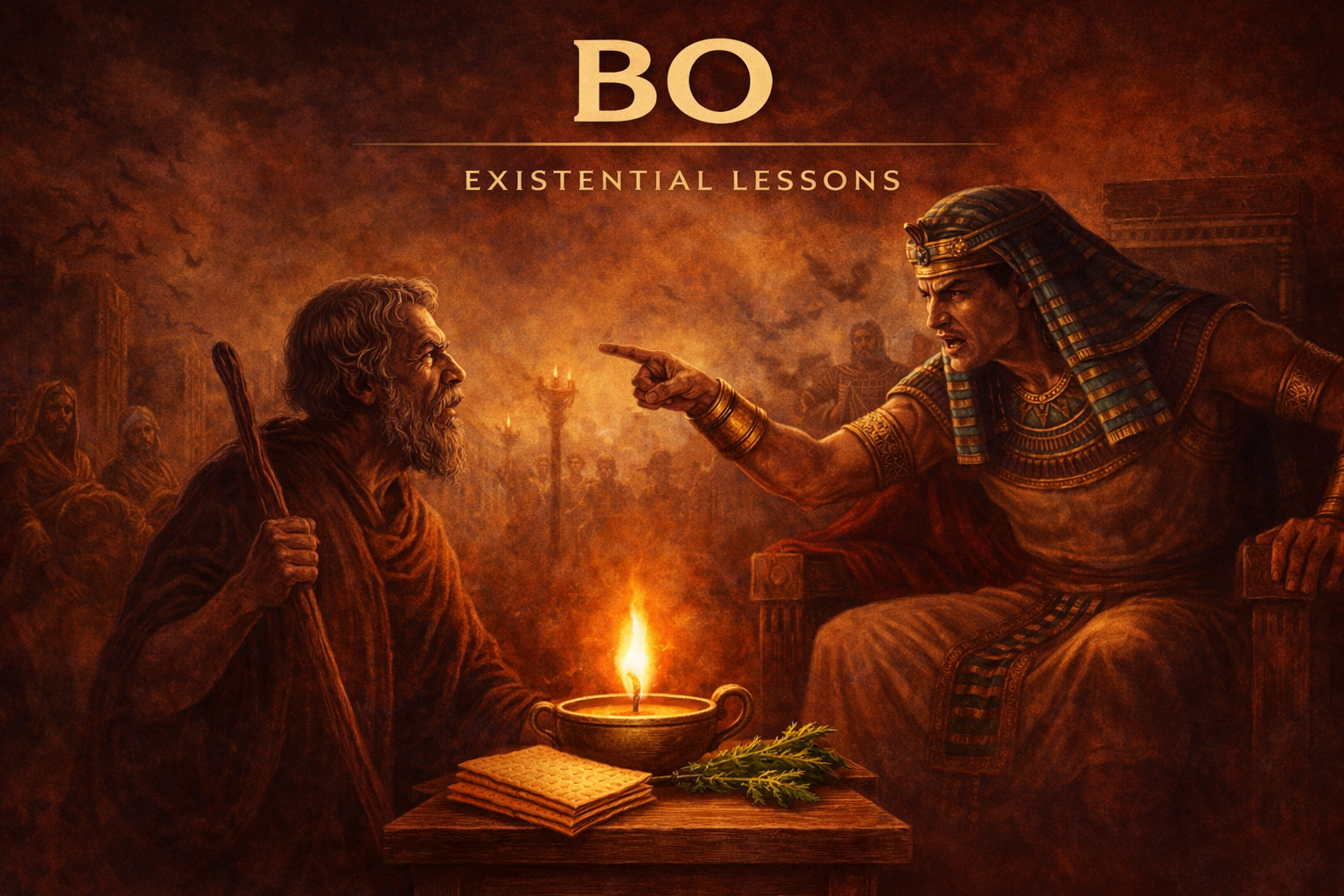
PARASHAH BO — Existential lessons
History doesn’t always advance in light. Sometimes the real beginning happens when the light is gone and you’re left with nothing but night — thick night, the kind that makes the air feel heavier than it should.
Bo is that edge. That moment right before dawn when it’s still dark enough to doubt the whole idea of freedom.
Egypt is breaking. The Nile stinks. The fields are dead. The sky feels shut. And Pharaoh still says no. Not because he’s strong. Because he’s scared out of his mind.
Letting go isn’t just politics. For a man like Pharaoh, letting go is death.
And ego, in any century, would rather sink with something familiar than be reborn into something it can’t control.
“Bo el-Paró” — don’t stand outside
The parashah opens with a command that honestly doesn’t sound comforting at all:
בֹּא אֶל־פַּרְעֹה — Bo el-Paró.
It doesn’t say, “Go speak.”
It doesn’t say, “Try.”
It says: Enter.
Enter the centre of the power that denied you. Enter the place you’d rather not look at.
Because freedom doesn’t start outside the problem. It starts when you stop circling the thing that scares you. Most slavery isn’t chains. It’s fear drawing a border around your life. It’s the line you never cross.
And the first shift doesn’t even happen in Pharaoh. It happens in Moshe.
He enters, and something changes in him. Not because he stopped feeling fear — but because he stopped obeying it.
That’s the Exodus rule: what you fear doesn’t necessarily destroy you.
Sometimes it just… hits you, shakes you, passes through.
And you’re still standing there, surprised you didn’t die.
Locusts — appetite without end
Then come the locusts. They eat what’s left. Everything green. Anything that could become tomorrow.
And it’s not just punishment. It’s a mirror.
A system built on control eventually devours itself. What you refuse to release rots. What you refuse to let breathe breaks. People do this all the time: they tighten their grip on a relationship, a child, a future, a self-image… and they crush the life out of it.
Pharaoh’s advisers are basically begging him: “Do you not see Egypt is ruined?”
But he can’t hear. Because hearing would mean stepping off the throne. And that’s the thing about ego: it can survive pain. What it can’t survive is losing the centre.
Darkness — paralysis
Then comes darkness you can touch. Not normal night. Heavy darkness. Three days where Egypt can’t move.
The Torah doesn’t say they didn’t want to. It says they couldn’t.
That line is terrifying, because we know it. There are states where your body moves but your soul is stuck. Where you keep doing life, but inside you don’t actually go anywhere.
And then the detail that cuts through everything:
In the houses of Israel there is light.
Not spectacle. Not heavenly fireworks.
Domestic light. A lamp. A table. A family still eating.
That’s where redemption starts. Not in the palace. Not in the square. In the home — when the home stops being a hiding place and becomes an altar.
Firstborn — the centre collapses
Then the firstborn die. Every house screams.
And it’s unbearable, but it’s also symbolic: the firstborn means continuity, permanence, “I will last.” In Egypt it’s the centre of the whole order.
That night the centre collapses.
And Pharaoh yields — not because he’s enlightened, but because he’s empty.
The most shocking thing: Israel cooks
While Egypt screams, Israel cooks. That’s insane. But it’s Torah’s point.
They prepare the Korban Pesach. A lamb lives for days with the children. They feed it. Touch it. Then they slaughter it, roast it, paint the doorway with blood, eat in haste — sandals on, staff in hand.
It’s not magic. It’s a boundary.
This is what freedom looks like in practice: a visible “up to here.”
The blood on the threshold says: this house has law now. This life has a border now.
And matzah says the same thing: you don’t leave inflated. You don’t leave with ego. You leave light, with the essential.
Time changes owner
Then HaShem resets time:
“This month shall be for you the first.”
Freedom isn’t only escaping geography. It’s escaping a rhythm. Pharaoh rules by quotas, bricks, exhaustion. HaShem breaks that by giving the people their calendar back — meaning, their life back.
Tell your son
And Bo closes with one more command:
“And you shall tell your son.”
Because humans forget. And forgetting is how you end up back in Egypt with a new name for it.
Freedom isn’t an event. It’s a practice.
Not “they left.”
“I left.”
Threshold
Bo isn’t really an exit story. It’s a threshold story.
Liberation begins when you enter the place you avoid, mark your boundary, light a lamp at home… and decide, without drama, that night can rage outside, but inside it no longer owns you.