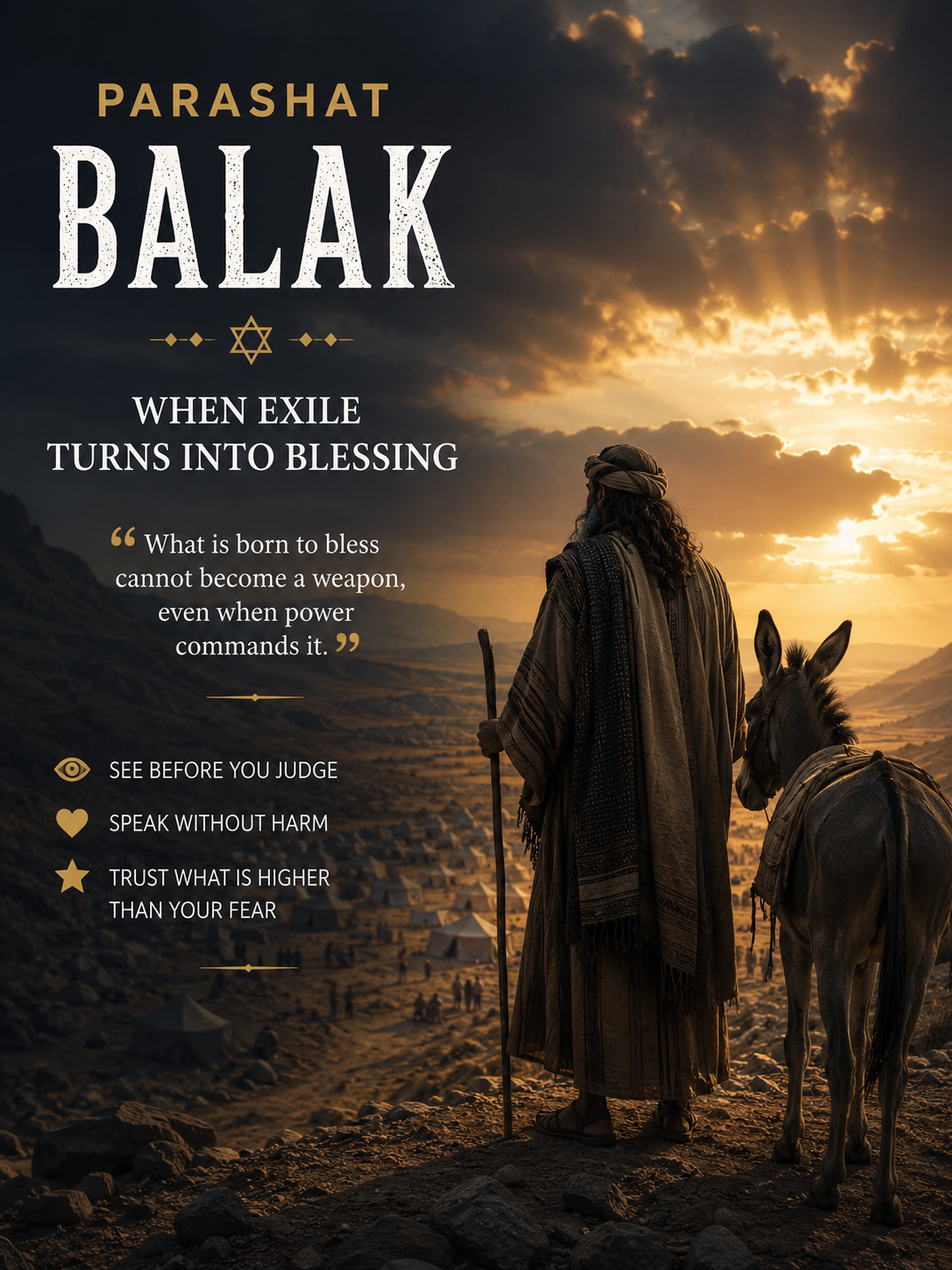
PARASHAT BALAK: When Exile Turns into Blessing
The camp of Moav does not sleep in peace. From the hills, Balak watches the movement of a people advancing without noise, like a slow current that does not stop. He sees no raised swords, no armies prepared to strike, yet his gaze reads threat where there is only passage. Fear does not arise from what is happening, but from what he imagines might be taken from him. In that inner space — the gap between event and interpretation — the king decides to act before he understands. Messengers travel to Bilam bearing promises wrapped in gentle words. Gold, honour, recognition. The prophet listens, and though his mouth speaks caution, his heart already feels the weight of possibility.
The road toward Moav narrows between fields and stone walls. The donkey walks ahead with certainty, until she suddenly halts. Her ears tense, her legs recoil. Bilam sees nothing and strikes, convinced the obstacle is disobedience. Three times the staff falls. Only when the pain becomes unbearable does the voice of the humble break the silence — and force the prophet to look again. The angel appears then like a line of fire that had always been there, waiting for the eyes to clear.
When Bilam stands before Balak, the air is thick with expectation. Altars are prepared, smoke rises, and the king waits to hear words that will turn fear into power. Yet each time the prophet opens his mouth, blessing emerges without permission. “How beautiful are your tents, Yaakov.” The words flow as if they had waited for this moment from the beginning. What was meant to be curse becomes unexpected song, and the camp of Israel continues unaware that, from outside, someone has proclaimed its beauty. Balak clenches his fists, unable to accept that gold cannot purchase what descends from another axis altogether.
The Word That Does Not Submit
There are moments in life when fear arrives before reality does. Balak observes from a distance and decides that what he cannot decipher must be stopped. The human being does this too: projects threat where there is only movement different from one’s own. A slow current. A people that simply continues.
Bilam carries a different tension — quieter, more interior. To possess a gift does not mean to be free of ambition. The inner voice is often clear enough; what fails is the willingness to accept what is already known. Desire hunts for a crack through which truth and personal advantage might coexist. It usually finds one. That is precisely the problem.
The donkey who sees before the prophet does not offer comfort. She offers something more unsettling: the simple can perceive what intellect, in its haste, ignores. To strike what halts us — a relationship, a limit, an inner warning — is a blindness that looks, from the outside, entirely like decisiveness. The blessing that rises in place of curse carries a related teaching. Not everything bends to the one who holds the instrument. There are words that do not belong to whoever utters them — and those words, when they come, arrive with a force the speaker did not assemble.
To accept that resistance is not weakness: that may be the costliest recognition in this entire portion. It requires acknowledging an axis that operates beyond what immediate control can reach.
Balak in the Present Time
The contemporary world knows Balak’s gaze well — perhaps better than it would care to admit. Governments, leaders, entire systems react from fear before comprehension has arrived. The speed at which information circulates has made this worse: any unfamiliar movement becomes instant threat, classified and responded to before it is understood.
Bilam, meanwhile, maps onto a figure we encounter constantly now. Someone with access to knowledge and public voice, divided between inner fidelity and the desire for recognition — not evil, exactly, but negotiable. In an era where speech circulates as currency, the temptation to adjust the message in order to please or gain position is not occasional. It is structural.
The scene of the donkey carries its own contemporary weight. She sees what he cannot. Amid the noise of sophisticated discourse and high-velocity technology, the clearest signal sometimes surfaces from somewhere far simpler: a bodily unease, an obvious boundary one is trying to ignore, a quiet halt that the situation does not explain. Contemporary culture rewards speed and certainty above almost everything else. That reward structure is what makes the staff fall three times before the angel becomes visible.
The problem is rarely lack of information. It is the prior decision — made faster than it appears to be made — not to listen to what does not fit.
Inner Activation
Balak and Bilam stand at two extremes still active today: fear that reaches for control, and ambition that attempts to negotiate with what cannot be negotiated. Between them, the narrative places a donkey. Not a sage. A donkey. Something that simply saw.
The portion does not end with triumph or with a lesson extracted and filed. It ends with a blessing spoken from the outside, almost like an echo — reaching a camp that does not hear it. The people continue through the desert, unaware that their beauty has just been declared by someone who came to curse them. Many true transformations work this way: away from the spotlight, without requiring the beneficiary’s awareness or approval to take hold.
Are you acting from fear or from trust — and what would shift in your next decision if that foundation changed?
“What is born to bless cannot become a weapon, even when power commands it.”
Balak does not conclude with victory or with explicit resolution. It ends with an open fracture: the awareness that fear can manufacture enemies where none exist, and that true speech does not submit to the desire of whoever attempts to use it. As the people move through the desert, the echo of blessing lingers among the hills — a reminder that there are forces no gold can reach and no threat can redirect. Only the one who learns to see before speaking has any chance of understanding what those forces are.