
Parashat Beha’alotcha
When the Light Rises
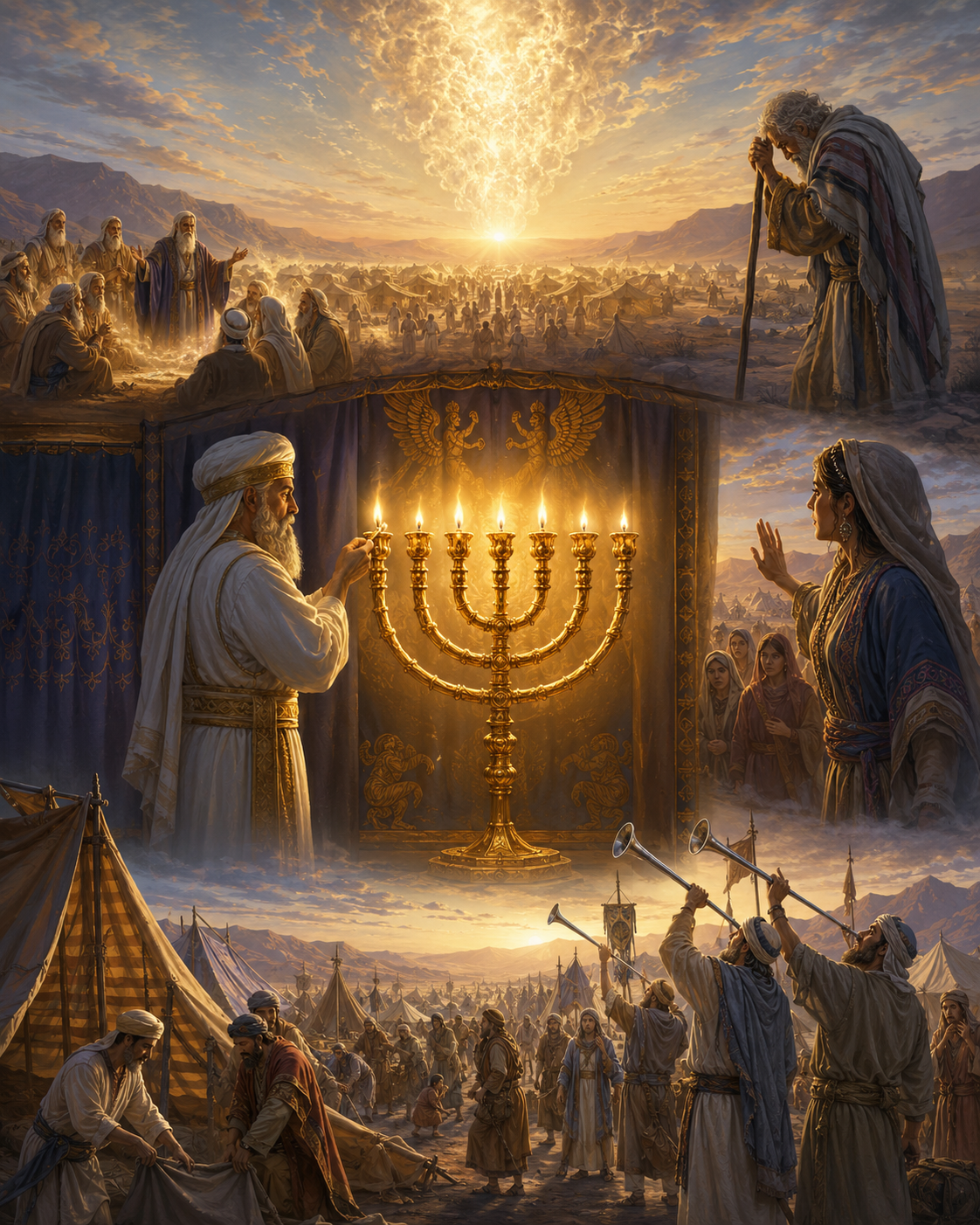
The menorah burns before the camp awakens. Aaron brings the flame close and waits until it stands on its own. He does not force the light; he accompanies it. The sanctuary breathes in silence, and the gold reflects a clarity that does not seek to spread outward but to incline toward the centre. The trumpets sound. Metal cuts through the cool desert air and the tents begin to fold. No one runs. The movement is born from a shared listening. The cloud advances slowly and the people follow without disputing direction.
Then the murmur appears. It is not open rebellion; it is weariness turning into memory. The manna falls as it does each morning, yet some look at the ground with disdain. Egypt returns as a warm illusion. “We remember the fish,” they say. The food falls as it did yesterday, but now it tastes empty to those who crave something heavier, something that resembles the past. Fire touches the edge of the camp and silence grows dense, as if the desert hears something the people still do not.
Moshe feels the weight of the people upon his back. He speaks to God from fatigue, without grandeur, without elevated words. His voice is human, stripped bare. And the response is not to remove the burden, but to share it. Seventy elders receive the ruach, and the air changes. Voices open as if prophecy were a breath that belongs to no one alone. Yet the balance fractures again. Miriam speaks. She does not shout, does not accuse with violence; she simply questions, and her word touches what should not have been touched. Her skin turns white, the camp halts, and the cloud remains still. No one advances without her.
✦ ✡ ✦
THE RUACH THAT IS SHARED
Elevation is not a visible gesture; it is an inner orientation that no one can impose from outside. The menorah teaches that authentic light does not seek prominence, but alignment. When the soul tries to expand without a centre, it consumes its own oil. The sound of the trumpets reminds us that spiritual time is not measured by personal impulses. We live surrounded by stimuli that call us to move without pause, yet the parashah reveals that to advance without the cloud is merely to relocate. True listening is a form of invisible discipline.
The longing for Egypt reveals a wound deeper than hunger. Human desire tends to romanticize what once confined it. To remember the past as refuge is to resist the work that freedom demands. The shared ruach breaks the illusion of solitary leadership. What is spiritual does not diminish when multiplied; it grows steadier. The burden that seemed unbearable shifts when the spirit finds new bodies in which to dwell. The camp’s halt because of Miriam reveals that authentic growth includes moments of enforced pause. Not every movement is maturity.
✦ ✡ ✦
BEHA’ALOTCHA IN THE PRESENT TIME
In the present, the menorah may appear an ancient symbol, yet its gesture remains alive. The light rising toward the centre resembles attention when it chooses not to scatter in a thousand digital directions. The modern world multiplies trumpets that call without rest, and the contemporary soul runs after sounds that do not always arise from the cloud. The complaints of the desert echo in today’s culture as a constant search for stimulation. When everything is available, desire grows more demanding, more restless. Egypt is no longer a physical place; it is nostalgia for a simpler version of oneself, even if that version lived confined.
The shared ruach appears today in communities that learn to sustain themselves without depending on a single voice. The structures that endure distribute responsibility without losing their inner axis. In a time when authority is constantly questioned, Beha’alotcha offers a different vision: the spirit does not compete, it expands. And the camp’s pause at Miriam’s wound reflects the contemporary need to halt movement when speech damages the common fabric. The speed of the digital world rarely allows such waiting.
✦ ✡ ✦
INNER ACTIVATION
Beha’alotcha does not speak of escaping the noise of the twenty-first century. It speaks of learning to raise the flame within it. To remain beneath the cloud amid constant motion may be the deepest challenge of our time. When Miriam returns, the people continue. There is no celebration, no explanation. Only the march that begins again. The menorah continues burning at the centre, inclined toward the same place as at the beginning, as if nothing had changed — and yet everything had learned to breathe differently.
Are you willing to sustain each day the responsibility you accepted — or do you simply like the idea of having assumed it when everything burns?
✦ ✡ ✦
“The light that rises does not illuminate the path. It reveals whether the soul is willing to walk without looking back.”
The menorah burns before the camp awakens. Aaron accompanies the flame without mastering it. The people walk and doubt. The cloud sets the rhythm beyond desire. And each time attention inclines toward the centre, the menorah burns again — as if the desert had never ended.