Parashat Behar–Bechukotai
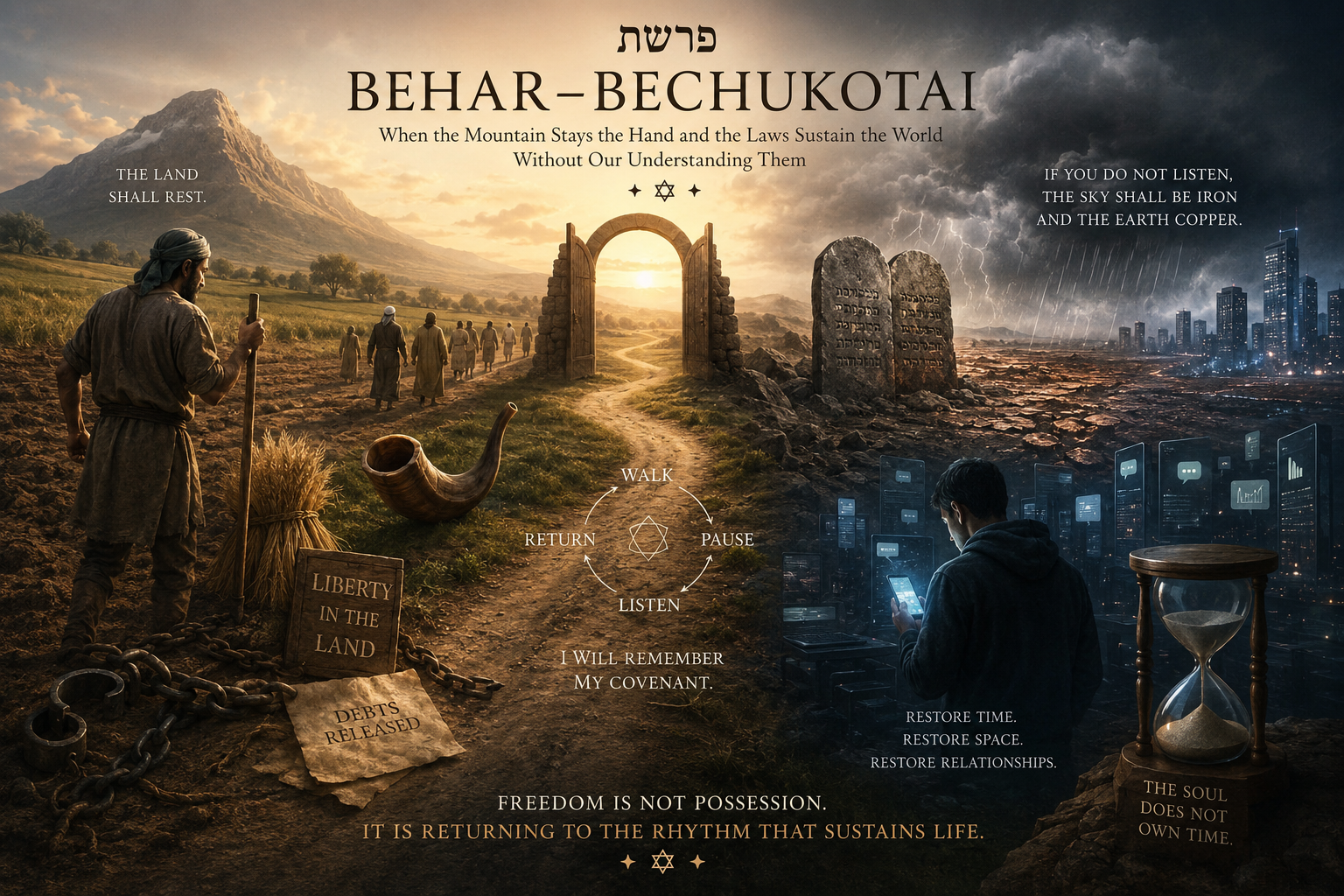
When the Mountain Stays the Hand and the Laws Hold the World Without Our Understanding Them
The mountain does not tremble. No one runs. There is no fire driving faces down. Only a voice settling over time like cool shade at midday. After so many commands that pressed forward, one arrives that pulls back: the land shall rest.
The men look out at fields they have always worked. The soil lies open, waiting for seeds that won’t come. Hands that know the rhythm of sowing hang in the air, not sure where to land.
First comes unease. The silence of the field is not immediate peace — it’s absence. The farmer runs quiet calculations about what’s still stored. The merchant imagines markets that won’t open. The poor walk between plots with no visible fences, and for a moment can’t tell who is owner and who is passing through.
The voice crosses the air again: For the land is Mine.
Not accusation. Slow revelation. The ground stops being an extension of the self and becomes again what it was — a place that sustains without belonging to anyone.
Then the shofar sounds. You shall proclaim liberty in the land. Not war, not victory — it cuts the invisible thread of debts that have quietly accumulated. Feet slow when each family hears its name bound again to a plot of land returning home. Some feel relief. Others fear. Hands that had gripped contracts must open. A man once sold begins the walk back. No loud celebration. Only a sense of something loosening in the chest. Freedom doesn’t look like triumph here. It looks like return to a place you’d almost forgotten was yours.
If you walk in My statutes.
The phrase doesn’t arrive as comfort or sweet promise. It lands dry, almost quietly, like a line drawn on sand before someone starts walking. It says nothing about believing more intensely or feeling more deeply. It says: walk. The body enters first. The soul follows a beat behind.
At first the ground seems indifferent. Nothing changes when the traveler takes his first steps. The wind stays the same, the fields still. Yet something slowly adjusts — like an old door finding its frame again.
I will give your rain in its time.
Not a storm tearing the sky open. A gentle moisture waking the earth without any noise. Seeds that seemed to be sleeping start to open, as though someone had said their name softly. Peace comes without announcement. Not victory, not control. The sense that the shoulders no longer have to carry the whole world alone. The traveler discovers that peace doesn’t arrive when he controls the road. It arrives when he stops fighting it.
Then the text turns without warning.
If you do not listen.
The rupture doesn’t start with a cry. It starts with a small distraction. The ear hardens before the heart does. The traveler walks faster, convinced he’s making progress, and the earth begins closing without a sound. Then the harsh image: Your sky shall be iron and your earth copper.
The sky no longer yields. The earth no longer opens. No visible punishment — only resistance. The sweat gets heavier, the voice rougher, and the traveler feels every step pressing against something he can’t see.
Trust Without Guarantees / The Pedagogy of Cycles
The boundary doesn’t appear to diminish the human being. It appears to keep the impulse to possess from devouring him. When everything can be accumulated, even time becomes a load that never gets set down. Behar introduces a pause born not of exhaustion but of fidelity.
The land rests before the man understands why he needs to. The unease before the empty field reveals something quiet: human identity often rests more on what it produces than on what it is.
The restitution of the Jubilee breaks the illusion of permanence. What seemed secured goes back to its origin, exposing the fragility of everything accumulated. Not arbitrary loss — a reminder that collective balance needs cycles of return. Without return, wealth becomes a border and poverty an open wound.
The question — What shall we eat? — crosses every generation. Trust doesn’t remove the uncertainty. It changes how you walk inside it.
Seven times. Reality repeats the lesson without raising its voice. Again and again, the world returns the echo of a step taken out of rhythm. Cities lose their warmth. Roads grow longer even though no one moved them. No heroic drama — just attrition.
And just when everything seems locked, a phrase appears that doesn’t accuse:
I will remember My covenant.
It doesn’t depend on the traveler’s merit. It is a memory older than the mistake. As though the earth itself draws breath and waits for someone to hear it again.
The traveler pauses. No tears. No speech. Only a brief, almost imperceptible halt. The feet feel the dust again, the body’s weight shifts slightly, and the air becomes less hard. No one applauds, no one proclaims anything. The road simply gets its rhythm back.
Beĥukotai offers no easy comfort. It reveals an architecture in which every step leaves a mark the world registers. It doesn’t demand emotion. It demands presence.
Behar–Beĥukotai in the Present Time
Today the field isn’t always soil. More often it’s a lit screen that never goes dark. Sowing looks like answering messages, generating ideas, maintaining continuous presence. Rest becomes suspect — as if pausing were the same as disappearing.
The contemporary economy no longer measures just harvests. It measures attention. Every gesture is recorded. The human being learns to live in continuous time — no seventh year, no Jubilee, no real return. And inside that continuity a quiet fatigue accumulates, the kind that doesn’t lift just because you move faster.
Restitution today rarely means returning land. It means returning time, interior space, relationships that have already started hardening into emotional contracts. There is no visible shofar. Still, the moment someone refuses the automatic cycle, something in the air shifts. The question stays the same: What will happen if I stop?
Behar doesn’t dissolve the fear inside that question. It answers from within it: there will be enough when the soul stops measuring its worth by the continuity of motion.
There is a real discomfort in reading Beĥukotai from the present. We live in an age that measures value by speed, growth, and visibility, while the text speaks of walking, of listening, of stopping when the rhythm breaks. The Parashah doesn’t argue ideologies or propose systems. It describes a quieter relation — though quieter doesn’t mean weaker: the relation between how a human being inhabits time and the way reality responds.
We talk today about climate crisis, collective exhaustion, economies that expand while people hollow out.
In 2026 attention has become an invisible battlefield. Screens open, voices layer over each other, decisions get made without pause. The contemporary world wants freedom without structure. Beĥukotai pushes the other direction. It suggests that freedom without rhythm doesn’t stay freedom for long.
Peace here doesn’t describe a political agreement. It describes a way of living in which the body stops fighting time. And when that fight doesn’t stop, you feel it — in the jaw, in the shoulders, in the way the day refuses to open.
Inner Activation
Real freedom isn’t measured by how much you hold or how many decisions you make. It’s measured by the capacity to withdraw in time. To stay the hand before desire becomes domination. To return before debt becomes identity. To remember, before forgetting takes hold, that the ground you’re standing on was never really yours.
Return doesn’t arrive as intense emotion or dramatic confession.
I will remember My covenant.
That memory doesn’t depend on cultural trends or collective moods. It remains, quiet, even when the world moves too fast to notice. The Parashah speaks of this instant — of how each person walks his own path, and what begins to harden when that path is abandoned for too long.
What are you holding as if it were yours — and what do you need to return before it starts destroying you from within?
Where in your life do you keep walking outside your own structure? What is already going hard like iron because of it? Maybe that’s where the text gets difficult: not when it threatens, but when it names resistance without taking it away.
“The soul rests when it remembers it does not own time.”
“I will remember My covenant. The covenant doesn’t disappear. It waits for the step to find its rhythm again.”
In the end there is no extraordinary event to recount. The mountain goes quiet again. But something has shifted in the way the people breathe: they no longer walk as absolute owners of the ground beneath their feet. They walk as attentive guests, knowing each step is borrowed, and that real strength lies not in possession but in knowing when to stop at the voice’s call.
Beĥukotai closes the book of Vayikra not with a climax but with architecture. Walk, pause, listen, return. The covenant doesn’t vanish when the traveler loses his way. The path stays, quiet, waiting for the moment someone places a foot on it in truth. Whether life can in fact be sustained without heroes is left there, at the edge of that final step.