Parashat Devarim
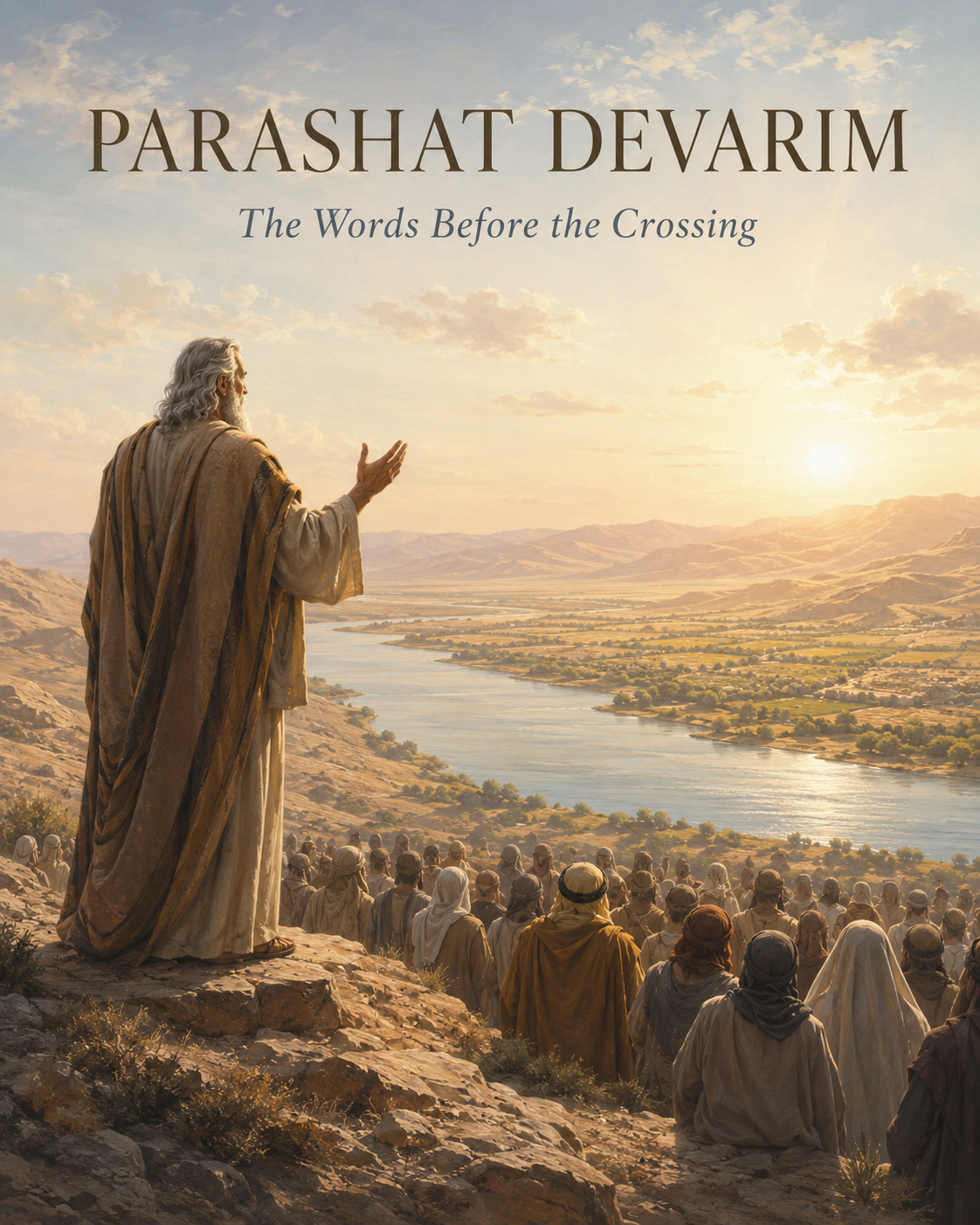
The Words Before the Crossing
There is a moment in Devarim when everything arrests without anything seeming to stop. No fire descends, no sea opens, no cloud moves before the camp. Only a voice. A voice that opens by saying: “These are the words.” Not a solemn introduction — a minimal gesture, as if Moshe were drawing breath before surrendering the last thing he can give.
The people stand before the Jordan. The promised land is no longer distant. It is there, visible, close enough to misread as arrival. And yet before the crossing, everything must pass through the word. Because to enter without memory is to repeat the desert. Moshe speaks from the margin — not from the centre of the camp, not from the mountain, not from the fire. He speaks as one who knows his steps will not cross with the others.
His body already belongs to the boundary. His voice belongs to the future.
He recalls the journey. Not as chronicle — as form. The error of the spies returns, not as open wound but as a lesson the people must carry in their hands. Memory stops being reproach. It becomes a map.
THE MEMORY OF THE ERROR
The fear that once paralyzed the people becomes a silent warning. The episode of the spies appears in Devarim not to humiliate the previous generation but to expose a simple law: fear without direction does not protect — it forecloses. The past does not yield to denial. It yields only when integrated as living learning.
What you do not integrate repeats you. What you embrace guides you. No cry in those words. Only clarity.
THE LIMITS THAT TEACH
The journey continues in the memory of boundaries: Edom, Moav, Ammon. Territories not to be touched. Strength learns to stop before it collapses into idolatry. The people discover that growth does not mean expansion without measure — it means recognizing where their task ends and someone else’s begins.
Obedience here is not submission. It is maturity. The boundary is not punishment: it is pedagogy. That distinction took forty years to learn.
THE VICTORIES BEFORE THE CROSSING
Then come the victories prior to the crossing: Sichon, Og. Names that once carried the weight of absolute threat. They appear now as shadows already passed through, as proof that fear had been measuring the wrong thing all along.
Even that victory does not occupy the centre. What is central is the silent transformation occurring while Moshe speaks — the interior crossing that must precede the geographical one. No external crossing holds if the shadow remains intact inside.
THE VOICE THAT REPLACES MOVEMENT
Moshe no longer acts. He speaks. And in speaking, he builds.
To explain is not to simplify. It means opening the hidden form within what has been lived — showing the architecture that suffering and error and obedience have already produced without anyone naming it. Each phrase orders time. Each memory settles into its place.
The new generation did not witness Sinai. They did not see the sea open. And yet they must enter. Leadership reaches its maturity when it ceases to move and begins to orient — when the only thing left to give is the word, and the word turns out to be enough.
THE INNER THRESHOLD
No urgency. No epic. Only a threshold that becomes interior before it becomes geographical.
The Jordan is not first crossed with the feet. It is crossed with what the word has already placed inside the soul. The promised land ceases to be only a place. It becomes a form that must dwell within before it can be touched — a formation that happens in the hearing, not at the riverbank.
THE ARCHETYPES THAT DWELL WITHIN US
Moshe is the voice that guides from the boundary and transmits without being able to cross. Ha-dor ha-chadash is the generation that inherits without having seen the origin. Ha-midbar is the desert as formative matrix. Ha-davar is the word that sustains identity beyond territory.
Not ancient figures. Living processes. Each time someone transmits from his own boundary. Each time a generation enters without having lived the beginning. Each time the word sustains what the body can no longer sustain. The archetypes move because they describe what keeps happening — not what happened once.
DEVARIM IN THE PRESENT TIME
Today.
We live saturated with information and starved of word that orients. Everything is recorded, everything is distributed, and very little transforms into wisdom. Speed has displaced understanding. A headline replaces a process. An algorithm decides what deserves to be remembered and what disappears — not by judgment, but by optimization. Memory expands like a desert of data without integration.
The new Jordan does not separate desert from land. It separates noise from word.
Without interpretation, memory becomes accumulation. Or denial. Both leave the people circling the same mountain. Devarim teaches the opposite: the future is born when the past is reorganized with truth. To choose what to remember — and what to allow to die — is the decisive act. It was then. It remains so now.
INNER ACTIVATION
Re’eh — See. What story do you repeat without having integrated it?
The intention is to remember with form: not as nostalgia but as responsibility. The concrete action is to narrate what has been lived until it ceases to weigh and begins to orient.
The arc of this parashah: Diber, Be’er, Bachar. Voice, Clarification, Choice. Without that sequence, memory remains raw and the soul circles.
What do you need to understand from your past in order to truly move forward?
“Lo ta’avor — You shall not cross. The one who does not enter with the body may enter with the word. To speak before crossing is to prepare the land others will inhabit.”
Devarim is not a tale of conquests. It is the moment when history becomes consciousness — when the word, for the first time, becomes territory.