
Parashat Naso
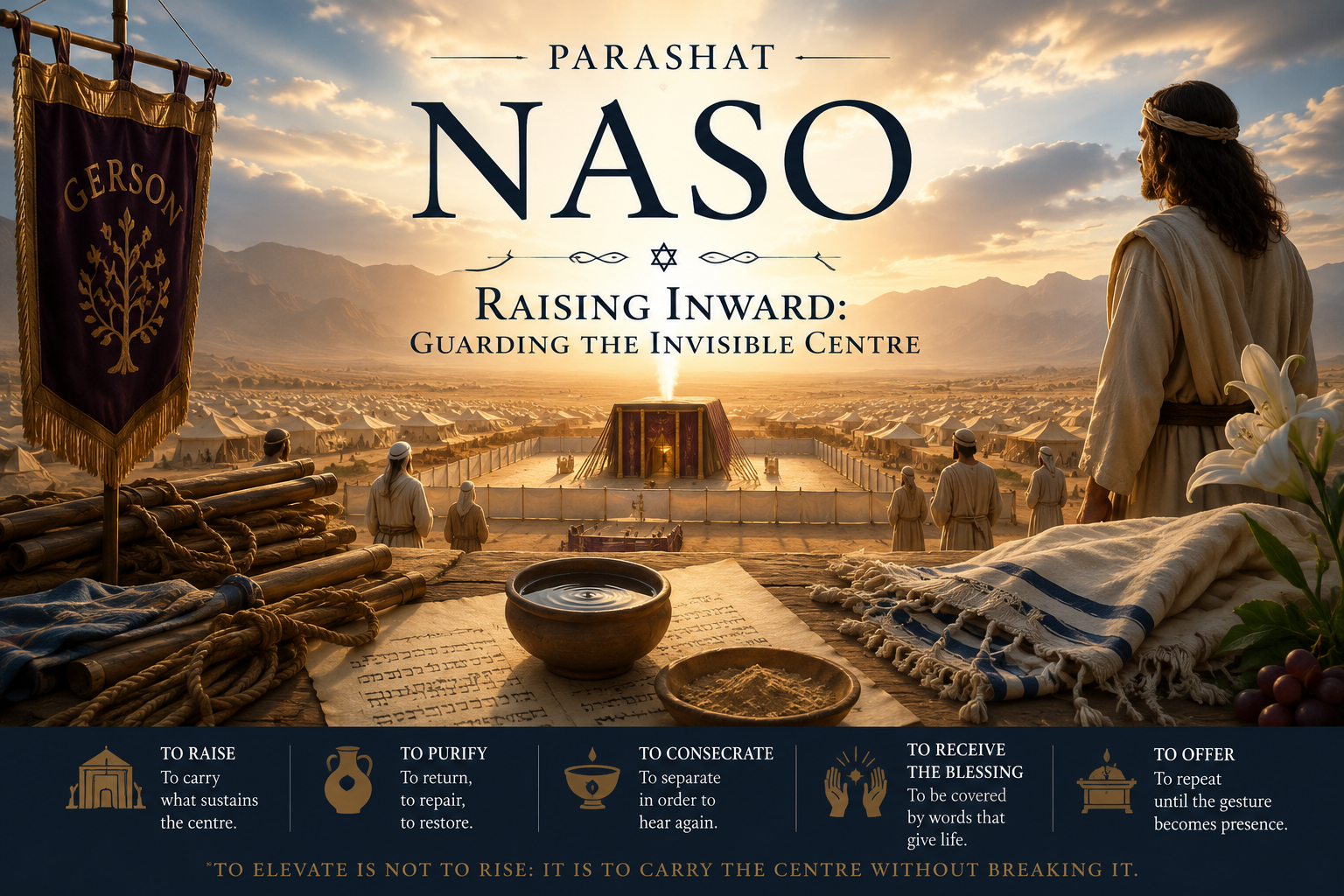
Raising Inward: Guarding the Invisible Center
The camp is already arranged. The banners stand where they were placed. The Mishkan sits at the center. Around the tents, the desert wind lifts almost nothing.
And still the voice comes again.
Raise.
It isn’t a command for battle. It doesn’t sound like glory. It’s quieter than that, almost private: raise the heads of those who carry the ropes, the fabrics, the beams nobody sees once the sanctuary stands. The sons of Gershon step forward without shine. Their hands know the weight of hidden things. They carry no weapons. They carry structure.
Then the movement stops.
Some must leave the camp. Not because the Torah wants to humiliate them. Because the center needs space in order to keep breathing. A camp can look ordered from outside and still be carrying damage within it. A wrong has been done. A word has wounded. A debt is still owed. The Torah doesn’t let the wound vanish under holy language. It demands return, confession, restitution — repair with the hands. The camp learns that silence, when it’s covering harm, cuts as deep as a blade.
Then comes the scene that’s hardest to read without discomfort.
A woman is brought before the priest. No witnesses. No proof. Only suspicion moving through the camp like dust. The bitter water is prepared with erased letters and earth from the sacred ground. Nobody should feel comfortable here. The scene isn’t clean. It exposes what jealousy does when trust has already cracked and no human court can see the whole thing through. Judgment is handed to what can’t be cross-examined. The camp holds its breath.
And then, almost from another direction, the Nazirite appears. Someone chooses separation. Wine is left aside. Hair is left uncut. Contact with death is avoided. Not because the person is rejecting the world, but because something in the world has gotten too loud. The vow is a way of making room again for a voice that ordinary life has nearly buried. I think of people I’ve known who needed exactly that kind of threshold — not escape, but interval.
The Blessing That Covers
In the middle of all this — impurity, suspicion, vows, restitution — the priestly voice rises.
May HaShem bless you and guard you.
No spectacle. No argument. Just hands lifted over the people, eyes lowered, and words that don’t explain themselves. The blessing doesn’t remove the desert. It doesn’t shorten the march. It doesn’t settle every fracture inside the camp. It covers. That’s already something. Sometimes what a people needs isn’t another mechanism but a word to stand under — not triumphant, just not consumed.
Then the princes of the tribes come forward.
One by one.
The offerings are repeated with almost unbearable patience. Same gesture. Same weight. Same rhythm. The text doesn’t compress them for our convenience. It lets each tribe arrive in its own turn. No tribe is swallowed by the previous one. No offering is treated as redundant. I used to find this section hard to sit with. Now I think that’s the point: repetition becomes a discipline against rivalry only if it costs something. The same act, offered twelve times, stops being sameness. It becomes presence — but not easily.
There’s an elevation here. It doesn’t look like ascent. It feels more like weight being accepted, and not put down.
Naso doesn’t show a people conquering anything. It shows a camp learning what can break from within. To raise the head doesn’t mean pride. It means accepting the burden that’s been placed there. The Levites are raised not to shine, but to carry what most people will never notice. What sustains a bond, a house, a people, or a soul is usually the part least visible from outside. That’s not a consoling thought. It’s a structural one.
Naso in the Present Time
The desert today is rarely silent. More often it’s noise: messages, decisions, visibility, exposed lives, fragile loyalties, relationships that break before anyone can name what broke.
We measure almost everything now. Performance. Reach. Efficiency. Success. Even attention becomes a number. But the things that actually decide whether a life holds together are harder to count: trust, restraint, inner boundary, the ability to repair before the crack becomes load-bearing.
Naso enters there.
What the present moment calls elevation is usually exposure. To be raised means to be seen, followed, recognized, displayed. The whole architecture of public life pushes in that direction. But Naso speaks a different language. To be raised is to carry. To protect the center without turning it into spectacle. To accept that some of the most important work leaves no visible mark except that something fragile didn’t collapse. I’m not sure how many people actually want that. I’m not sure I always do.
The priestly blessing speaks to a generation tired of technical solutions and still addicted to them. We try to optimize everything, as if every fracture could be fixed by method, strategy, or system. Naso gives a different image: hands lifted, simple words, a light that asks for nothing in return.
The blessing doesn’t fix the world. It changes the way a person can remain inside it — without going hard or hollow.
And the offerings, repeated again and again, push back against the impatience of a culture that wants every gesture to be new. Naso trusts repetition. It knows that a repeated act can go empty — but it can also go faithful. The difference isn’t visible from outside. It’s whether the center is still alive.
Inner Activation
Naso doesn’t ask us to escape the modern world. It asks something harder: to live inside it without losing what can’t be photographed.
A community that celebrates only its visible order will eventually fracture from within. A person who only wants to shine will one day discover that visibility can’t carry the weight of a life. Neither of these is a new observation. The difficulty is that knowing it doesn’t protect against it.
There are things in every life that have to be carried without applause. Duties no one sees. Repairs no one praises. Boundaries that feel severe until you understand what they were actually holding back. Blessings that don’t change the desert, but make it possible to cross without becoming someone unrecognizable.
The question isn’t whether there’s structure around you. The question is whether the center is still being tended.
Are you carrying the responsibility that’s yours — or finding ways to be visible without bearing what actually sustains your life?
“To elevate is not to rise: it is to carry the center without breaking it.”
Night falls on the camp. Not resolution — more like the moment when the day stops asking for more. Impurity has found its boundary. Harm has been named. Suspicion has passed through the only court that could hold it. Desire has become vow. The blessing has opened a space no one can own.
To raise.
Not upward. Inward.
As if the people were discovering, again, that the sacred doesn’t run on speed or visibility, but on the capacity to hold the fragile long enough for it to become strong.