Parashat Pinchas: The Covenant Born After the Cut
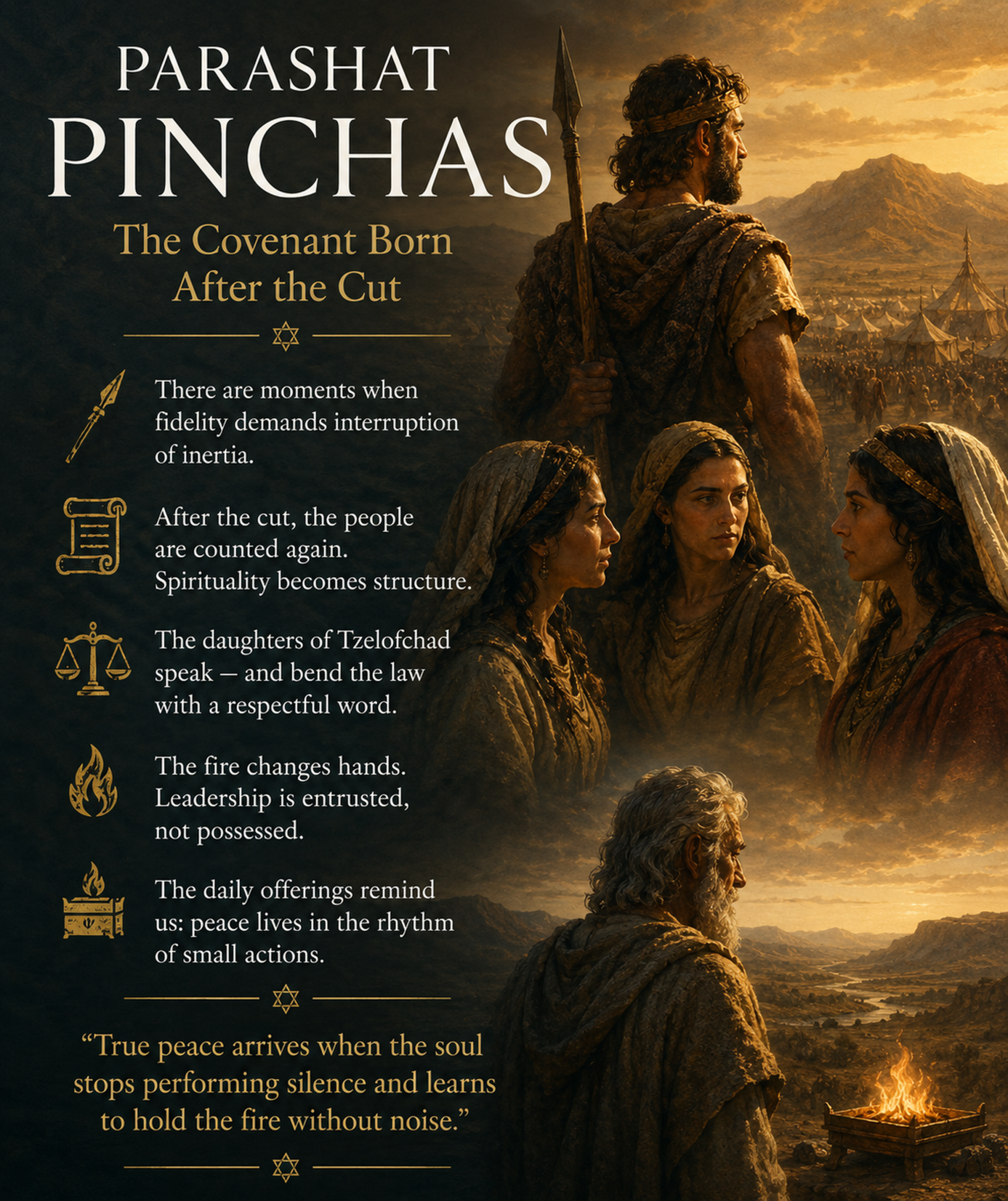
There are moments when everything appears to function, even as something deep has already fractured. The camp breathes; people walk and eat and speak. An invisible fissure runs through the centre of the community. Pinchas arrives precisely there — at the point where normality has become a form of denial. He does not arrive as hero or judge. He simply sees what is happening and cannot keep participating in the collective silence. While others watch, suspended between fear and doubt, he acts. His gesture is not born of noise or pride. It rises from a fidelity that cannot tolerate confusion when truth becomes visible.
After the cut, the rhythm changes. The Torah leaves the initial tension behind and enters a movement of reorganization — one that is less dramatic and, for that reason, harder to sustain. The people are counted again, as if each name must be spoken aloud to confirm it is still alive. The promised land is no longer only distant vision; it begins to acquire concrete form, measure, distribution. Spirituality becomes structure. Then the daughters of Tzelofchad appear. They do not raise their voices to destroy, but to ask — and that difference carries the full weight of the passage. Their question opens space that had never previously been considered. The system listens. In a parashah marked by a spear, another kind of intervention surfaces: a respectful word that also bends the law.
Later, Moshe understands that his path is reaching its limit. He looks at the land he will not cross. He does not cling. The fire that accompanied him through the desert does not disappear — it changes hands, finding in Yehoshua not only a recipient of mission but of a silence the text barely names. And just when everything seems resolved, the Torah introduces something unexpected: the detailed rhythm of daily and festival offerings. After the radical act and the transfer of leadership, what remains is cadence. Peace is not sustained only by extraordinary decisions. It lives in small actions repeated day after day — a truth that must be relearned each morning.
✦ ✡ ✦
The Rhythm That Sustains What the Gesture Begins
Corruption rarely begins with recognizable acts. It begins when discomfort no longer feels dangerous and silence becomes habitual — the kind of habit that gets called wisdom. Pinchas shows that there are moments when fidelity demands interruption of inertia, even if no one else is ready. The parashah does not remain with the cut. Immediately comes the census, as if to say that every intervention must be followed by order and care. It is not enough to stop a plague. What scattered in its wake — identity, trust, the sense of where the centre is — must be patiently rebuilt.
The daughters of Tzelofchad teach another kind of strength. Their intervention carries clarity rather than confrontation — which is not the softer option, as anyone who has tried it knows. They reveal an absence within the law and, in doing so, allow the structure to become more just without losing its form. Fidelity can also speak quietly. Moshe embodies a dimension of greatness that receives less attention: knowing when to withdraw. His renunciation is not defeat. It is the act that makes continuity possible. And the daily offerings show that mature spirituality does not live on extreme moments — it lives on rhythm, on the patient return to a centre that has nothing left to prove.
✦ ✡ ✦
Pinchas in the Present Time
Today the plague rarely appears as visible idolatry. It surfaces as saturation, as distraction that no longer needs to announce itself because it has become the baseline. Collective anaesthesia no longer resembles desert silence; it resembles a feed that refreshes before you have finished reading. Pinchas today might be someone who interrupts a chain of automatic reactions: one who stops a conversation that has turned destructive, steps away from a narrative engineered to hold attention, or chooses deliberate silence where noise had become the default. This is not heroism. It is discernment applied to ordinary time.
The daughters of Tzelofchad appear when a voice respectfully names an absence within structures we have come to treat as complete. The transition from Moshe to Yehoshua reflects a generational shift that every community must navigate: from visionary impulse to the less visible work of sustaining what has been built. And the daily offerings translate into practices simple enough to forget — rhythms that, precisely because they require no inspiration, restore something the body needs and the mind resists naming.
✦ ✡ ✦
Inner Activation
Pinchas does not teach violence. What he teaches is harder to name: the capacity to perceive when continuing as before has become its own form of betrayal, and to act without requiring others to validate that perception. He does not invite harsh reaction. He invites the particular discomfort of clarity — recognizing when a precise gesture can restore balance to a world that has grown accustomed to proceeding as if nothing essential had been lost. True peace is not the absence of conflict. It arrives when the soul stops performing silence and learns instead to hold the fire without noise.
What are you tolerating that you already know is not right — and how much longer will you call that silence “prudence”?
✦ ✡ ✦
“True peace arrives when the soul stops performing silence and learns to hold the fire without noise.”
Pinchas is not only the story of a spear. It is the story of how the soul cuts, then speaks, then entrusts — and finally learns to carry the fire without requiring noise to prove it is still burning. After the cut, the people are counted again. The land takes shape. The daily offerings recall that transformation does not live in extreme moments, but in the steady return to a centre that has already earned its stillness.