Parashat Shoftim
The Justice That Sustains the Path
Shoftim opens with three words that have echoed through history like few others: Tzedek, tzedek tirdof — Justice, justice shall you pursue. Not a typographical error, the repetition. It is structural emphasis — justice sought doubly, in outcome and in process. A just verdict is not enough. The path toward it must be just as well.
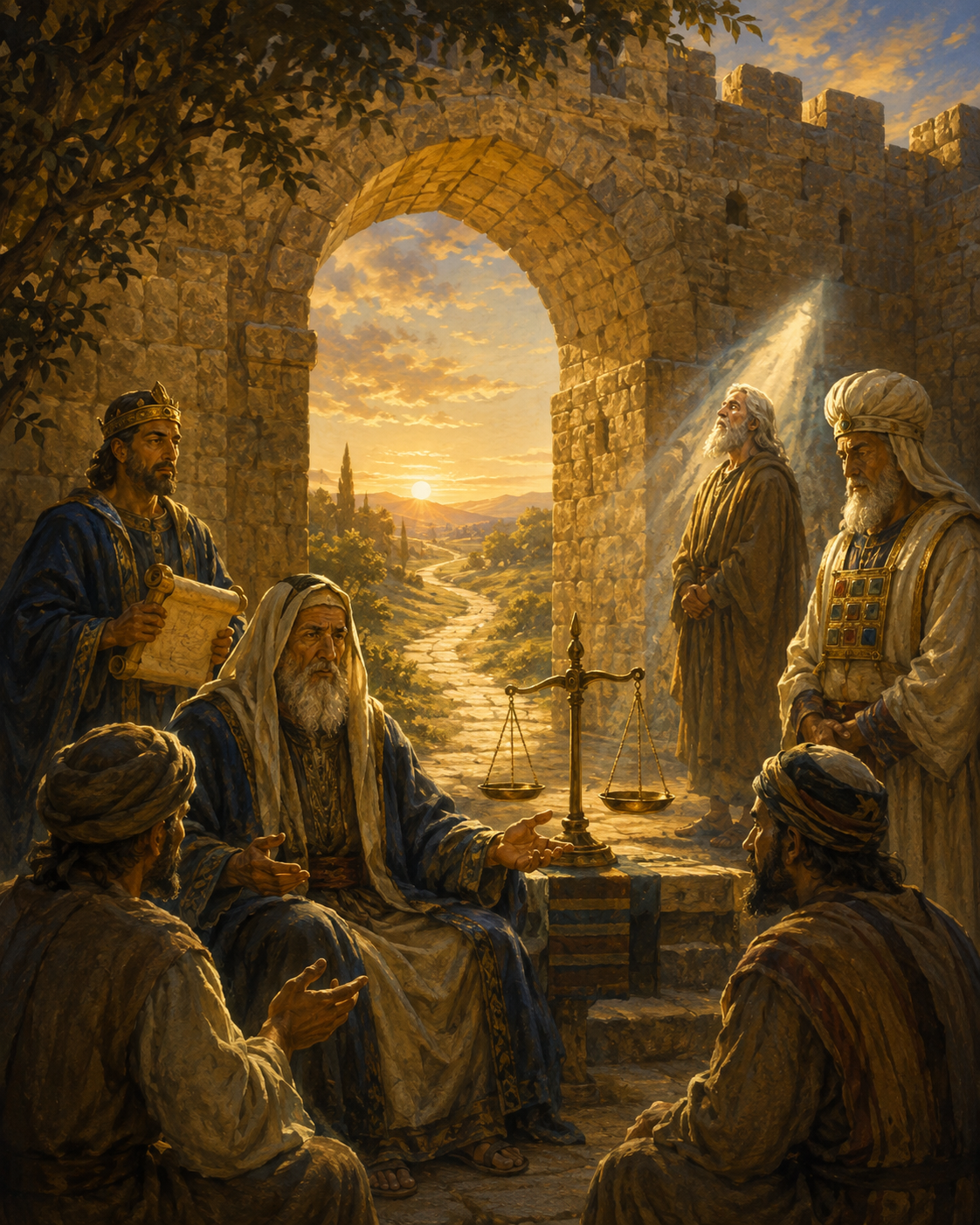
The parashah unfolds a complete institutional system — judges, kings, priests, prophets — and each figure receives its own laws, its own limits. The king must not multiply horses, wives, or gold. The priest does not inherit land. The prophet may not invent words he did not receive. Structure limits power so power serves the form, rather than becoming it.
There is something profoundly modern in this institutional architecture. Distrust of concentrated power is not cynicism: it is wisdom. The text knows even the best-intentioned leaders are human — so it builds restraints before they are needed.
THE JUDGES — THE STRUCTURE OF DISCERNMENT
You shall appoint judges in all your gates. The gate is more than a geographical entrance — it is the threshold of every communal decision. There, between the dust of the road and the voices that enter and leave, a community’s destiny gets decided. Justice cannot live in a distant building. It has to stand at every threshold where people meet.
You shall not pervert judgement. You shall not recognize faces. You shall not accept a bribe. Three prohibitions, one trinity of impartiality. The powerful man’s face must not outweigh the weak man’s. A bribe corrupts more than the outcome — it corrupts the judge’s very perception, until he stops seeing reality and starts seeing advantage.
THE KING — POWER SUBJECT TO FORM
If you say: I will set a king over me — the text has already anticipated the desire, and regulated it before it could arise. The king may be crowned. He may not accumulate unlimited power. No multiplying horses, wives, silver. And he must write, with his own hand, a copy of this Torah.
The king who writes the law himself cannot claim ignorance of it. Writing impresses law upon memory and body both. A power that knows its own written limit is less likely to cross it. Power subject to form is structure; power without form is tyranny.
THE PRIEST — SERVICE WITHOUT TERRITORY
The priest shall have no portion or inheritance among his brothers: the Eternal is his inheritance. Of every figure Shoftim regulates, the priest alone is stripped of what every other form of power reaches for first — land. He owns no ground he serves. He lives on what the community offers, not on what he can claim for himself.
This is not poverty as punishment. It is service purified of appetite. A priest who owned territory would end up serving the territory, not the sacred. Shoftim removes the possibility before it can ripen into temptation — the one who mediates between people and the holy must have nothing left to defend but the holy itself. Service without accumulation can still see clearly.
THE PROPHET — THE VOICE THAT CANNOT BE INVENTED
I will raise up for you a prophet. But the false prophet exists too. How to tell them apart? The text’s criterion is simple: if what he says doesn’t happen, don’t listen to him. Truth isn’t invented by the speaker’s desire. The authentic prophet doesn’t speak to please — he speaks because he has received a word larger than himself.
False prophecy is the most dangerous form of spiritual power, because it dresses itself in divine authority. Shoftim builds a collective defense against it: the test of truth isn’t the intensity of the prophet’s emotion, nor the polish of his rhetoric — it’s whether his word matches reality.
THE ARCHETYPES THAT DWELL WITHIN US
Shoftim presents four archetypes of power: the judge who discerns without partiality, the king who governs within written limits, the priest who serves without accumulating territory, the prophet who transmits without inventing. Each is also a function of the soul — judging one’s own actions impartially, governing the ego within limits, serving without pocketing the fruit of service, listening for a truth beyond personal desire.
Every time the ego strains perception toward what it wants to see, the inner judge is corrupted. Shoftim calls us to build an impartiality that owes nothing to self-interest.
SHOFTIM IN THE PRESENT TIME
We live in an age of authority in crisis. The institutions meant to sustain justice have eroded — power concentrated, interests conflicted, regulation captured. Shoftim’s diagnosis is ancient, and it fits the modern problem precisely: power with no written, known limit becomes an end in itself.
The institutional architecture of Shoftim isn’t naïve. It knows power tends to expand past its limits, so it builds the brakes before they’re needed. We need that same preventive wisdom now — systems where power is limited not by the will of whoever holds it, but by the structure itself.
Tzedek, tzedek tirdof speaks to personal life too. With what justice do you judge yourself? The same standard you apply to others? Harsher? More permissive? Inner impartiality is as hard as the outer kind — and just as necessary.
INNER ACTIVATION
Tzedek: justice. Perception starts by watching how the inner judge works. Does it recognise faces? Does it take emotional bribes? Does it bend judgement to protect a favoured story? The aim: an inner tribunal held to the same standard you’d demand outside yourself. The move: pick a recent decision, and review it with honest impartiality.
The arc of this parashah: Discern → Limit power → Listen to truth. Without discernment, power scatters. Without limits, it corrupts. Without listening, truth gets invented. The justice that sustains the path is born only when all three move together.
What partialities distort your judgement when you evaluate yourself or others?
“Tzedek, tzedek tirdof — Justice, justice shall you pursue.
The path towards what is just must be as just as its destination.”
Shoftim makes no promise that justice is easy. Only that it’s necessary — and that a society, like a soul, holds together only when power knows its own limits.