Parshat Bo: Leaving No Doubt
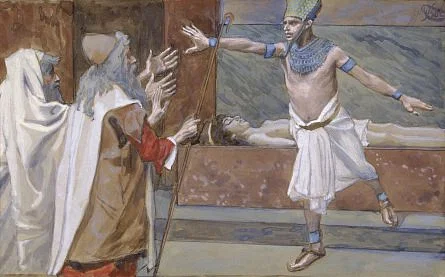
In this week’s Parshah, Parshat Bo, the Prophet Moses appears on the surface to make a slightly imprecise statement. While informing Pharaoh about the 10th plague, the slaying of the Egyptian firstborns, Moses tells Pharaoh, “Thus saith the Lord: About midnight I will go forth among the Egyptians” (Exodus 11:4). Why would Moses say “about midnight” and not simply say at midnight? Did Moses not know the exact time when G-d would go out among the Egyptians? This is even more odd since we later read, “And it was at midnight the Lord struck down all the firstborns in the land of Egypt” (Exodus 12:29). We see here that the tenth plague happened at exactly midnight and not about midnight as Moses says. While the original statement of Moses is not wrong, about midnight could mean exactly midnight, it seems to be imprecise. G-d went out among the Egyptians to strike down the Egyptian firstborns at exactly midnight. Why does Moses, speaking in the name of G-d, say “about midnight”?
The commentator Ibn Ezra offers an explanation. Ibn Ezra writes, “Now it is known that it is beyond the ability of wise men to ascertain the exact moment of noon without great effort and the use of large copper instruments. It goes without saying that it is much harder to ascertain the more difficult time of midnight.” Ibn Ezra observes that wise men find it extremely difficult to calculate the exact time of midnight. Therefore, an estimation of when midnight falls could very well fall slightly before or slightly after the real midnight. It seems that Moses’ statement about midnight is more precise since it takes into consideration human error. This explanation still leaves a large issue. G-d is all-knowing and therefore must know the exact time of midnight. Since Moses is speaking for G-d, Moses must also be able to say exactly when midnight is. Why does this statement of Ibn Ezra seem to imply that Moses did not know the exact time of midnight?
Rashi’s commentary will clarify for us the statement of Ibn Ezra. Rashi explains, “he feared lest Pharaoh’s astrologers might make a mistake as regards the time when the slaughter of the firstborns actually took place, thinking that it was a little earlier or later than midnight, and would say, in consequence of this error, ‘Moses is a liar.’” We see from Rashi that the wise men whom Ibn Ezra mentions must be Pharaoh’s astrologers and not Moses. Moses was worried that the Pharaoh’s astrologers would calculate incorrectly when the killing of the firstborns occurred. Therefore, even though the astrologers would have been the ones who had made a mistake, they would say that Moses was the one who had lied by saying at midnight. Therefore, Moses includes the imprecise view of the astrologers in his statement, even though anything they say contrary to the actual word of G-d through Moses would in this case be in error.
Even though both G-d and Moses knew that the slaying of the firstborns would happen at exactly midnight, it was possible that the astrologers who were perceived as wise men would not. While the astrologers would not be able to deny that the tenth plague happened, they would be able to say that Moses had prophesied falsely in regards to the time. The calculations of the astrologers were seen as authoritative scholarship, so even their incorrect statements would be regarded as factual by the Egyptians. By saying about midnight rather than at midnight, Moses is making sure that a likely human error in scholarship will not be able to discredit the accuracy of his words. Moses is not only thinking about how to deliver the word of G-d to Pharaoh but is also considering the likely impact and perceived validity of his speech. At midnight would be a completely true statement and the perfect word of G-d. On the other hand, about midnight is beyond any doubt true, even from the perspective of the astrologers. Moses takes into account the likely Egyptian objection to his statement and chooses words that are not only true but are also beyond any doubt.
While Moses knew the 10th plague would happen at exactly midnight, we in our own lives are never completely certain. Therefore, based on this example, we must seek the truth from G-d while also being careful not to say anything imprecise. This involves finding the truth for ourselves, but also anticipating how others will object to our statement. By taking into account the likely objections to our statement, we can model the humility displayed by Moses and make all of our statements more and more truthful without room for doubt. May it be G-d’s will that we see the world of perfect truth with the coming of the Messiah, son of David, may it be soon and in our days.