
Greek Jewish roots. New York voice. Unfiltered perspective.
Part II: Israel Is Gone. Who Fills the Vacuum?
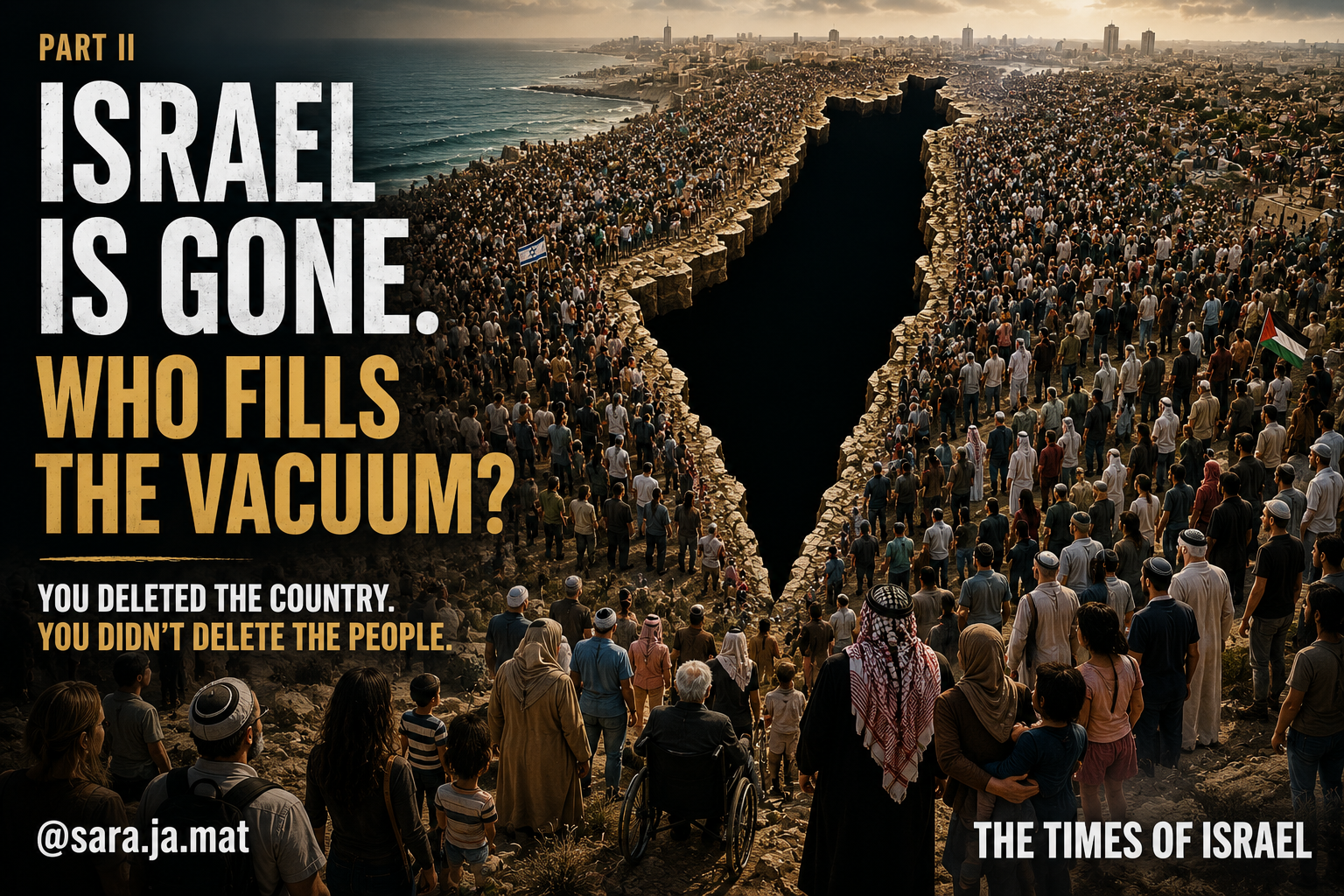
The second in a three-part series examining what actually comes after “Delete Israel.” In Part I, I asked what the slogan means for the Gazans its supporters claim to be fighting for. Now let’s grant the hypothetical completely. Israel is gone. What happens to the millions of people still living there — and what fills the space Israel leaves behind?
In Part I, I asked a deceptively simple question:
Delete Israel. Okay. And then what?
I asked what happens to the Gazans the movement claims it wants to liberate.
Who governs?
Who builds the economy?
Who protects women, minorities, journalists and political dissidents?
And, perhaps most importantly, who protects Gazans who oppose Hamas?
Not everyone who advocates for Gazans or criticizes Israel is calling for Israel’s destruction. I am addressing the people who are — and asking them to finish their own argument.
But the comments that prompted this series did not say:
Change Israel’s government.
They did not say:
Negotiate different borders.
They did not say:
Build a better future for Gazans.
They said:
Delete Israel.
So for Part II, let’s take them literally.
Israel is gone.
Deleted.
Now what happens to everyone still standing there?


These are just a small sample of the many “Delete Israel” posts and comments I have encountered across social media over the past several months.
And What Happens to the Israelis?
This is the part of “Delete Israel” that is so often left conspicuously unfinished.
Countries contain people.
Israel isn’t an icon on a computer screen.
You cannot highlight it, hit delete, and watch millions of human beings disappear with it.
So what happens to them?
Where do the Jews go?
Do they stay?
Under whose government?
Who guarantees their safety?
What happens when they refuse to leave their homes?
What happens to Tel Aviv?
Haifa?
Jerusalem?
The kibbutzim?
And it is important to be precise about who we are talking about.
Because the people living inside Israel proper are not only Jews.
They are Jews and Muslims.
Christians.
Druze.
Bedouins.
And people of different religions, ethnicities and communities who all live inside the country you just “deleted.”
According to the Israel Central Bureau of Statistics, Israel’s population on the eve of Independence Day 2026 included approximately 2.157 million Arabs: Muslims, Arab Christians and Druze, alongside its Jewish population and other communities.
When you say “Delete Israel,” you are not deleting a government or moving a line on a map. You are talking about the disappearance of a country millions of human beings: Jews, Muslims, Christians, Druze and Bedouins, living inside Israel proper call home.
And that is where some of those social-media responses became particularly revealing to me.
Because I had already granted the hypothetical.
Israel was gone.
Yet some people still immediately returned to describing Israelis being killed or punished.
But you already got what you wanted.
There is no Israel.
You cannot kill the same hypothetical country twice.
So why is your imagination still occupied by ways to hurt Israelis rather than ways to improve the lives of the people you claim to be liberating?
If your political solution requires an existing nation to disappear, you have an obligation to explain what happens to the human beings living inside it.
“Delete Israel” is not an answer.
It is where the questions begin.
And Then Comes the Vacuum
This is the part of the thought experiment that worries me most.
Because removing a government, an army, an economy and an entire security architecture from one of the most volatile regions on Earth does not leave behind a peaceful blank canvas waiting for someone to paint a new country on it.
It leaves a vacuum.
And vacuums attract power.
Hamas does not simply disappear because Israel does.
Neither does Palestinian Islamic Jihad.
Neither does Iran.
Neither do the armed organizations, competing political factions and regional powers with their own interests.
And this hypothetical would remove not merely a government, but a major military and intelligence power currently constraining Iran and Iran-backed armed groups across the region.
Who fills the vacuum?
Who has the weapons?
Who has the money?
Who has the backing of outside governments?
Who decides which faction gets to rule?
And what happens when two of them disagree?
That is not an abstract question.
The region has already seen what can happen when armed Palestinian factions compete with an existing government for political and military power.
In Jordan, that confrontation ultimately erupted into the fighting known as Black September. King Hussein’s government defeated and dispersed the fedayeen, and the PLO shifted much of its operations to Lebanon — which subsequently became entangled in its own devastating conflict involving armed Palestinian factions alongside numerous other domestic and regional forces.
So why would we simply assume that Hamas, Palestinian Islamic Jihad, Fatah and other armed or political factions would politely agree on who gets to govern the morning after Israel disappears?
They have different leadership.
Different interests.
Different patrons.
Different weapons.
And potentially different answers to the most important question of all:
Who gets the power?
That is precisely why a power vacuum matters.
And what happens to the Gazans everyone claimed this was supposed to be about?
They are still there.
Except now they are living inside the power vacuum.
Hamas is still there.
Palestinian Islamic Jihad is still there.
Other armed groups are still there.
And if those groups begin fighting over who controls what comes next, ordinary Gazans are the people caught in the middle.
And Gazans do not have to imagine what Hamas is capable of. Gazans themselves have lived for years under Hamas rule and know what can happen to those who challenge its authority.
So who protects the family that wants nothing to do with any of these groups?
Who protects the Gazan who supports the wrong group — or no group at all?
Who stops a struggle for power from becoming another war fought around the very civilians everyone claimed they were trying to save?
Israel may be gone. The people with guns are not.
We Have Seen What Power Vacuums Can Do
We don’t have to pretend to know precisely what that future would look like.
Nobody does.
But the Middle East has already given us enough examples of what can happen when governments collapse and armed factions compete for the space left behind.
Iraq.
Syria.
Libya.
Yemen.
Different countries.
Different histories.
Different causes.
But one lesson should be difficult to miss:
Removing the existing order is not the same thing as building a better one.
State collapse can create civil war, competing militias, extremist movements, foreign intervention and humanitarian catastrophe.
And those consequences do not necessarily remain inside the borders where they began.
Syria alone produced one of the largest displacement crises of modern times. By the end of 2024, UNHCR reported approximately 4.2 million Syrian refugees and asylum-seekers living in Türkiye and Europe.
That doesn’t mean an Israel-less Middle East would automatically become Syria or Yemen.
It means anyone advocating the destruction of an existing state has an obligation to confront the possibility of what fills the space afterward.
Because a power vacuum is not a peace plan.
And the Ripple Effects Do Not Stop at the Border
Now we get to Nebraska.
Because perhaps you don’t care about Israel.
You aren’t Jewish.
You’ve never been there.
You don’t particularly care about the Middle East.
Fine.
But there is another reason Nebraska should care.
Look at where Israel sits on the map.
It is a small democratic country planted in one of the most hostile and strategically consequential regions on Earth — surrounded by conflicts, authoritarian regimes, terrorist organizations and an Iranian network of armed proxies that has repeatedly targeted both Israel and American interests.
And Israel does something remarkably important from an American perspective:
Israel largely fights its own battles with its own soldiers.
The United States already has military personnel throughout the Middle East.
But with the exception of wartime emergencies, the United States does not ordinarily maintain a large American troop presence inside Israel.
Israel has its own military.
Its own intelligence services.
Its own people standing on that front line.
And many of the forces Israel confronts are the same forces the United States considers threats to its own interests.
Iran.
Hezbollah.
Hamas.
Palestinian Islamic Jihad.
The Houthis.
Iran-backed militias elsewhere in the region.
So when someone in Nebraska says, Why should I care whether Israel exists?, perhaps the question should be reversed:
What happens to America’s security burden if Israel doesn’t?
Remove Israel from the map and you don’t remove Iran.
You don’t remove Hezbollah.
You don’t remove Hamas.
You don’t remove Palestinian Islamic Jihad.
You don’t remove the Houthis.
And you certainly don’t remove the ambitions of governments and armed movements hostile to the United States.
You remove one of the region’s most capable militaries currently confronting many of them.
Then who fills that space?
American soldiers?
Another regional government?
Nobody?
And if nobody does, why would we assume those forces simply stay where they are?
They do not need to arrive as an army landing on an American beach for the danger to reach us.
Hostile governments and armed organizations can find common cause when their interests converge.
The enemy of my enemy is my friend is not some new foreign-policy theory.
It is one of the oldest strategic calculations on Earth.
They can finance proxies.
Build networks.
Conduct cyber operations.
Recruit and radicalize.
Target Americans abroad.
Collect intelligence.
Move people, money and resources across borders.
And potentially attempt operations inside Western countries.
The FBI has warned that Hezbollah has sent operatives to build terrorist infrastructure around the world and has pointed to arrests in the United States involving people allegedly linked to Hezbollah’s overseas terrorist arm, including intelligence-collection and procurement efforts. The FBI has described those activities as evidence of Hezbollah’s interest in long-term contingency planning inside the American homeland.
So the question is not whether Nebraska is geographically close to Israel.
The question is what happens to Nebraska’s security when one of America’s most capable regional partners disappears.
Geography does not make Nebraska immune.
In some respects, Israel’s geography is precisely why Nebraska gets to feel so far away from all of this.
And that is a benefit Americans rarely put a human price on.
Every hostile force Israel confronts with Israeli soldiers is one the United States does not automatically have to confront with American boots on that particular ground.
We cannot know the counterfactual.
No one can calculate how many American deployments would be required in a Middle East without Israel, or how many American lives Israel’s existence has saved.
But that is precisely why the question matters.
Perhaps the conversation shouldn’t only be about what America gives Israel.
Perhaps Americans should also ask what Israel’s existence may prevent America from having to give: more troops, more deployments, more American families waiting for someone to come home — and potentially more American lives.
But What About All Our “Hard-Earned Tax Dollars”?
And then comes the argument Americans hear constantly: Why are our hard-earned tax dollars going to Israel when we have problems here at home?
It has become a familiar political refrain. New York City Mayor Zohran Mamdani has spoken of “tens of billions of dollars” in taxpayer money going to Israel. Michigan Democratic Senate nominee Abdul El-Sayed has argued that money sent abroad for weapons should instead be used for American schools, infrastructure and healthcare.
There is a legitimate debate to be had about foreign aid and how the United States spends taxpayer money.
But there should also be some perspective.
Under the current U.S.-Israel Memorandum of Understanding, the regular annual commitment is approximately $3.8 billion: $3.3 billion in Foreign Military Financing and $500 million for cooperative missile-defense programs. Congressional Research Service documents that regular commitment separately from additional emergency or supplemental appropriations.
That distinction matters. Congress has separately approved substantial supplemental and emergency funding, particularly since October 7. Those are real expenditures and belong in any honest accounting. But they are not the same thing as the recurring annual package politicians often invoke when discussing the ongoing U.S.-Israel relationship.
The Congressional Budget Office projects total federal outlays of approximately $7.4 trillion in 2026.
Do the math.
The regular $3.8 billion Israel package amounts to roughly 0.05 percent of projected federal spending.
Not five percent.
Not one percent.
Five one-hundredths of one percent.
So when politicians talk as though eliminating regular aid to Israel would suddenly fix American healthcare, rebuild our schools and fill every pothole, forgive me if I find the arithmetic a little less dramatic than the rhetoric.
Apparently, the other 99-point-something percent of federal spending has nothing to do with why Americans can’t afford healthcare or better schools. Israel ate your homework.
And even that framing misses something important.
The $3.3 billion is Foreign Military Financing. It is financing used to acquire defense articles, services and training, much of it through the American defense system. The missile-defense component includes cooperative U.S.-Israeli programs.
In other words, this relationship is not simply America placing billions of dollars in a suitcase and dropping it off in Tel Aviv.
American companies manufacture and supply equipment.
American defense manufacturers receive orders.
American workers build it.
American researchers collaborate on it.
And the economic relationship extends well beyond defense.
The U.S. Department of Commerce reports that the United States is Israel’s largest trading partner and that U.S.-Israel trade has grown ten-fold since the two countries signed their free-trade agreement in 1985. U.S. exports of goods and services to Israel totaled $24.2 billion in 2024.
Israel is also deeply integrated into American research and technology. According to the U.S. Department of Commerce, Israel hosts more than 400 multinational research-and-development centers, and American companies account for approximately 55 percent of them.
So if Israel disappeared tomorrow, America would not simply stop writing a check.
Americans would lose something too.
Jobs.
Trade.
Research partnerships.
Technology.
Defense cooperation.
Intelligence cooperation.
Innovation.
The question is not simply:
What does America give Israel?
It is also: What does America get back?
Deleting a Country Does Not Delete the Consequences
So let’s return to where we started.
Israel is gone.
But the Israelis did not disappear.
The Gazans did not disappear.
Hamas did not disappear.
Palestinian Islamic Jihad did not disappear.
Iran did not disappear.
Hezbollah did not disappear.
The Houthis did not disappear.
The competing interests of regional powers did not disappear.
Only Israel did.
And that is the flaw buried inside two deceptively simple words.
Deleting a country is easy on a screen.
Deleting the consequences is impossible.
Because “Delete Israel” doesn’t tell us who governs the morning after.
It doesn’t tell us what happens when armed factions compete for power.
It doesn’t tell us who protects Gazans caught between them.
It doesn’t tell us what happens to millions of Israelis.
And it certainly doesn’t tell us why any of those consequences would politely remain inside the borders of the country you just erased.
A slogan can end at the border.
Consequences don’t.
And that leaves one more part of this thought experiment.
Because the people typing “Delete Israel” anonymously online are not the only ones shaping how millions of people understand this conflict.
Some of the loudest voices have some of the largest platforms in the world.
And having a microphone is not the same thing as knowing what to say into it.
Part III of this three-part series will examine the celebrity megaphone: how misinformation travels when the person repeating it has millions of followers, what responsibility comes with that influence — and whether the people demanding Israel’s disappearance will still be there for the difficult work of building whatever they believe should replace it.
Related Topics
Related Posts