
"I'm the spokesman for the OK Boomer generation"
Paul Gottfried, William F. Buckley and American Conservatism
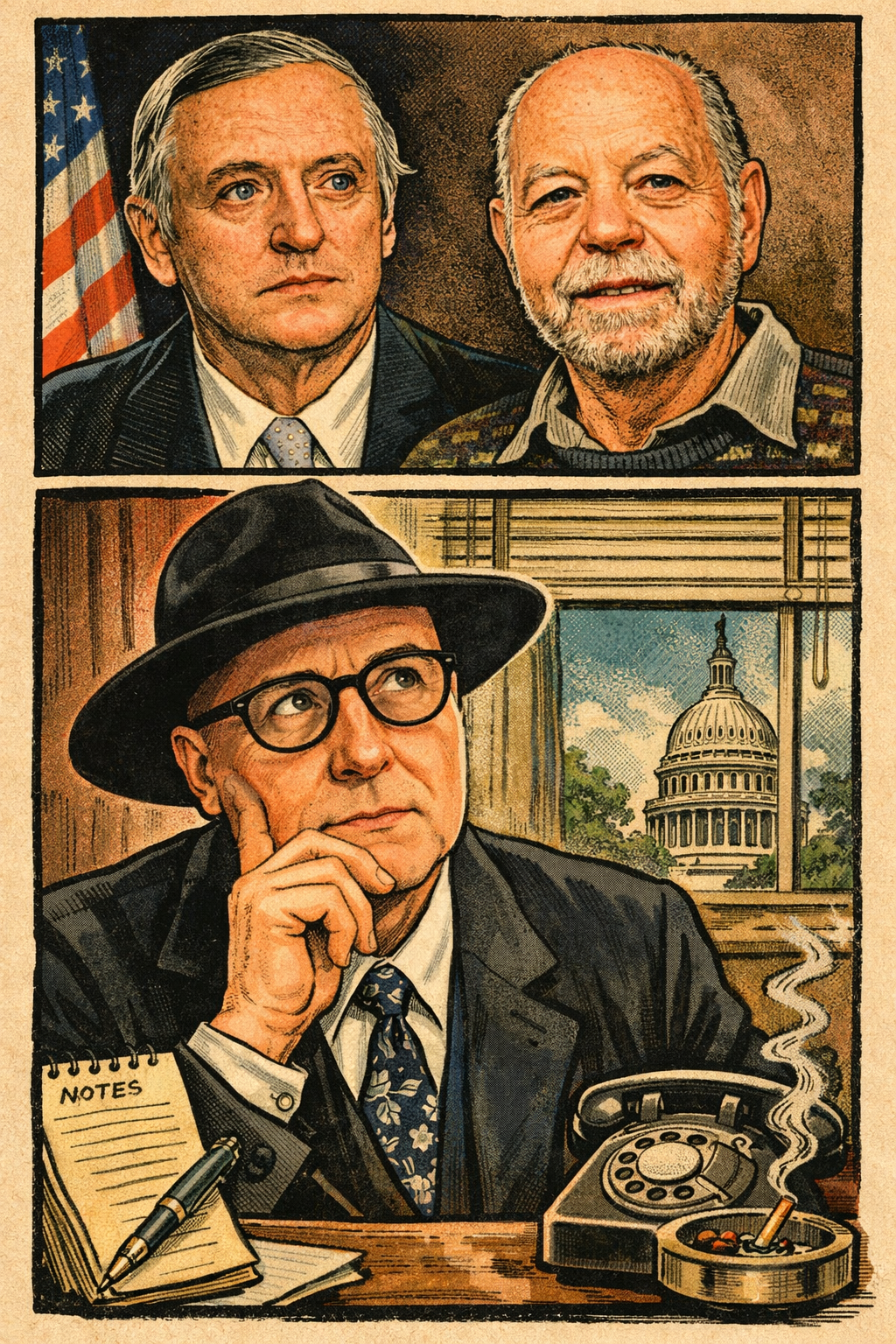
Photo: Tony Senatore: all rights reserved
This blog contends that Paul Gottfried offers the key intellectual lens for understanding the shift in American conservatism. William F. Buckley transformed the movement by purging the Old Right and aligning it with the establishment, prioritizing respectability over foundational principles. Gottfried diagnosed this as the rise of managerial conservatism centered on legitimacy rather than principle. Trump’s populist rise fractured the Buckley consensus. Yet, this upheaval ironically confirmed Gottfried’s critique: control over conservatism, as well as progressivism, is defined by those who police membership through exclusion and discipline, often at the cost of substance. Buckley excluded deep thinkers to meet elite norms; Trump harnessed loyalists to challenge the norms and standards Buckley created. The conservative movement shifted from a civilizational struggle to a personal one, appealing to a base uninterested in complexity and more concerned with vengeance. Buckley’s purges earned establishment respect; Trump’s made the movement adversarial to establishment authority. Disagreement became labeled as betrayal, deepening the populist rift. Ultimately, Buckley’s logic persists in new forms. In this climate of rapid media cycles, it is crucial to recognize that today’s politics are rooted in long-standing intellectual battles.
Those who know me best recognize the profound influence William F. Buckley has had on my life; his legacy shaped my initial interest in conservatism. When I first met Paul Gottfried, I was unaware of the depth of his insights into the conservative movement. I made a statement I now reconsider: I claimed Buckley had made the movement respectable by removing crackpots and conspiracy theorists. Paul, despite his formidable scholarly reputation, is above all a teacher, always ready to share his perspective with a student. In reality, my remark stemmed from a notion I picked up online and repeated uncritically. Paul explained that he himself had been a casualty of the Buckley purge: one of those cast aside in the early days. This conversation encouraged me to pursue the direction Paul recommended. I discovered that the early conservative movement was once composed of a diverse and brilliant array of figures, including Ayn Rand, Murray Rothbard, Frank Chodorov, John T. Flynn, and the John Birch Society. Over time, Buckley’s leadership became dominant. Importantly, Buckley was essentially a libertarian, heavily influenced by Albert J. Nock. Some anticipated the 1960s communist threat would only temporarily override Buckley’s libertarian inclinations, but this proved untrue. Ultimately, Buckley removed anyone unwilling to support the welfare-warfare state, the Cold War, and the neoconservative economics underpinning it.
Ayn Rand’s atheism led to her split with Buckley, who saw Christianity as vital to conservatism. The early movement’s debates recalled lively exchanges I once had at Columbia, but Buckley was no facilitator of diverse views; he used McCarthyism to marginalize dissent. Few challenged Buckley’s neoconservative direction for years. Pat Buchanan offered a significant challenge, making principled, courageous arguments and even taking unpopular positions, such as on Israel. For this, the media and donors marginalized him. Serious statesmanship, a Buchanan strength, has become a modern liability, discouraged in today’s politics. Trump’s 2016 rise sparked loyalty-based purges that eclipsed Buckley’s. Personal allegiance now supplants debate, and opportunists replace thinkers. While Buchanan might have succeeded with fair media coverage, Trump thrives on opposition and unfair media coverage. Buchanan challenged direction; Trump challenged authority in a style that favors confrontation over critique, and, in a subtle way, he is incorporating neoconservative elements into his America First policy, which deeply disturbs me. However, unlike many of my friends, I hope I am wrong, and he is right, and that he is acting on information I am not privy to. After all, I still live in the United States. I am not hoping for its demise because I disagree with our President. I wish him well, and if his decisions destroy the country, I will act accordingly on Election Day.
I believe that Paul Gottfried might view the current conservative crisis as the outcome of William F. Buckley Jr.’s strategic shift. By making conservatism” respectable” through purges, discipline, and alignment with liberal values, Buckley granted it political legitimacy but hollowed out its substantive resistance. The movement maintained electoral success and gatekeeping, but lost the ability to govern against the managerial state it accepted. Trump’s rise was not an ideological revival but a reaction to this emptiness, exposing the contradiction at conservatism’s core. Trump’s ascent signals a reckoning with Buckley’s legacy more than a rejection of it. To grasp today’s political landscape, one must engage directly with Gottfried’s analysis.
A good start would be Chronicles, where he is Editor-in-Chief. In closing, whatever political perspective you prefer, you should consider Paul’s wise advice: “We cannot reproduce the political or cultural past,” and it is an error to try. “But we can absorb the wisdom of thinkers from the past while trying to relate what they said and wrote to the present crisis.”
Related Topics