
Pay Iran One Dollar to Dilute Its Uranium in Public, Then Give It the Rest
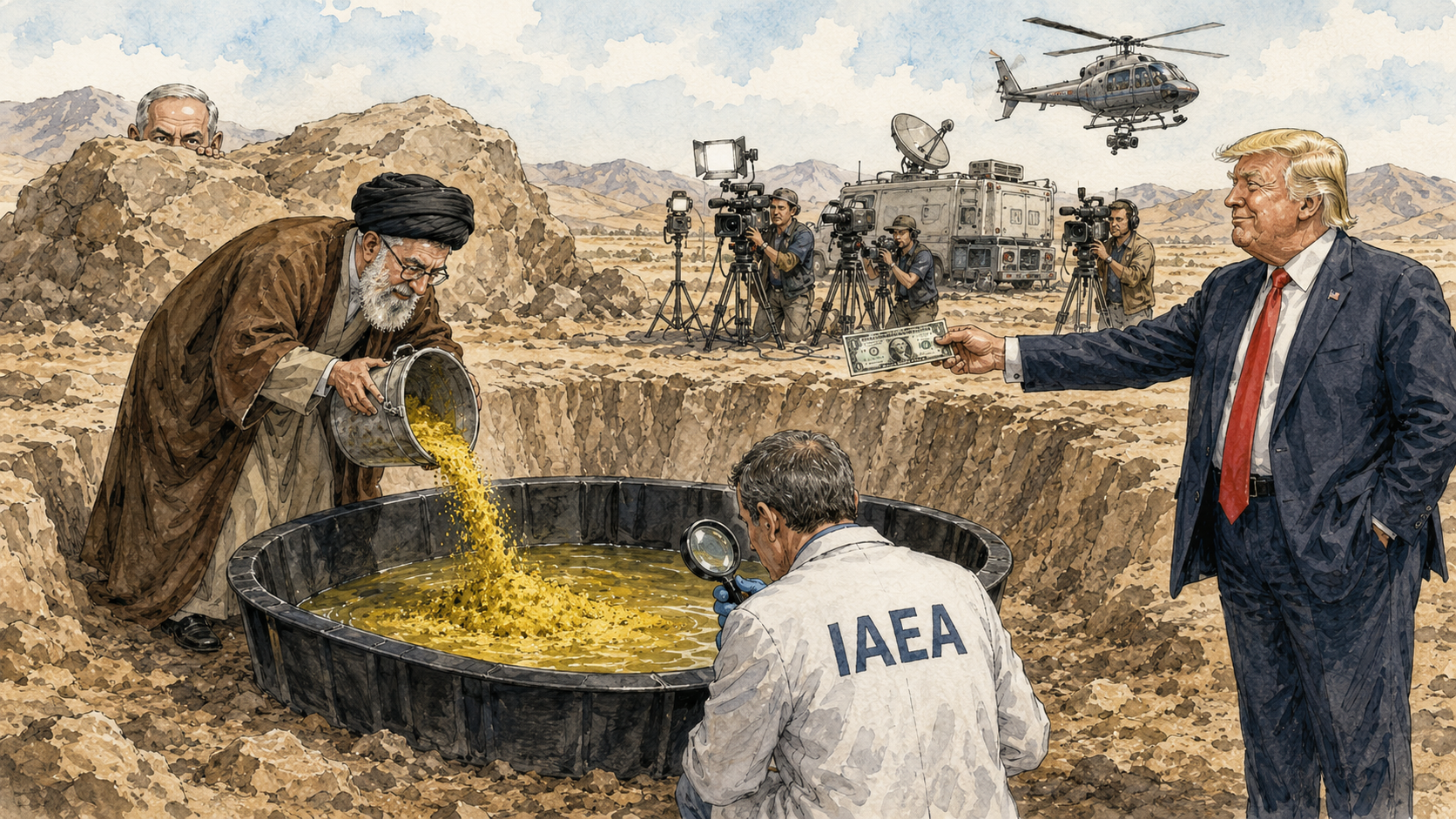
On June 17, the Jerusalem Post reported that the memorandum of understanding between Washington and Tehran lets the regime dilute its enriched uranium at home, on Iranian soil, under the eyes of the International Atomic Energy Agency. The material never leaves the country. The exact mechanism is parked in the next sixty days.
There is a quiet irony folded into that headline. Iran asked for this. Back in February, the head of its Atomic Energy Organization said Tehran would water down its sixty percent stockpile the moment every sanction was lifted. What the regime now accepts as an American concession is the very card it once tried to play.
A deal that ends a war
The memorandum, signed this week, halts the fighting on every front, Lebanon included. It opens a sixty-day window for a final accord, lifts the American naval blockade, and asks Iran to keep the Strait of Hormuz clear for commercial traffic. The carrots arrive only after the regime performs.
Vice President JD Vance spent Thursday selling it. He told reporters the Iranian nuclear weapons program is destroyed. His words. It is gone. He insists Iran will see no American money, and that the United States wins either way, because Tehran either gets nothing or transforms itself from the inside.
That language ratifies what President Trump has said more times than anyone can tally. Iran cannot have a nuclear weapon. He said it in Iowa in 2023. He said it on podcasts through 2024. The White House even pushed out a reel of the receipts. On this single point the man has never drifted.
The war was never about the strait
Trump says he won the war, that he flattened the program, and that he holds the purse that opens toward Iran afterward. That is how he frames the leverage. He bent the regime’s arm.
Follow the logic. If victory is measured that way, then the war’s primary objective was the nuclear file. The Strait of Hormuz was a sideshow. The strait was open before the first American bomb fell. No one stepped to a podium on the eve of the strikes and announced that the United States was going to war to reopen a waterway that tankers were already crossing. The strait is a clause. The uranium is the cause.
Remember what the president told Reuters on April 17. The two countries would recover the material together, he said, going in with Iran at “a nice leisurely pace” to excavate it and haul it out. A joint dig in the desert. That single sentence is the seed of the whole strange picture, and of the cartoon above this column.
Where the uranium lives now
How much survived the bombing, and where it rests today, is a matter for the regime and for Washington. The four hundred and forty kilograms of sixty percent material, enough for nine to eleven weapons, were last accounted for at sites that were later sealed under rubble. Israel is not a signatory here. The coordination runs between Tehran and Washington, and nowhere else.
I argued months ago that Iran could keep its uranium so long as it came all the way down to civilian grade, near three point six percent. The principle survives. The peril hides in the verb. Diluting at home, under a regime with this particular resume, is a reversible act. Independent analysts warn that low enriched uranium already carries most of the technical labor toward a bomb, and that anything left on Iranian soil stays exposed to seizure and quiet reconcealment.
This is a country that mastered an empire of tunnels long before it ever spun a centrifuge. I have written about that digging tradition before, and about why buried uranium should keep any honest inspector awake at night. The instinct to hide runs deeper than the program itself.
A regime with a record
This distrust is documented, and it is recent. On June 12, 2025, the IAEA Board of Governors found Iran in noncompliance with its safeguards agreement, the first formal finding of its kind in roughly two decades. The strikes followed the next day.
The agency reached that verdict after years of evasions. Inspectors found man-made uranium particles at undeclared sites, among them Turquzabad, Varamin, and Lavisan-Shian, and Tehran never produced a technically credible explanation. The agency concluded the traces belonged to an undeclared, structured program that ran until the early 2000s, and that Iran had sanitized locations to frustrate the inquiry. One of those investigations, opened in 2018, is still open today.
Then there is the figure with no civilian alibi. Iran is the only non-nuclear-weapon state on earth that has enriched uranium to sixty percent. After last year’s war it suspended cooperation with the agency, kept inspectors away from the bombed sites, and stopped filing the accountancy reports that tell the world where its material sits. This is the negotiating partner now asked, on paper, to police himself.
One dollar down
So here is the structure an honest broker would draw. You never hand a proven liar the full sum before he performs. You stage the payment, and you make the staging public.
Trump is a dealmaker, and dealmakers pay in tranches. He can place part of the three hundred billion dollars in reconstruction, along with the sanctions relief, on the table and release it slowly. One dollar is part of that three hundred billion. It is a fraction so thin it disappears behind a decimal point and a long parade of zeros, and still it is not nothing. It is a real first installment, and it even honors the vice president’s promise that no great American fortune flows in advance.
Then the show begins. The four hundred and forty kilograms come down, verified by the IAEA, in public view. The dilution starts in public and stays in public, gram by gram, with the world watching. When the final gram reaches civilian grade, the remainder of the money is released. Every cent of it.
It is a magnificent arrangement for Iran. The regime collects a fortune for parting with material that is already entombed and, by the vice president’s own account, already beyond its reach. And are the Iranians not celebrated the world over as shrewd negotiators?
The fine print
The small type is where the war is truly settled. Iran now lives under the magnifying glass, and not the courteous kind. Inspections without excuses. Access without games. Every maneuver from the long years of cat and mouse is barred this time, and the burden of proof sits permanently on Tehran.
That is the price of losing a war that Trump and Vance say they won. A defeated party does not draft the terms of its own verification. It accepts them, in the open, in full public view, with the world watching the meter run.
Two hundred words
There is a generous way to read all of this, and it deserves to be said aloud. Diluted to civilian grade, the uranium does not disappear. It stays in Iran as reactor fuel, as medical isotopes, as electricity for ordinary homes. The regime keeps the material and turns it toward the quality of life of its own people, and with the reconstruction fund behind it, Tehran walks away with a future it can hand to its children.
If the regime truly means it, that would confirm the most hopeful claim on the table, the one the vice president reaches for when he says Iran has fundamentally transformed itself from within. A leadership more rational than the one before it. A regime at last sincere with Washington.
The Persians, who know their own rulers better than anyone, have a line for precisely this moment. دو صد گفته چون نیم کردار نیست. Two hundred words are not worth half a deed, wrote the poet Saadi. A deed proves what an announcement only claims. So let Tehran show us the deed, in public, gram by gram, until the last of the four hundred and forty kilograms has come down. Voilà.
Iran has now announced that it renounces nuclear weapons. A good first step. No?
Will Tehran swallow a public dilution for three hundred billion dollars, or keep its uranium undiluted, and its dignity, both?