Hadassah Educators Council, Hadassah Writers' Circle
Paying Tribute to a Survivor’s Moral Victory: A CNN Documentary that Resonates
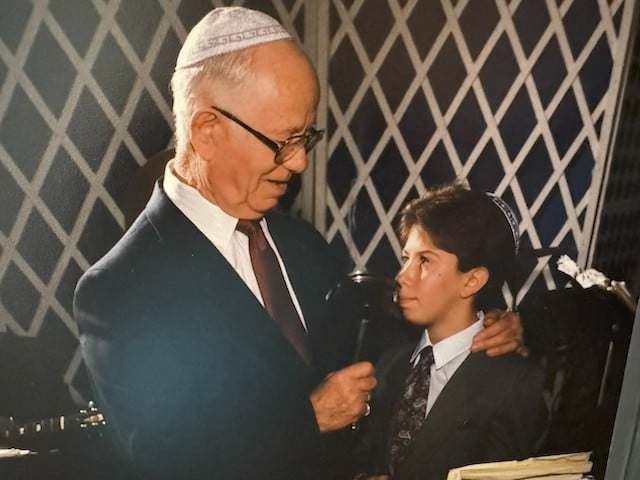
Photo of Zayde and Daniel. Photo courtesy of the author.
I felt totally immersed listening to my Newtown, Pa. Hadassah chapter’s guest speaker CNN’S Elie Honig, producer of the documentary, 60 Years Ago We Saw the Face of Evil. Honig was clearly infused with a Jewish pride that mirrored my own!
A CNN analyst and former federal prosecutor, Honig is also a grandson of Holocaust survivors. The core of his presentation (and the subject of his documentary) was the Jerusalem trial of the malevolent murderer Adolf Eichmann. To my mind, the guilty verdict, with its subsequent hanging, was a belated bitter-faintly sweet victory over the pain, suffering and unspeakable losses and grief that the survivors of the Shoah (Holocaust) endured.
Though capital punishment like the execution of Eichmann continues to be extremely rare in Israel, it is reassuring to me that the hanging of Eichmann, the epitome of malignant evil, was considered by the Israeli court of three judges to be unequivocally just!
Besides the inconceivable murder of six million Jews (along with other “groups” of equally innocent human beings), the intrinsic value of such “lost” lives surely became like mournful echoes in the courtroom.
Judaism teaches that life is a sacred gift from God. As you may well know, the Hebrew word chai means life and I, like many Jews, wear chai necklaces. This brings me back to the Hadassah event, which featured an alluring display of symbolic, evocative Jewish jewelry.
My eyes were drawn to a delicate chai charm. For me, chai has a uniquely meaningful and heart-tugging association, which began with our family’s first visit to Israel. Led by our Ohev Shalom’s Rabbi Eliott Perlstein, we were joined by (among others) close friends, their son and daughter and those children’s Zayde (grandfather), Solomon, a Holocaust survivor.
Learning how this courageous grandfather valued life, though his was filled with such profound tragedies, I felt emotionally overwhelmed, giving the chai charm profound significance for me.
During the Holocaust, while Solomon toiled at forced labor, he suffered most from his tormenting “day and nightmares” about the fate of his first wife and their young children.
After the war ended, Solomon learned the agonizing truth: Neither his wife nor their children were alive. Then, in the midst of such horror, he unexpectedly experienced a “miracle.” He found out that His wife’s younger sister was alive! Together, they grieved for family who would never return – and blessed their names.
Sometime later, Solomon and his sister-in-law joined their broken hearts together again, but dramatically differently this time. Though sadness continued to dwell deeply within them, they joined their hearts in marriage and chose life. As it is written in Deuteronomy 30:19, “I have put before you life and death, blessing and curse. Choose life so that you and your children may live.”
Affirming life, these survivors exemplified wisdom that was expressed decades later by Rabbi Emil Fackenheim, a noted Jewish philosopher: “Jews should observe a 614th commandment: Do not grant Hitler a posthumous victory.” I would add that we should not grant one to Eichmann either!
Years later, my family and I spent some time with Zayde (despite what he went through, still an unconditionally devout Jew). We saw him weep with his whole body for his first wife and their young children. We saw him, too, entranced, filled with soulful pride, as his eldest grandchild, Daniel, became a Bar Mitzvah, surrounded by the hills of Safed (Tzfat).
The impassioned survivor declared, “How happy I am to live to see this moment, especially here, in this place . . . that I never dreamt of.” To me, neither his beaming with joy (kvelling) nor his sobbing was diminished by the other. They both were testimony to Solomon’s emotional truths.
Back to Honig’s presentation and another amazing set of revelations: Michael Goldman-Gilad, the lead investigator at the Eichmann trial, was a Holocaust survivor who courageously sustained 80 savage Nazi beatings. He agreed to witness Eichmann’s hanging. To me, this was a moral Jewish victory. Was this, also, karma?
Gabriel Bach, lead prosecutor at the Eichmann trial, was a German-born Israeli. For him, like Goldman-Gilad, there’s no doubt that the moral verdict was intensely personal, as well as historically victorious – for both Jews and all of humanity!
The fact that Eichmann’s trial was held in Israel adds another layer of justice. Today, wherever we Jews make our home, we can feel proud of the blue Star of David (Magen David –literally translated from the Hebrew as “shield of David”) that adorns the blue and white flag of Israel.
I think the Star of David is itself a “survivor”! Whenever I wear my Magen David necklaces, I gratefully remember our star’s historical endurance.
During the Shoah, when sadistically mocking Nazis forced the Jews to wear their sacred Star of David as if it were a mark of shame, I wonder whether they felt pain or numbness. Either way, that Magen David as appropriated by the Nazis, was a demeaning tool for identifying Jews.
Today, thankfully – despite an exceedingly worrisome surge in antisemitism globally – we Jews continue to recite and count our blessings and place a mezuzah on the doorpost of our homes as a reminder of our faith and God’s presence. The mezuzah on my doorpost glows with a bright Star of David.
Indicative of our conflicting needs to preserve our ancestral roots while fitting into the larger society, Honig, named after his Holocaust survivor grandfather, Lazar, changed his first name twice! Honig’s full name is Eliezer, a variation of Lazar. Although Honig emphasizes he “never was ridiculed” for his ethnic name, Elie, he sometimes hated that it did not conform to typical, familiar American boys’ names. Much worse, his name, Elie, was “constantly’’ confused with being a girl’s name.
So, as he tells it, before going to overnight camp, he legally changed his name to Eliott. But, in time, he felt less sensitive about his name and, after becoming a lawyer, he felt strongly that he wanted to reconnect with his ancestral name, so he legally changed it back to Eliezer, (known as Elie).
I, Ilene, was meaningfully named after my grandfather, Isaac. I, too, know the irreplaceable value of cherished namesakes. This is nowhere more profoundly expressed than at the Children’s Memorial at the Yad Vashem World Holocaust Remembrance Center in Israel. Along with solemn music being played in the background, there are tiny lights, like sparkling stars, symbolizing each child who perished in the Shoah. I recall how my heart pounded as I listened to the recording of the children’s names, ages and countries. The full recording, which takes three months to complete, is played continuously – like a sacred blessing, honoring those of previous generations and the endurance of the Jewish people.
Related Topics
Related Posts