
CEO of Time to Stand Up for Israel
Perhaps It Is Time for Radio Silence
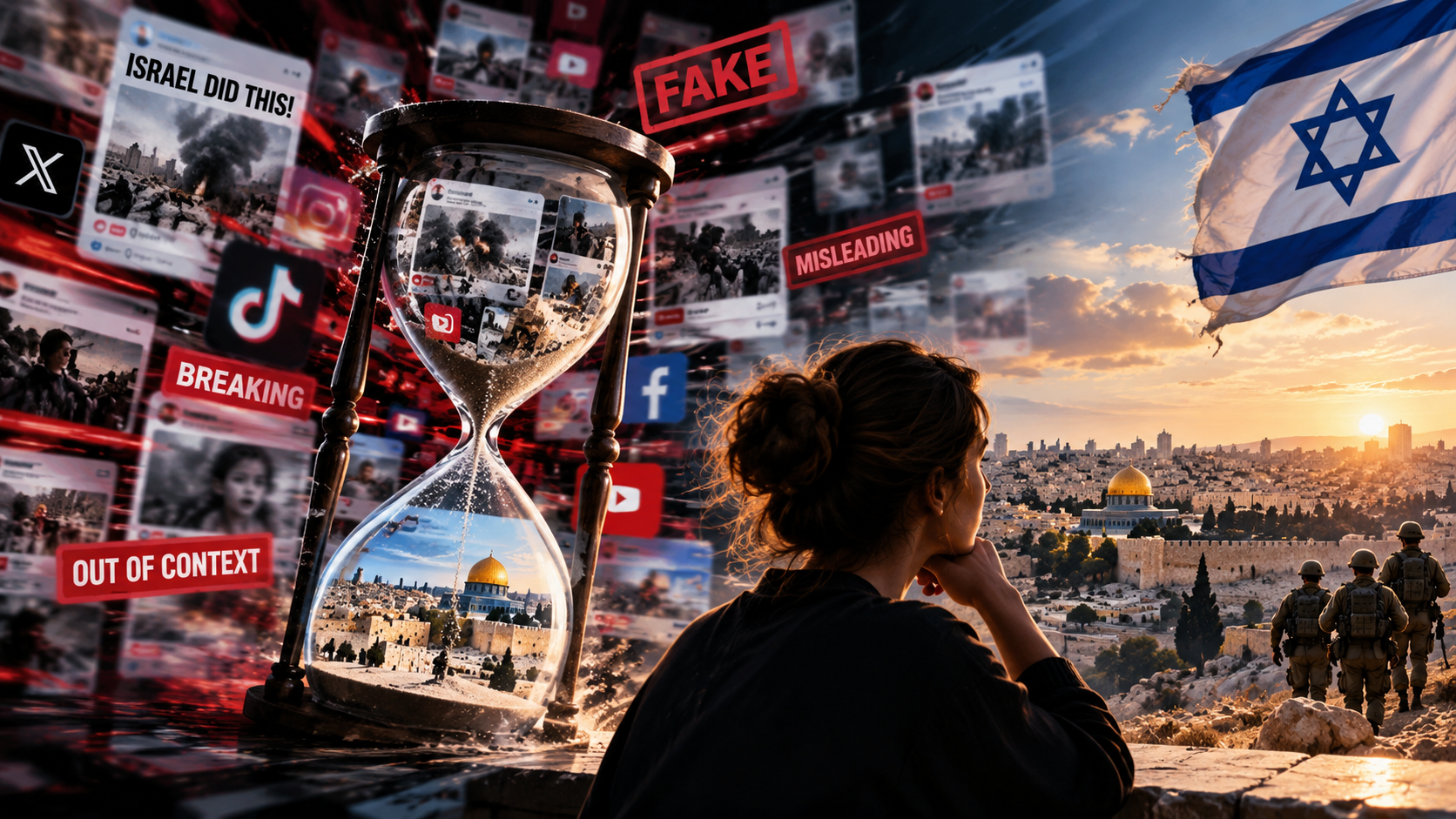
Photo Credits: Sabine Sterk (AI)
At nursing school, I learned something that stayed with me throughout my life: it is impossible not to communicate. Even when two people are sitting opposite each other and one deliberately decides not to speak, that silence communicates something. Your expression communicates, your posture communicates, the fact that you turn your head away communicates. Silence can express anger, disappointment, fear, contempt, sadness or simply the unwillingness to engage. Back then, however, communication still largely meant communication between human beings. Nobody in that classroom could have imagined a world in which a message written in Rotterdam could reach Jerusalem, New York, Tehran and Sydney within seconds, or a world in which millions of people could watch a disaster unfold thousands of kilometres away almost in real time. We certainly could not have imagined that one day artificial intelligence would be capable of producing photographs of events that never happened, voices of people who never spoke those words and convincing stories about incidents that never took place.
The internet gave humanity something extraordinary. Distance almost disappeared. I can communicate with friends and family on the other side of the world as easily as I can communicate with someone living around the corner. During a natural disaster, information can reach emergency organisations immediately. During wars, people can warn relatives and friends. Ordinary citizens can document events that otherwise might never have been seen. Yet the same technology that brought the world closer together created something much more dangerous: information became instantaneous while verification remained slow. UNESCO has warned that generative AI, algorithmic filtering and social media can amplify misinformation and disinformation, while increasingly realistic synthetic images, audio and video make it harder for ordinary people to determine what is genuine. UNESCO has even described the problem surrounding deepfakes as a wider crisis in how societies establish what is true.
Nowhere is that problem more visible to me than in the information war surrounding Israel and the conflicts with Hamas and other armed groups. A photograph appears, somebody writes a dramatic sentence underneath it, thousands share it, influencers repeat it and before professional journalists or independent investigators have established what actually happened, millions of people have already formed an opinion. Sometimes photographs and videos are not even from the conflict they supposedly depict. Reuters, for example, has fact checked videos from Poland, Algeria and Spain that were falsely presented online as scenes from Israel. The problem is not exclusive to one side, and anyone who genuinely cares about truth must acknowledge that. Reuters has also documented deceptive AI assisted influence activity involving accounts posting material supportive of Israel. Truth cannot become something we demand only from our opponents. If I want people to verify accusations against Israel, then I must be prepared to verify information that supports Israel as well.
For years I have tried to counter false narratives about Israel, and increasingly I wonder whether constantly reacting is actually part of the problem. Every outrageous accusation generates another discussion. Every discussion generates comments. Every comment generates engagement. Engagement gives the original allegation greater visibility, and suddenly the lie we wanted to destroy has travelled further because thousands of us helped distribute it while trying to correct it. Social media does not necessarily reward truth. It rewards attention. Anger produces attention, fear produces attention and outrage produces enormous amounts of attention. This is why I increasingly see what is happening not merely as a political crisis but as a media crisis. UNESCO has similarly warned that online hate speech and misinformation can be rapidly amplified by social media, algorithms and emerging technologies, weakening trust and increasing social tensions.
It reminds me, strangely enough, of the oil crisis of the 1970s. In the Netherlands there were car free Sundays. The principle was remarkably simple: when something precious becomes scarce, you stop wasting it. Perhaps today the scarce commodity is not petrol but reliable information. What would happen if we introduced our own version of the car free Sunday into social media? What if, instead of immediately responding to every allegation about Israel, we simply refused to participate until information had been verified? No furious reposting, no instant condemnation, no race to be first and no sharing a dramatic photograph merely because it confirms what we already believe. Perhaps sometimes the most powerful response would simply be: we do not know yet.
Imagine if supporters of Israel adopted one uncompromising rule: verify first, communicate second. Not because Israel should remain silent in the face of false accusations, but because credibility is more valuable than speed. If something cannot yet be independently established, say so. If an image cannot be authenticated, do not share it. If a source has repeatedly proved unreliable, stop rewarding it with attention. If information turns out to be incorrect, correct it publicly, even when that correction is inconvenient to our own argument. Defending Israel should never require abandoning intellectual honesty. On the contrary, intellectual honesty should be one of the strongest foundations of Israel advocacy.
That raises another uncomfortable question. How far does freedom of expression extend when modern technology allows deliberate falsehoods to reach millions of people within hours? I strongly believe in freedom of expression, but freedom of expression and freedom from criticism or accountability are not the same thing. Any attempt to regulate false information also creates a serious danger because someone must decide what qualifies as false, and governments and institutions can themselves be wrong, biased or dishonest. The answer therefore cannot simply be censorship. It must include stronger verification, transparent corrections, media literacy, responsible journalism, clear identification of synthetic material and, above all, personal responsibility before pressing the share button. UNESCO likewise argues that AI generated media should be held to standards of verification, accuracy and ethical processing.
Perhaps my nursing teacher was right in a way she could never have imagined. It is still impossible not to communicate. Today, however, silence communicates too. Refusing to share an unverified accusation communicates that truth matters more than being first. Refusing to amplify obvious rage bait communicates that our attention cannot simply be manipulated. Waiting for evidence communicates responsibility.
After years of trying to fight every lie about Israel, I increasingly wonder whether we need to change tactics. We do not need to stop defending Israel. We need to stop allowing other people to determine what we spend our days defending Israel against.
Sometimes we should answer.
Sometimes we should correct.
Sometimes we should expose a lie with evidence.
And sometimes perhaps the smartest answer is radio silence until the facts arrive.
Because in an age in which everybody can communicate with the entire world within seconds, the most revolutionary act may no longer be speaking.
It may be refusing to spread something until we know it is true.
Related Topics
Related Posts