
Writer covering Israel–Africa, Jewish affairs, and Israel worldwide
Perpetually Pending: The Diplomatic Fantasy of “Future Palestine”
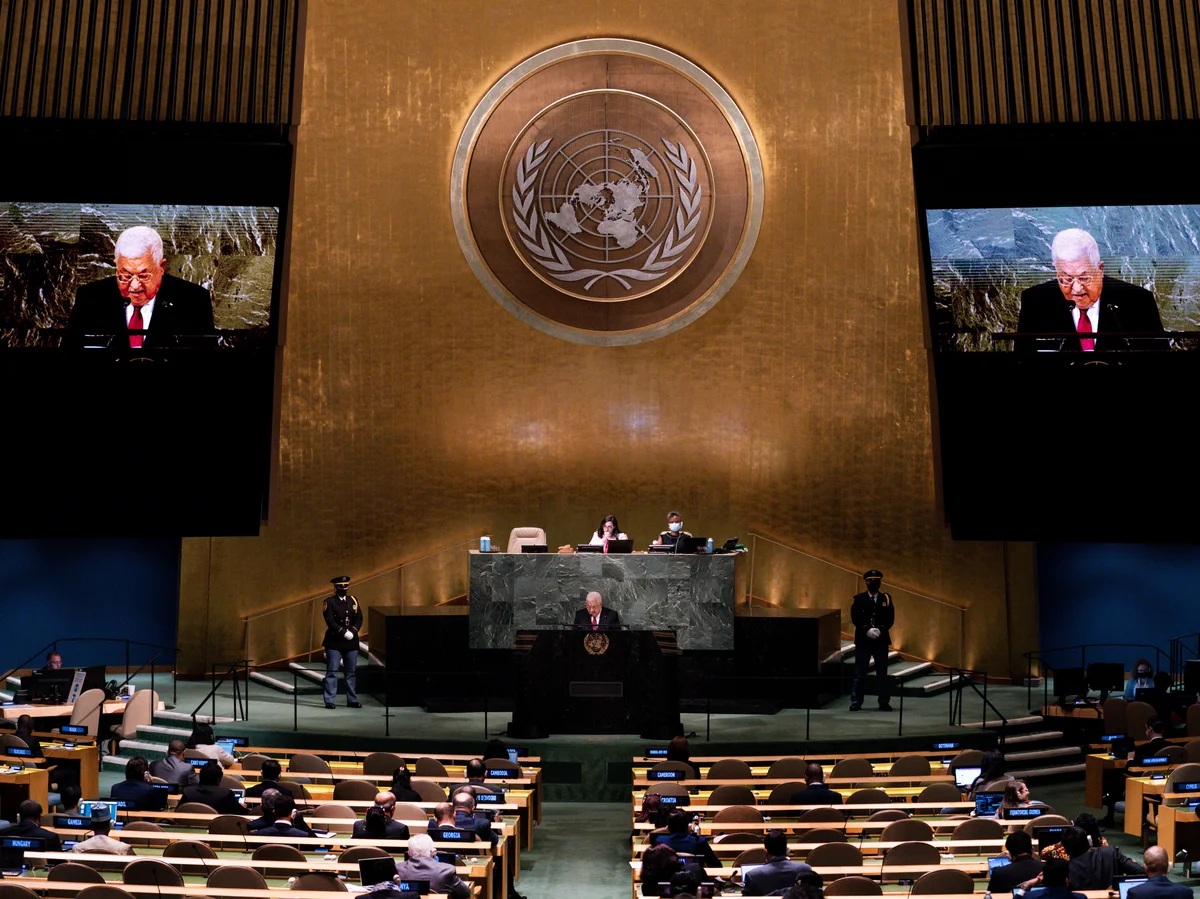
Palestinian President Mahmoud Abbas addresses the United Nations General Assembly on Sept. 23, 2022. The U.N. General Assembly has voted on a resolution to grant new "rights and privileges" to Palestine and call on the Security Council to favorably reconsider its request to become a member of the United Nations. Julia Nikhinson/AP
“A future Palestinian state” is the most durable construction project in modern politics — endlessly funded, frequently applauded, never completed.
The Verb That Betrays the Doubt
Diplomacy is rarely honest — but grammar sometimes is.
“A future Palestinian state” is not an accident of phrasing. It is institutional vocabulary. The United Nations Security Council and European Union routinely affirm their commitment to a “future” Palestinian state — a formulation that has survived decades without acquiring a date or a draft constitution. The architecture of postponement was embedded early. The Oslo Accords did not create a state; they created an interim arrangement. Final status issues — borders, Jerusalem, refugees — were bracketed for later negotiation. Sovereignty was not declared. It was deferred.
Even the upgrade to “non-member observer State” at the United Nations General Assembly in 2012 expanded symbolism more than sovereignty. The title rose. The structure did not. If something is morally urgent and historically inevitable, one expects deadlines. Instead, the Palestinian state remains permanently conjugated in the future tense — affirmed with conviction, implemented with hesitation.
Grammar, it turns out, can be a confession.
The Balkans Didn’t Stay “Future”
When the international community believes a state is viable, it does not speak of it indefinitely. It schedules it.
Take South Sudan. The 2005 Comprehensive Peace Agreement established a timeline. A UN-supervised referendum was held in January 2011. Independence was declared in July. Admission to the United Nations followed swiftly. “Future South Sudan” had a calendar attached. Or consider the dissolution of Yugoslavia. Through the Badinter Commission and coordinated recognition processes, new states were assessed, acknowledged, and admitted into international society. The debate was fierce, but it was procedural. Sovereignty either met criteria or it did not. The word “future” was transitional — not permanent.
Even in contested cases like Kosovo, declaration preceded recognition debates. The question was legality and diplomatic acceptance — not whether the entity would remain suspended indefinitely in rhetorical anticipation. Where viability is believed, deadlines emerge. Where deadlines emerge, the future collapses into the present.
The Palestinian case, by contrast, has perfected indefinite imminence — an arrival eternally expected, never operationalized.
Institutions, Not Incantations
A state is not a slogan. It is infrastructure, administration, and authority — things a repeated UN resolution cannot conjure. Gaza and the West Bank are run by two competing governments: Hamas in Gaza, Fatah in the West Bank. Authority is fragmented, control is partial, and policy is often dictated by ideology rather than bureaucracy.
Hamas’ charter openly calls for the elimination of Israel, embedding conflict into governance. Meanwhile, the Palestinian Authority survives largely on foreign aid, with institutions chronically underdeveloped. Reports from the World Bank and IMF routinely note weak administrative capacity and dependency, and security forces cannot project coherent authority across the territories.
In short, the structural prerequisites of statehood — unified governance, monopoly of force, institutional continuity — are absent. The “future state” exists less as a real entity than as a negotiation tool, a rhetorical placeholder for aspirations that reality refuses to fulfill.
Observer Status, Observed Dysfunction
Recognition has a strange life of its own. In 2012, the United Nations General Assembly upgraded Palestine to a non-member observer state. Flags rose. Cameras clicked. Applause echoed. Yet Gaza and the West Bank remain governed by competing authorities, administrative capacity is fragmented, and sovereignty is operationally absent.
Statements from the European Union, the United States, and the Arab League celebrate this status while urging political moderation and continued negotiation. Academic observers call it symbolic sovereignty — a political theater where the actors appear recognized even as the stage lacks structure.
The Palestinian state exists on paper, on speeches, on ceremonials — a recognition without realization. Reality has not caught up with rhetoric, and the word “state” is suspended between aspiration and observation.
Why “Future” Is So Convenient
The word “future” is diplomacy’s Swiss Army knife. It allows the international community to criticize Israeli policy endlessly while carrying zero obligation to build a functioning state. UN and EU statements repeatedly condemn actions that “threaten a future Palestinian state,” preserving moral authority without enforcing timelines.
Deferred statehood is leverage. It pressures Israel diplomatically, signals moral posture to global audiences, and keeps negotiation tools alive. Meanwhile, no actor is held accountable for the absence of actual governance, infrastructure, or sovereignty. The “future” is a perpetual placeholder — a versatile instrument, endlessly useful, operationally irrelevant.
In short, the indefinite state is less a project to build than a device to wield.
The Word That Gives It Away
If the Palestinian state were viable, it would exist in the present tense. Deadlines, borders, governance, security — these would define it, not rhetoric. Yet decades of international statements, from the UN to the EU, insistently place it in the future.
The Oslo Accords embedded postponement structurally, bracketing final status issues for “later.” Today, every resolution, every diplomatic communiqué, and every call for negotiation repeats the same verb tense: future.
This is no accident. Language here acts as a confession: the world doubts the feasibility of Palestinian statehood, even while endorsing it morally. The phrase “future Palestinian state” is simultaneously aspirational, strategic, and revealing. It signals that the state is less an arrival than a story the international community tells itself — endlessly approaching, never realized.
Every sensible observer knows the Palestinian state is, in practice, unviable — yet the world keeps rehearsing its future, not to build it, but to wield it as a blunt instrument against Israel.
Related Topics