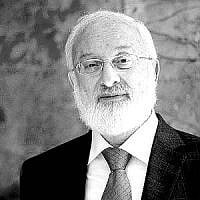
Peter Beinart: The Last Good Jew

Ernesto “Che” Guevara once wrote, in a moment of revolutionary bravado, “Better to die standing than to live on one’s knees.” Twenty-five centuries earlier, a different kind of revolutionary—Mordechai ha-Yehudi, the first Jew in history to be called simply “the Jew”—refused to bow before Haman. Jews bow only before God. In our liturgy, whether in Bar’chu or Aleinu, bending the knee is an act of faith, not subservience. For centuries, however, our ancestors lived at the mercy of Christian princes, Muslim caliphs, popes, and European czars; humility often meant survival rather than devotion.
Modern Zionism wanted to reverse that historic posture. It insisted that the Jew would stand upright again. In classical halakhic language, the Jew should walk in the streets with the head down, not as an act of humility but as an account of the self-humiliation that the Jew had to endure as a persecuted minority. In political life, however, the Zionist dream was the opposite: no more bowed heads before the whims of rulers, mobs, kings or “enlightened” opinion-makers. Menachem Begin, in a line widely attributed to him and faithful to his spirit, captured this shift: “We are no longer Jews with trembling knees.”
Except, of course, that some still are. And that brings us to Peter Beinart— well educated, eloquent, deeply Jewish, widely known, and, in the eyes of many in today’s progressive West, the last good Jew.
Beinart’s biography is familiar: American, highly educated, deeply engaged in Jewish life, observant in his practice, committed to moral seriousness. He is also the archetype of the liberal Jew, shaped by elite universities, a journalist (a Jewish profession per excellence) progressive politics, and the ideological fashions of the moment. For two decades, he has been a prominent voice in American Jewish debates about Zionism, Israel, and Palestinian rights.
There was a time when Beinart sounded like many American liberal Zionists of the 1990s and early 2000s. He criticized settlement expansion, lamented discrimination against Arab citizens of Israel, and feared the moral cost of permanent occupation. But he defended Israel’s right to exist as a Jewish state, justified its wars against terrorism, and routinely framed Israel and the United States as partners in a global struggle against violent Islamist extremism. One could read his early work and find much to agree with—sometimes I did.
His 2012 book, The Crisis of Zionism, still resonated with the Jewish heart of many: a plea for Israel to remain democratic, a critique of illiberal policies, a call for moral responsibility. One could disagree with parts of it, but its tone was rooted in love and concern—even if sometimes demanding or naïve.
But something changed. Slowly at first, then dramatically. Over the past decade, Beinart shifted from liberal Zionism to post-Zionism, and from post-Zionism to a form of anti-Zionism that denies the legitimacy of a Jewish state at all. In 2020 he declared the two-state solution dead, called for a single binational entity, and began to argue that Jewish sovereignty itself is morally indefensible. After October 7, when Hamas perpetrated the worst massacre of Jews since the Holocaust, his language hardened further: Israel, in his telling, is now a genocidal, apartheid state—an accusation he repeated earlier this week at Tel Aviv University.
Within hours of his appearance at Tel Aviv University, Beinart was attacked—not by right-wing Zionists (only), but by his own ideological comrades in the BDS movement. Why? Because he had violated their guidelines by engaging with an Israeli academic institution at all. And so, in a move painfully reminiscent of those centuries when Jews begged foreign rulers for permission simply to live, Beinart took to X/Twitter to apologize (https://x.com/PeterBeinart/status/1993776435673419788?s=20). Not to Israelis. Not to his hosts. But to the activists who police ideological purity in today’s progressive spaces.
This, we are told, is what a “good Jew” looks like:
- A Jew who criticizes Israel relentlessly.
- A Jew who agrees with the moral vocabulary of Western progressivism.
- A Jew who bends the knee—not in prayer, but in political submission.
- A Jew who must say I am sorry when he strays even an inch from the approved script of anti-Israel activism.
Beinart’s apology was not an act of moral courage. It was an act of ideological obedience. It was the posture of the bowed head, the trembling knee, the old Jewish condition Zionism tried to end.
That is why the episode is important. Not because of Beinart alone, but because he represents a broader tragedy in contemporary Jewish life. Many Jews, often with the best of intentions, start from a place of love—love for Israel (the State and the people), love for justice, love for peace, love of idealisms. Their criticism, at first, is sincere, careful, rooted in hope. But over time, the gravity of the academic, political, and cultural elite pulls them toward a harsher stance: criticism without context, condemnation without compassion, activism without loyalty.
Eventually, the love disappears. What remains is only the critique. And beneath the critique, too often, lies fear: the fear of being cast out of the circles they wish to belong to. To belong in those circles, they kneel.
Mordechai taught us otherwise: Lo yichrá ve-lo yishtachavé—he would neither bend nor bow. Not because he lacked empathy, but because he refused to surrender his identity to the demands of the empire.
Beinart, for all his gifts, has become a paradigm of what happens when Jews seek legitimacy not from their own people, history, and values, but from movements that despise Zionism, distrust Jewish self-determination, and see Israel as the original sin of modern geopolitics.
The tragedy is not that Jews criticize Israel. Jews must criticize Israel. A State without self-critique is a state without moral compass. The tragedy is when critique loses its grounding in love, responsibility, and belonging—and becomes instead a performance for the applause of the world.
When that happens, we are no longer standing. We are kneeling again. And the entire point of Jewish sovereignty was to stand.
If Peter Beinart is then the last good Jew, I would rather be seen as a bad Jew.