
Urban Sociologist and Global Affairs Commentator
Physician, Heal Thyself
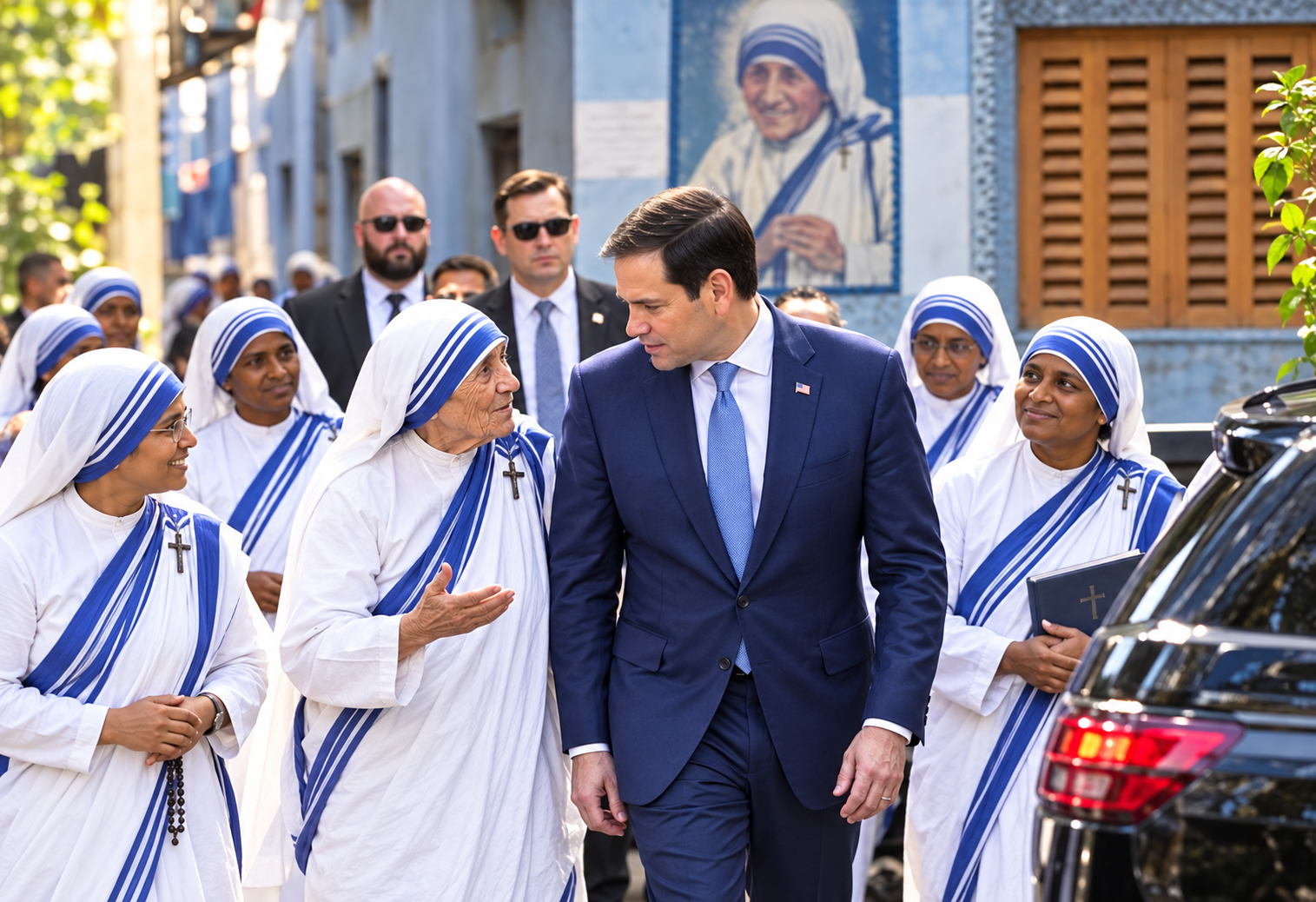
Marco Rubio visits Missionaries of Charity in Kolkata during first Official India Trip. May 23, 2026. (Representational Image/ChatGPT)
A cardinal warns of a Europe without Christ. He should look at who has been selling Christ abroad.
Cardinal Robert Sarah says that if Christianity disappears in Europe, the whole world is threatened. It is a magnificent line, and it comes from a church that has spent five centuries treating other people’s civilisations as vacant lots.
India was never a vacant lot. Its philosophers were dissecting the self, the cosmos and the ethics of liberation before most of Europe had a written liturgy. When missionaries arrived, they did not come as students. They came as surveyors, with the confidence of men who had already decided what the land was worth.
Sarah laments that Europe is cutting its own roots. A fair question follows: who taught the world that roots are negotiable? For generations, the missionary enterprise treated other people’s inheritance as the thing to be uprooted. Temples were a problem to solve, gods were errors to correct, and ancestral custom was a stage to graduate from. If Europe now watches its own faith drain away and calls it catastrophe, it is tasting the logic it exported.
Nobody should be insulted by being told that what they cherish is expendable. Missionaries said it for centuries. Now Europe hears it from its own children, and suddenly the language of civilisational loss is available.
Charity with a hook
Let us be fair, since fairness makes the case stronger. Missionary schools, hospitals and orphanages have done real good, often where the state was absent. Many sisters and priests have served the poor and asked for nothing. Their goodness is not in dispute.
What is in dispute is the arrangement itself. Put a hospital, a scholarship or a promise of a Western future in front of a family with nothing, and the question of free choice becomes a joke. A person who is hungry, indebted or shut out of every door is not choosing a faith the way a professor chooses a book. If belief arrives bundled with bread, schooling or a visa-adjacent dream, it is hard to tell conviction from transaction.
India’s states have heard these complaints for decades, which is why many have passed laws against conversion by force, fraud or inducement. Those laws are themselves contested, and critics say they are often used to harass minorities. But the grievance behind them is not invented. It is the oldest suspicion about charity: that it may be an investment.
If a faith is true, it should not need an incentive. A gospel that must be subsidised has already confessed something about its own persuasive power. The test of any mission is simple. Would the clinic treat you the same way tomorrow if you stayed exactly as you are?
The diplomat at the shrine
Then there is geopolitics, where piety and power sit uncomfortably close. In May, the American Secretary of State, Marco Rubio, opened his first India trip not in the capital but at the Missionaries of Charity headquarters in Kolkata, where he paid homage at Mother Teresa’s tomb. It was a symbol, and symbols are the grammar of diplomacy. Some Indian Christians welcomed it as solidarity, and others, by some reports, saw a gesture that would rankle the ruling party.
Let me be careful here, because the temptation is to say more than we know. A visit to a shrine is not a threat, and there is no public record I could find of Washington using its ties with Delhi as a cudgel for missionary interests. But the question writes itself. Why do religious institutions with large foreign funding streams so reliably find friends in powerful capitals?
India’s efforts to reform the Foreign Contribution (Regulation) Act (FCRA) to enhance transparency and accountability in foreign funding have drawn criticism from US lawmakers, with warnings that the proposed amendments could strain bilateral ties. The timing of these concerns, alongside US Secretary of State Marco Rubio’s visit to the Missionaries of Charity in Kolkata, is particularly noteworthy, as the organisation’s previous FCRA licence suspension in 2021 had brought the regulation of foreign-funded religious charities into focus. Moreover, Congressman Chris Smith explicitly cited the Missionaries of Charity while urging Washington to raise concerns over the proposed amendments, lending substance to the perception that the issue extends beyond regulatory differences to encompass religious freedom and diplomatic sensitivities.
When a church’s outposts become entangled in the diplomacy of great powers, the suspicion of a spiritual mission as soft power is not paranoia. It is pattern recognition, and the church earned that suspicion over centuries of walking beside empire.
The lecture and the mirror
So consider the cardinal’s sermon again. Europe, he says, must not abandon its roots. Fine. But a church cannot demand reverence for one continent’s inheritance while its institutions have treated everyone else’s as raw material. Moral authority is not a title deed. It cannot be passed down from Chartres and Aquinas to whoever happens to hold the pulpit. It is earned daily, by behaving the same way when the audience is powerless as when it is powerful.
Here the secular Europeans Sarah mourns have an uncomfortable advantage. They are doing what the church once asked of everyone else: reconsidering what they were handed. They have decided, rightly or wrongly, that inherited belief is not binding. If that freedom is legitimate for a Frenchman, it is legitimate for a Gond farmer, and by the same logic a Hindu or Buddhist is no less entitled to keep the faith of their ancestors without being treated as a target.
I would add the reverse, because honesty demands it. India cannot defend its heritage by denying any citizen the right to leave it. A civilisation that is sure of itself does not need to keep its members by statute.
What a serious Christianity would do
If Christianity wants a civilisational role, in Europe or anywhere, it will not get it by announcing that the world needs it. It will get it the old way, the way the Gospels themselves suggest. It would open its books to the public and take every complaint of inducement seriously, without calling each one persecution. It would treat people identically whether or not they convert. It would accept that a conversion counted in baptismal registers means nothing, and one counted in dignity means everything.
Credibility is a currency, and the missionary enterprise has been spending it for centuries on shortcuts. The bill is arriving now, in empty pews and in the suspicion of whole nations.
Sarah is right that something precious is at stake. He is wrong about who holds the key. Christianity does not recover its standing by warning the world of its absence. It recovers it by showing, in places where no one is watching and no one can reward it, that its kindness comes with no conditions at all.
Until then, the cardinal should stop checking Europe’s roots and go and check the receipts.
Related Topics
Related Posts