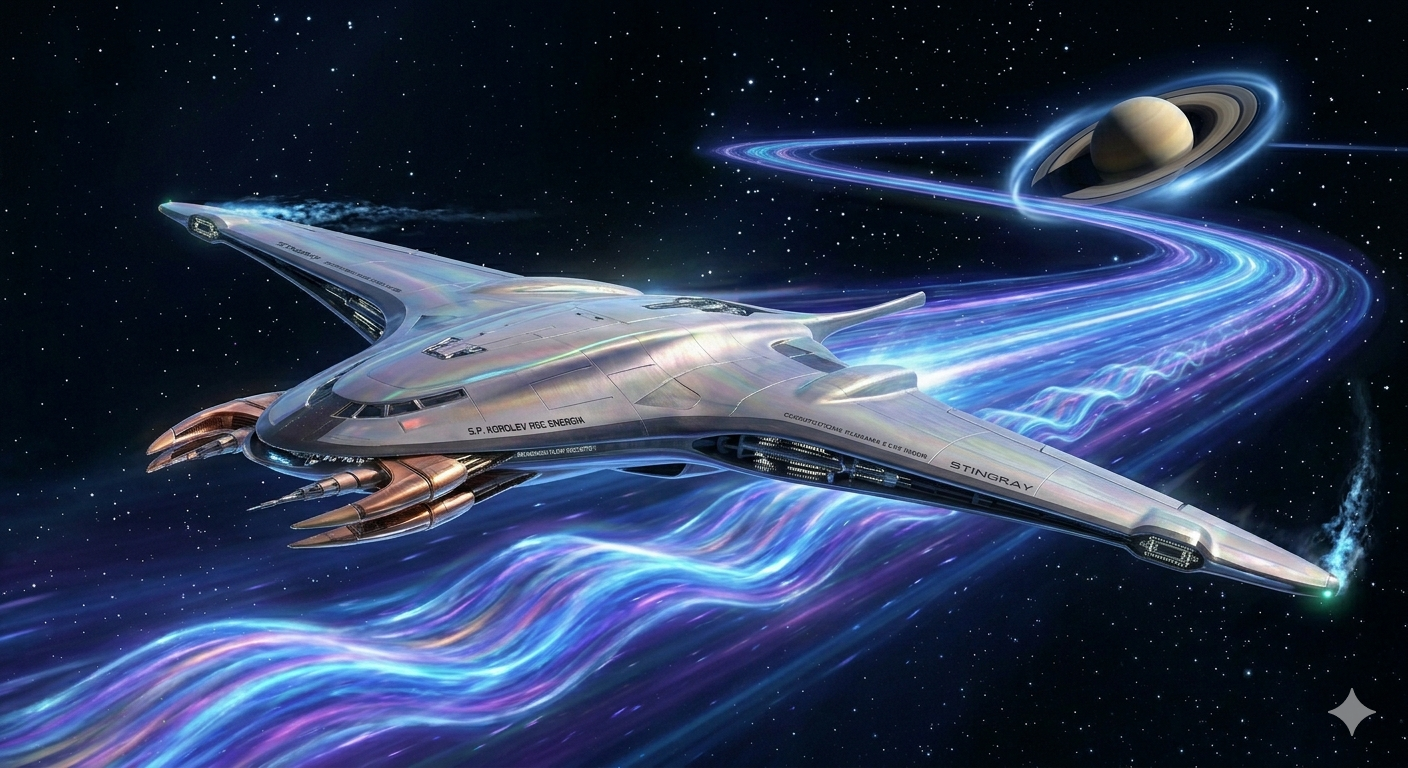
For an ordinary spacecraft, the Io torus is a high-radiation zone you’d rather not cross unshielded. For a plasma glider — a possible acceleration corridor.
Today’s interplanetary navigation is, more or less, motion between gravity wells. Planetary orbits, gravity assists, chemical engines, ion thrusters. It’s a powerful, well-tested approach. No one is proposing to throw it out.
But if space is filled with particle flows, you can add another layer of navigation. Plasma roads.
These are regions where density, flow speed, and magnetic structure make movement particularly profitable — for a craft that knows how to work with that plasma.
The sea has its winds, storms, doldrums, dangerous straits, and useful currents. Space has its own counterparts: the solar wind, magnetospheric tails, corotating regions around the giants, high-radiation zones, plasma disturbances, quiet patches where there’s nothing to grab onto. The only real difference is that we’re not yet used to seeing all this as a navigational chart.
Imagine a future map of the Solar System. Not just planetary orbits. New layers, instead: where the plasma is denser; where the flow runs faster; where the magnetic field helps the craft along; where the radiation is too dangerous; where you can accelerate; where it’s better to wait out a season.
For an ordinary reader — something like a weather forecast for cosmic sailors. For an engineer — an optimal control problem in a non-uniform medium. For a mission planner — a simple question: which route lets the medium itself help you move?
A Scene: Jupiter, Io, Saturn
Just to keep things from getting too dry, let me sketch one imagined mission.
The craft launches from Jupiter’s outer magnetosphere. Switches on its fields. Catches a corotating plasma flow near Io — the way a yacht catches a coastal breeze. Gets its first push. Then it slips into Jupiter’s magnetic tail, which stretches away from the Sun across distances comparable to Saturn’s orbit. The tail is a natural corridor pointing outward, away from the system.
After that — a long, multi-year drift in the solar wind. Slow, but continuous. The craft picks up plasma gradients, catches windows of favourable space weather, gives a wide berth to strong coronal mass ejections.
At Saturn — back into a magnetosphere. The craft brakes against its plasma structures, like a sailboat entering a harbour against the wind.
This is not a finished project. It’s a scenario that has to be worked out numerically. But scenarios like this are the ones that pose the questions we then go and answer.
Not Magic, Not a Free Lunch
Let me say it plainly, so as not to leave any false expectations.
Plasma navigation does not bend physics. The craft does not pull energy out of thin air. It interacts with an external particle stream, the way a sailboat interacts with the wind. To make any of this work you need fields, onboard energy for control, charge balance, radiation shielding, careful mathematics, and serious engineering.
There is no shortage of difficult questions. How large an “effective capture area” can actually be created with an electromagnetic field. How you keep the craft’s charge balanced when ions are constantly settling on it. How you operate inside a radiation belt. How much power the whole thing draws. How stable plasma corridors are over time. Whether such routes can really be computed and then confirmed against mission data.
But difficult is not the same as pointless. I’ve been working on this for the past few years; the mathematical model of the craft and the formal problem of plasma navigation are openly published on Zenodo. It’s a working draft, not a finished answer.
Why It Matters
Today, we move through the Solar System slowly and cautiously. Every distant mission means years of preparation, complex ballistics, narrow launch windows, and tonnes of propellant.
Learning to use the external medium — the solar wind, plasma, magnetospheres — could make distant missions more flexible. Not instantly fast. Not instantly cheap. But more nautical: with routes, windows, seasons, weather, and the art of navigation.
This won’t replace rockets. The way sails didn’t replace shipbuilding — they just made it richer.
A rocket lifts the craft out of the gravitational harbor. An ion thruster keeps it moving long and economically. A gravity assist uses the planets. Plasma navigation might teach the craft to use the very medium of the Solar System.
The Map Doesn’t Yet Exist
We’re used to thinking of space as the empty distance between planets. Maybe it’s time to start thinking of it as a medium. Not an ocean, of course. But a medium nonetheless — with its currents, its storms, its quiet corners, and its windows of opportunity.
The first sailors didn’t know all the winds at once, either. They began with observation, mistakes, and stubbornness.
The first cosmic sailors, in all likelihood, will begin the same way — not with perfect ships, but with a new map. A map of plasma roads.
And if that map turns out to be true, the Solar System will stop being a collection of gravity wells. It will become an ocean of energy. One we can learn to sail.
–––––––––––––––––––––––––––––––––––––––––––––––––––––